Datawave Marine Solutions
  • Dms Logo
  • Services
    • Vessel Design
      • Concept Design
    • Naval Architecture
    • Advanced Analysis
    • Marine Systems
    • Civil Engineering
  • Marine Operations
    • Passenger Vessels
    • Work Boats
    • Research Boats
    • Shipyards
    • Marine Startups
    • Waterway Maintenance
    • Autonomous Vessels
  • Portfolio
  • About Us
  • Resources
    • Blog
    • GHS Tutorials
    • FAQs
  • Contact
  • Menu Menu

Which CFD?

Is there anything that CFD can’t do? Practically speaking, we can achieve the result, but you may regret paying for the answer. Several CFD projects involve combinations of different CFD methodologies. Combined together, they evolve into a major project risk. Gain some insight about the risk factors for your next CFD project. Plan a strategy to minimize project risks so that you don’t get caught by combining unknown cost increases.

1.0 Introduction

Is there anything that computational fluid dynamics (CFD) can’t do?  At DMS, clients ask variations on this question when discussing new projects.  Theoretically, CFD remains capable of nearly any fluid dynamics problem.  Practically speaking . . . it can’t work for free.  And several categories of CFD problems become prohibitively expensive.  We can achieve the desired result, but you may regret paying for the answer.

The rates for CFD costs get driven not by the problem to solve, but by the CFD tools required for the solution.  Don’t get caught unprepared.  Review the major CFD methodologies and catch the warnings to know when combinations may lead to cost overrun.

2.0 Hierarchy of Methodology

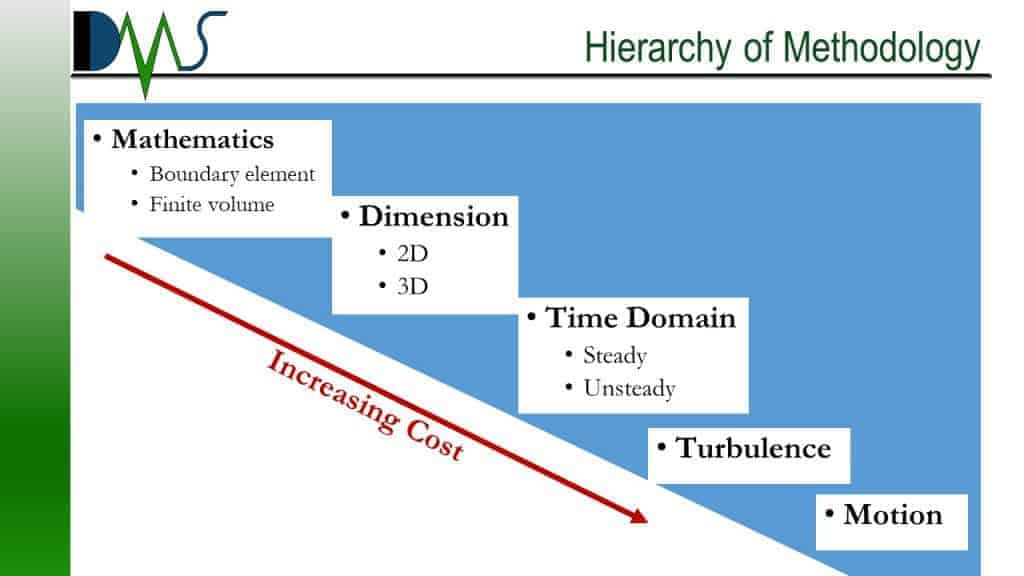
Figure 1‑1 lists the hierarchy of CFD methods.  These generally increase your project costs as you select from lower down in the hierarchy.  Selecting combinations from this hierarchy really compounds the costs.  The trick requires understanding typical expectations for normal CFD methods and which tasks compound to increase costs.  In some cases, careful selection of combinations can actually decrease costs.

Each of the following sections lists the typical methods available in each category, with the common default option highlighted in bold.

3.0 Mathematics

  • Boundary element method
  • Finite volume method

The normal options for mathematics are the finite volume method.  This is not an especial burden on cost or schedule. 

The alternative of the boundary element method reduces run times down to 1% or less, compared to the run times of the finite volume method.  But you sacrifice quality for boundary element method.  Consider that for early stage design when you need to iterate through thousands of design alternatives.

4.0 Dimension

  • 2D
  • 3D

We exist in a 3D world.  For all real world problems, the normal is 3D.  The cost depends on the size of your problem, and the detail required.  For example, flow around a 300 m long ship may be a large size, but require relatively coarse details.  In terms of CFD effort, that could be equivalent to flow from an inkjet printer with tiny details. 

When modeling tiny details or trying to validate specific flow physics, consider 2D space as an alternative.  Many structures can be simplified down to 2D dimensions without losing the essential flow physics. (Figure 1‑2)  This greatly reduces costs and allows you to focus more budget on the questions that you set out to answer.  You can explore more design variations, more optimization, better performance, or just save some budget for later in the design.

5.0 Time Domain

  • Steady
  • Unsteady

The time domain captures variation in CFD flow, changes in the input conditions.  This may be necessary for items such as a rotating propeller, a column of water collapsing, or bubbles rising to the surface.  All these changes require unsteady flow in the time domain.  That implies larger, more expensive runs. 

CFD engineers prefer to stay with steady flow if possible.  It keeps budgets down and maintains high simulation quality.  To that end, they employ many alternatives to recast an unsteady problem into a steady-state CFD simulation.  Ask you CFD engineer about alternatives when looking at modeling in the time domain.

6.0 Turbulence

  • Laminar
  • RANS
  • LES / DES
  • DNS

Turbulence may be the largest technical question for each CFD engineer.  Each category of turbulence employs several methods and alternatives.  You engineer spends a fair amount of time selecting the best turbulence model for your case.  The normal approach are RANS turbulence models, and they work for 85% – 90% of all marine CFD applications. 

Laminar turbulence models are specialized and only work for extremely low speed applications.  They imply a complete lack of turbulence and require even less effort than RANS models.

LES / DES methods take an exponential jump in effort.  Theoretically more accurate than RANS methods, but also easier to get them wrong.  Do not switch to LES / DES methods just because you liked the sales pitch.  Take a critical assessment to ensure you absolutely need them for accuracy.

DNS methods are flat out not possible with modern computers (circa 2019).  If a CFD engineer promises DNS turbulence models, throw them out of your office.

7.0 Motion / Mesh Deformation

  • No motions
  • Prescribed motion
  • DFBI (dynamic fluid body interaction)

In the category of motion, we move the object in the simulation, and this requires us to shift and deform the mesh around the object.  The mesh was fundamental to the simulation, and now we need to alter that mesh while using it to perform calculations.  The quality of our calculations hinges on the shape of the cells in our mesh, and those cells now change with each update to the calculations.  You see the resulting potential for complication. 

Normally, we prefer to avoid this complication and create a simulation with no motion at all.  The next step up involves prescribed motion.  Imagine a piston in a cylinder.  Some type of mechanical motion independent of the fluid flow conditions.  The ultimate challenge invokes dynamic fluid body interaction (DFBI). 

DFBI gets employed for rigid body motion; imagine a ship turning in a channel.  In DFBI, the CFD solver calculates the fluid forces on your object, the body.  Those forces drive the motion of that body.  The motions of the body then feed back and influence the flow patterns of the fluid.  If unchecked, this feedback loop goes haywire.  Done correctly, it leads to almost autonomous predictions of maneuvering and motion control.  DFBI is definitely advanced fluid modeling.  It requires loops within loops within loops for the CFD solver.  Major potential for cost overrun and project risk.
8.0 Conclusion

Taken individually, each CFD method becomes an important decision.  Combined together, they evolve into a major project risk.  Table 7‑1 compares the various CFD methods.  The blue bar in the middle shows the combination for a normal CFD project with reasonable cost expectation.  The rest of the table shows alternatives from that normal CFD project, with red text highlighting the relative increase or decrease in project budget for each change.

The tricky part comes from combining changes in multiple categories.  Consult your CFD engineer when considering a complex CFD project.  They will estimate the relative risk, and suggest alternatives.  CFD engineers do more than just run software.  We understand your project and plan a strategy to minimize project risks so that you don’t get caught by combining unknown cost increases.

9.0 References

[1]

Michael Belisle, “Streamlines Around a NACA 0012,” Wikimedia Commonds, 23 April 2008. . Available: https://commons.wikimedia.org/wiki/File:Streamlines_around_a_NACA_0012.svg. .

[2]

C. Walkins, “Pocket Watch with Chain,” Wikimedia Commons, 6 Oct 2005. . Available: https://commons.wikimedia.org/wiki/File:Pocket_watch_with_chain.jpg. .

[3]

Youtube Author: alpha754293, “Cylinder Valve IC Engine CFD Test,” YouTube, 3 Dec 2009. . Available: https://www.youtube.com/watch?v=2Ql8IPG6iTY. .

[4]

Nick Jenkins, “Turek Fluid-Structure Interaction Benchmark,” YouTube, 28 Oct 2011. . Available: https://www.youtube.com/watch?v=-lDbseYB7Sc. .

Share This Post

  • Share on Facebook
  • Share on X
  • Share on WhatsApp
  • Share on Pinterest
  • Share on LinkedIn
  • Share on Tumblr
  • Share on Vk
  • Share on Reddit
  • Share by Mail

More Like This

Seakeeper Clickbait

How a Seakeeper Works: Gyro Stabilization Explained

Fluid Dynamics, Fluid Loads, Fluids, Miscellaneous, Naval Architecture, Ship Motion Control
https://dmsonline.us/wp-content/uploads/2026/03/Clickbait.jpg 720 1280 Nicholas Barczak /wp-content/uploads/2025/06/DMS-logo.svg Nicholas Barczak2026-04-07 07:00:002026-06-01 10:09:14How a Seakeeper Works: Gyro Stabilization Explained
How to Buy a Towing Tank

How to Buy a Towing Tank: Purchase and Design Guide

Fluids, Fluids Special Methods, Miscellaneous, Towing Tank
https://dmsonline.us/wp-content/uploads/2025/08/Clickbait.jpg 720 1280 Nicholas Barczak /wp-content/uploads/2025/06/DMS-logo.svg Nicholas Barczak2025-11-11 07:00:002026-06-01 10:09:18How to Buy a Towing Tank: Purchase and Design Guide
050618 G 3721c 067

Surviving the Arctic: Polar Class Icebreakers

Design Support, Fluids, Mechanical, Propulsion, Special Purpose Mechanical Systems, Structural
https://dmsonline.us/wp-content/uploads/2023/12/USCGC_Healy_WAGB-20_north_of_Alaska-scaled-1.jpg 633 1200 Nate Riggins /wp-content/uploads/2025/06/DMS-logo.svg Nate Riggins2024-05-14 09:00:002026-06-01 10:09:22Surviving the Arctic: Polar Class Icebreakers
Mackinawice1

Ramming the Ice: Icebreaker Propulsion

Energy Generation, Fluids, Hull Structure, Propulsion, Propulsion Plant, Propulsion Units, Propulsors, Structural, Transmission and Propulsor Systems
https://dmsonline.us/wp-content/uploads/2023/12/MackinawIce1-scaled-1.jpg 883 1200 Nate Riggins /wp-content/uploads/2025/06/DMS-logo.svg Nate Riggins2024-03-19 09:00:002026-06-01 10:09:22Ramming the Ice: Icebreaker Propulsion
Ever Given Repaired

Ever Given: What We Don’t Know

Command and Surveillance, Fluid Dynamics, Miscellaneous, Ship Maneuvering, Ship Motion Control, Ship Response
https://dmsonline.us/wp-content/uploads/2022/03/Ever-Given-repaired.webp 667 1000 Nate Riggins /wp-content/uploads/2025/06/DMS-logo.svg Nate Riggins2022-03-21 08:00:002025-07-23 09:49:47Ever Given: What We Don’t Know
Clickbait1 1.84.1

Stability Letters Explained

Fluids, Hydrostatics, Integration / Engineering
https://dmsonline.us/wp-content/uploads/2022/02/ClickBait1_1.84.1.jpg 1080 1920 Nate Riggins /wp-content/uploads/2025/06/DMS-logo.svg Nate Riggins2022-02-21 06:00:002025-08-15 13:17:02Stability Letters Explained
Seawise University Wreck

Free Surface Moment

Fluids, Fluids Testing, Hydrostatics, Stability Test
https://dmsonline.us/wp-content/uploads/2021/01/Seawise_University_wreck.jpg 1059 1412 Nate Riggins /wp-content/uploads/2025/06/DMS-logo.svg Nate Riggins2021-01-18 07:00:002026-06-01 10:09:25Free Surface Moment
Stability Test Pendulum Setup

Practical Stability Test: Naval Architect’s Guide

Fluids, Fluids Testing, Stability Test
https://dmsonline.us/wp-content/uploads/2021/06/PendulumSetup_500px.webp 422 500 Nate Riggins /wp-content/uploads/2025/06/DMS-logo.svg Nate Riggins2020-11-02 06:00:002026-06-01 10:09:26Practical Stability Test: Naval Architect’s Guide
Container Ship Just Exiting Port

Stability Test Theory

Fluids, Fluids Testing, Stability Test
https://dmsonline.us/wp-content/uploads/2021/06/container-ship-2893480_1920.jpg 924 1386 Nate Riggins /wp-content/uploads/2025/06/DMS-logo.svg Nate Riggins2020-10-19 06:00:002026-06-01 10:09:26Stability Test Theory
Previous Previous Previous Next Next Next

Categories

  • 3D Modeling
  • Arrangements
  • Auxiliary Systems
  • Command and Surveillance
  • Design Support
  • Drafting
  • Economics
  • Elastic Static Loading
  • Electrical
  • Energy Generation
  • Engineering Business
  • Equipment Integration
  • Fatigue
  • FEA / Numerical Methods
  • Fluid Dynamics
  • Fluid Loads
  • Fluids
  • Fluids Special Methods
  • Fluids Testing
  • Green Ship Design
  • Hiring Consultant
  • Hull Decks
  • Hull Structural Bulkheads
  • Hull Structure
  • Human Ergonomics
  • Hydrostatics
  • Insurance
  • Integration / Engineering
  • Legal
  • Marine Entrepreneurship
  • Masts, Kingposts, Service Platforms
  • Materials
  • Mechanical
  • Mechanical Handling Systems
  • Miscellaneous
  • Naval Architecture
  • Passenger Vessel
  • Piping
  • Production Engineering
  • Project Management
  • Propulsion
  • Propulsion Plant
  • Propulsion Units
  • Propulsor Shrouds and Ducts
  • Propulsors
  • Quality Assurance
  • Recreation
  • Regulations
  • Replenishment Systems
  • Resistance
  • Seakeeping / Fluid Structure Interaction
  • Shell and Supporting Structure
  • Ship Control Systems
  • Ship Maneuvering
  • Ship Motion Control
  • Ship Response
  • Shipyard And Support Services
  • Special Methods
  • Special Purpose Mechanical Systems
  • Special Purpose Structure
  • Stability Test
  • Structural
  • Support Services
  • Sustainable Marine Technology
  • Towing Tank
  • Transmission and Propulsor Systems
  • Unmanned Vessels
  • USCG
  • Vessel Design
  • Waterjet Propulsors

Our Socials

About Us

Ship designs tailored to your mission. Engineering that advances profits.

Dms Logo Negatives

What We Do

Vessel Design

Naval Architecture

Advanced Analysis

Marine Systems

Civil Engineering

Contact Us

(616) 504-1619

[email protected]

Website by Abstrakt Marketing Group ©
  • Privacy Policy
  • Sitemap
Scroll to top Scroll to top Scroll to top

This site uses cookies. By continuing to browse the site, you are agreeing to our use of cookies.

AcceptLearn more

Cookie and Privacy Settings


How we use cookies

We may request cookies to be set on your device. We use cookies to let us know when you visit our websites, how you interact with us, to enrich your user experience, and to customize your relationship with our website.

Click on the different category headings to find out more. You can also change some of your preferences. Note that blocking some types of cookies may impact your experience on our websites and the services we are able to offer.

Essential Website Cookies

These cookies are strictly necessary to provide you with services available through our website and to use some of its features.

Because these cookies are strictly necessary to deliver the website, refusing them will have impact how our site functions. You always can block or delete cookies by changing your browser settings and force blocking all cookies on this website. But this will always prompt you to accept/refuse cookies when revisiting our site.

We fully respect if you want to refuse cookies but to avoid asking you again and again kindly allow us to store a cookie for that. You are free to opt out any time or opt in for other cookies to get a better experience. If you refuse cookies we will remove all set cookies in our domain.

We provide you with a list of stored cookies on your computer in our domain so you can check what we stored. Due to security reasons we are not able to show or modify cookies from other domains. You can check these in your browser security settings.

Other external services

We also use different external services like Google Webfonts, Google Maps, and external Video providers. Since these providers may collect personal data like your IP address we allow you to block them here. Please be aware that this might heavily reduce the functionality and appearance of our site. Changes will take effect once you reload the page.

Google Webfont Settings:

Google Map Settings:

Google reCaptcha Settings:

Vimeo and Youtube video embeds:

Accept settingsHide notification only