
How to Buy a Towing Tank: Purchase and Design Guide

Introduction
The boss told you to go and buy a new towing tank. What is that? It sounds expensive. Who sells towing tanks? What should you look for? What even IS a towing tank?
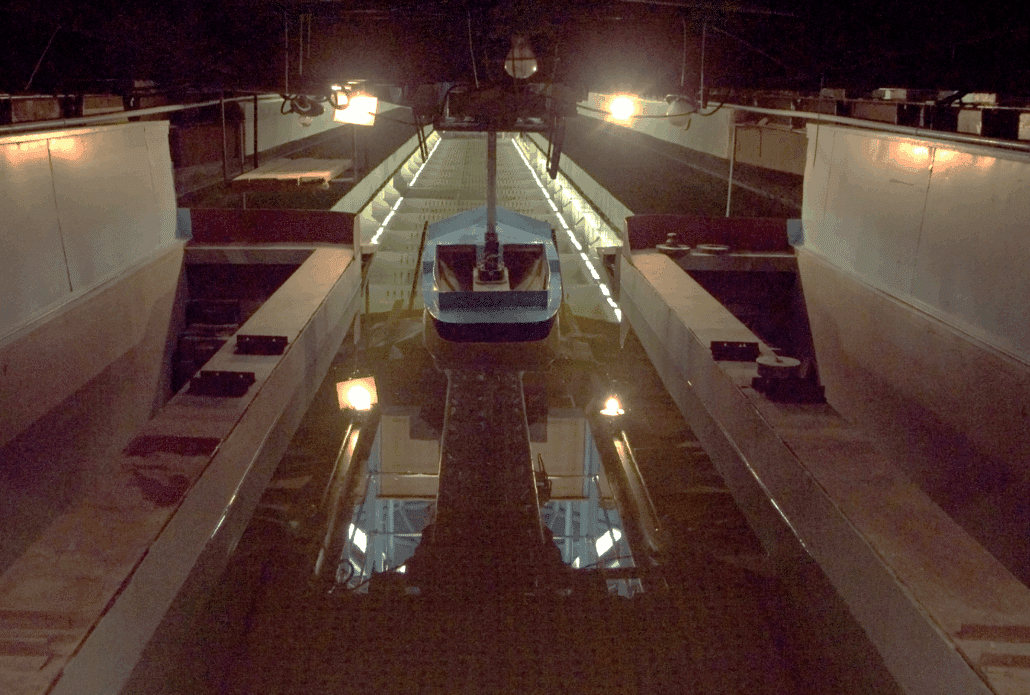
Towing tanks are experimental facilities used to study ship resistance and powering. We manufacture models of ships and then tow them down a long basin of water. This includes a bunch of electronic equipment to measure the drag on the model very precisely. Add in some fancy math and we get very reliable predictions of ship resistance and powering.
But all that precision adds up to a lot of expense. Your average commercial towing tank costs around $3M – $5M, not including the concrete for the basin of water or the surrounding building to house the tank. All told, a new towing tank, along with all associated facilities, involves capital expenses of $10M – $15M. Whoof! Make sure you buy the right tank.
Limited Expertise
Except 99.9% of us have no idea how to build or buy a towing tank. Even among naval architects, we only work with a towing tank 2-3 times in our lives. Because of this, I see many major projects ready to spend the money, but with practically no correct guidance on the design and build of a towing tank. Usually managed by someone who, understandably, doesn’t know what to ask for. So here we go. Nick’s shopping guide for towing tanks.
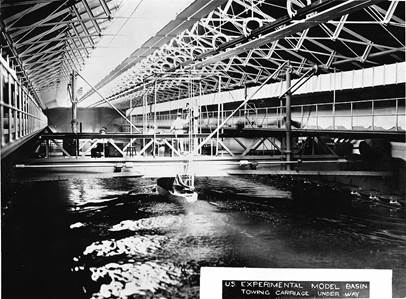
Figure 1‑1: Towing Carriage [1]
Who Sells Towing Tanks
Google searches do little good here. Across the entire world, I only know two firms with major experience designing towing tanks. And only one firm offers full turn-key service (design and build). They build very good and reliable tanks. If you just want a towing tank with no effort, go with them. But expect to pay a premium. These firms know their market. Competition? They don’t have any, and they know it. If you want a competitive bid, you need to cast a wider net.
The key thing to recognize about towing tanks: it’s just a collection of specialized components. No fancier than any other industrial equipment. Build the right team of specialists, and their collective expertise easily matches a dedicated “towing tank” designer. Table 2‑1 lists the major specialists you need. Seek all these specialties under one banner, and you confine yourself to two choices. But build a team with each specialty from a different company, and the world becomes a buffet of options.
Table 2‑1: Towing Tank Specialties
| Major Components | Specialty | Major Experience |
| System integration | Naval architect | Experience with seakeeping and wave mechanics |
| Water basin | Civil engineer | Previous designs of recreational pools, water treatment facilities, or other major water storage |
| Wavemaker | Wavemaker fabricator | Offering hinged flap type wavemakers |
| Towing carriage | Mechanical engineer | Previous projects with vibration control and design of industrial equipment like gantry cranes. |
| Electrical engineer | Design of power supplies for industrial factories and similar. | |
| Mechanical / controls engineer | Design of electronic control systems for industrial purposes. | |
| Data acquisition system | Metrologist / Electronics engineer | Previous experience specifying and calibrating data acquisition or industrial control systems. |
Tank Quality Standards
What makes a good towing tank? Thankfully, you don’t need to answer that. The ITTC answers for you.
Any towing tank worth using follows the standards of the international towing tank conference (ITTC). (https://ittc.info/downloads/archive-of-recommended-procedures/) They provide a robust set of recommended procedures and standards. This specifies accuracy standards for critical measurements, test procedures for normal experiments, and validation processes for data reporting. These standards are available for free download. The ITTC is the definitive guide to follow for a towing tank. Read it and require it for any new towing tank.
Standard Experiments
Your specification needs more detail than just asking for a hole filled with water. (No joke, I saw purchase specifications that basically said this.) The best way to design a towing tank is to start with a list of experiments. All towing tanks require flexibility to accommodate new experiments. But we build the tank expecting several major experiments that govern the main equipment lists. These are the must-have items. Write these experiments into the purchase specification. Make them a performance requirement. Once we have a list of expected experiments, then we can form the major equipment lists.
When planning your experiments, also think about the typical customer. Will they test models of large oil tankers or small yachts? Will your facility focus on high speed ships or medium speed? Will it be commercial customers, students, or academic research? Will you run 24/7? Or will the tank sit idle 90% of the time. All this information influences decisions for the “best” towing tank. Because there are no perfect towing tanks. Instead, we want one optimized for your program specifically.
Typical Experiments
The average ship expects a battery of standard tests. These form the core of a normal resistance and propulsion set. Start with these at a minimum:
- Calm water resistance test
- Propeller open water test
- Self-propulsion test
Then there are seakeeping experiments. Testing the model against wave interaction. This requires a wavemaker. A towing tank uses two types of waves: regular and irregular waves. Both use the same machinery. But irregular waves require a much longer tank to ensure sufficient testing time. Normal seakeeping experiments include:
- Model response in regular waves, while towed from the carriage
- We also test the model at different wave angles. But the width of the towing tank limits the available wave angles to around 15 deg off the bow as a maximum.
- Free running model tests with waves
- This may also involve motion capture with cameras
Towing Tank Size
How big to make the towing tank? As big as you can make it. But I never met someone suffering from the hardship of unlimited budgets. So practically, we find a compromise between competing demands:
- Physical space for the building. It’s best to create the tank as its own independent building, starting from empty ground. Keep it away from any industrial power sources or large motors. They contaminate the measurements. When selecting a site, remember this building will be extremely long and narrow.
- Minimum model size. All tanks plan for a typical size of test model. Pick this from the beginning. Ideally, the model should be around 1:20 the size of the full scale ship. Minimum sizes may be set by propellers. Your model scale propeller should be no smaller than 75-100 mm. (3-4 in.) in diameter. Much smaller and it gets difficult to accurately fabricate the propeller.
- Tank settling time. Larger tanks require more time to settle between runs. More on this later.
- Top model speed. A faster model means you run out of tank quicker. Less time to record data.
Available Testing Length
How long is your towing tank? Length is one of the most important dimensions. It influences your test time, top towing speed, and productivity (number of runs per hour). But you don’t get all the length you pay for. A large portion of the physical length in a towing tank is not useable for testing. There are numerous deductions from the physical length. Table 5‑1 shows a typical example.
| Item | Typical Length | Notes |
| Length of flume | 36.5 m (120 ft.) | This is the concrete basin. |
| Deductions | ||
| Wavemaker on end A | 1.2 -1.8 m (4-6 ft.) | |
| Beach on end B | 3.0 – 4.5 m (10-15 ft.) | |
| Length of towing carriage | 3.0 – 4.5 m (10-15 ft.) | |
| Carriage emergency stop distance | 4.5 – 6.0 m (15-20 ft.) | This is a safety feature. In normal operation, the towing carriage stops before the end of the tank. If we go past this safety limit, a sensor trips and forces the carriage into emergency braking. |
| Carriage acceleration distance | Varies depending on target speed. At a target of 5.0 m/s, acceleration distance is 12.5 m (41 ft.) (assume 1.0 m/s2 acceleration) | The distance it takes the carriage to reach its design speed, with normal acceleration. |
| Carriage deceleration distance | Varies depending on target speed. At a target of 5.0 m/s, acceleration distance is 12.5 m (41 ft.) (assume 1.0 m/s2 acceleration) | The distance for the carriage to brake in normal operation, applying a gradual, controlled deceleration. |
| Available distance for testing | 0 – 2.8 m (0 – 9.2 ft.) | This is the available distance for model measurements. |
In this example, at the top speed of 5 m/s, we only achieve 0.56 s of time to record useful data. That isn’t enough time. You lose at least 0.5 s on either end for the data to stabilize to a repeatable pattern. I intentionally picked this to show an example of a bad tank design. This demonstrated that the time available for testing depended on the tank dimensions and the speed of the towing carriage.
Model Test Time
We need sufficient time in each run to obtain a good measurement. When recording physical experiments, sensor signals oscillate, constantly changing. We want to capture at least five (5) oscillations in each run to get a good average from those oscillating signals. Practically, plan for six (6) oscillations, because we don’t get a clean start and stop for data recording. ITTC gave a handy formula to estimate the frequency of oscillations.

Where:
U = Model test speed (m/s)
g = Acceleration due to gravity (9.8065 m/s2)
f = Oscillation frequency (Hz)
At the top speed of 5 m/s, that suggests a test frequency of 12.8 Hz. With an oscillation period of 0.078 s. So, we need a minimum recording period of 0.468 s. And then add at least four (4) seconds to that as time for the flow to stabilize before we get good data. A total of roughly 4.5 s. At the top speed of 5 m/s, that equates to a testing length of 22.5 m (73.8 ft), plus all the deductions. This shows how towing tanks quickly escalate to massive lengths.
The wavemaker also influences our priorities for model test time. The waves travel down the towing tank. Eventually, they hit the beach at the back wall and reflect back towards the model. Once those incident waves reach the model again, they contaminate the measurements, and we stop the experiment. That sets the maximum time length for any test involving waves. A naval architect with experience in wave mechanics can estimate those wave run times. And yes, DMS, this includes DMS. We create these initial parameters for a towing tank by starting with the major tests and expected recording time during each test.
Settling Time
Settling time makes or breaks the economics of a towing tank. This determines the tank productivity: how many runs you achieve in an hour. Every time we move a model in the towing tank, that generate waves. Any movement on the surface propagates waves around the tank. Then we wait. Wait for those waves to dampen out. All experiments must start when the water sits practically motionless. Most tanks require around 10 – 20 minutes of waiting between each run. That limits testing to only 3-4 runs per hour and greatly limits the productivity of the tank.
How to improve productivity? This is why we add beaches to the end of the tank. Many tanks also include beaches along the side walls. Some tanks even went extreme. They removed their old beach, which acted as a passive wave damper and replaced it with wave makers at both ends. Modern wave makers sense the oncoming waves and actively work to absorb those surface waves. It’s all about quickly damping out those waves.
The greatest problem are the resonant waves. Wave frequency matches to a physical wave length. A lower frequency wave has a longer wave length. And the bane of every towing tank are the two resonant waves. One where the wavelength matches the width of the tank. And another one where the wavelength matches the length of the tank. You can’t visually see these waves. The movement is too small. But they exist. And they show up on sensor readings. And they take FOREVER to dampen out.
Because these waves resonate with the tank dimensions, they become standing waves, reinforcing themselves. When I quoted 10-20 minutes of waiting. Most of the waves are gone in 5 minutes. It’s these resonant waves that require most of the time. We want anything possible to eliminate these waves. Damping resonant waves reduces the settling time and improves tank productivity.
Project Schedule
So you can build this in a month, right? The second major mistake I see: planners expect to summon a tank from thin air with only a few months of schedule. This might be possible for small demonstration tanks. But a full sized commercial tank, expect much, much . . . much longer.
Table 8‑1: Approximate Schedule for Towing Tank
| Towing Tank | Civil Works / Building | |
| Design towing tank and building | ≈ 6 months | ≈ 6-9 months |
| Building construction | ≈12-18 months | |
| Tank equipment fabrication | ≈ 6-8 months | |
| Commissioning | ≈ 3-4 months | |
| Equipment install and functional testing | ≈ 0.5 months | |
| Rail alignment | ≈ 1-2 months | |
| Calibration | ≈ 1 month | |
| Validation testing | ≈ 0.5 months | |
| Documentation & training | ≈ 0.75 months | |
| Total Time | ≈ 16 – 19 months | ≈ 18 – 27 months |
From initial funding to finished project, expect around 2 years to complete. Even after construction finishes, we still need around 3-4 months for commissioning. Towing tanks don’t work the same as simply flipping on a light bulb. They combine loads of sensitive equipment from a dozen different vendors. It won’t work the first time. We need to troubleshoot, track down problems, and fix them.
Even after the equipment works, we need to calibrate everything. One underappreciated task is the rail alignment. To ensure the best data quality, we need the towing carriage to travel down the rails with minimal vibration. That requires precise alignment of the carriage rails to less than a millimeter deviation. A very long and tedious process.
Once we get everything working smoothly, expect some validation testing. We run a standard ship model in the tank. Something previously tested at other tanks so we can compare results. If all goes well, our numbers should fall very close to previous tests. That demonstrates tank accuracy. Time to train your staff and hand over the reins. After years of work, preparation and testing, your towing tank stands ready for service.
Conclusion
Towing tanks are a huge project, made all the worse by imprecise specifications. The first step in any tank design is to create that list of experiments and determine the requirements from that list. Most experiments and testing equipment follow strict requirements, set by the ITTC. But the actual implementation of those requirements is a custom endeavor, specific to the restrictions of each towing tank. Everything from site restrictions, to budget, to political influences. This guide helped establish the questions to ask for a towing tank. From these questions, engineers can design a towing tank to fit your needs.
References
| [1] | Wikimedia Authors, “Experimental Model Basin, Washington Navy Yard, Washington, DC – interior view, c. 1900. This was the first model basin (towing tank) for the United States Navy.,” Wikimedia Commons, 19 Aug 2007. [Online]. Available: https://en.wikipedia.org/wiki/File:US_Experimental_Model_Basin_-_interior_view,_c._1900.jpg. [Accessed 18 Jun 2019]. |
| [2] | QinetiQ, “QinetiQ Ship Tank,” QinetiQ, 15 Mar 2012. [Online]. Available: https://www.youtube.com/watch?v=OD4ApYYtRaQ. [Accessed 18 Jun 2019]. |
| [3] | HR Wallingford, “Wave Generation Systems at HR Wallingford,” YouTube, 6 Sep 2017. [Online]. Available: https://www.youtube.com/watch?v=KZanGVCLHzI&t=2s&ab_channel=HRWallingford. [Accessed 4 Aug 2025]. |
| [4] | MHL Media, “What it Takes to Clean as Towing Tank – Summer 2022,” YouTube, 19 Aug 2022. [Online]. Available: https://www.youtube.com/watch?v=O2JzGNiIMBU&t=2s&ab_channel=MHLMedia. [Accessed 04 Aug 2025]. |
| [5] | B. &. S. J. &. L. S. &. S. D. &. R. S. Han, “Uncertainty assessment for a towed underwater stereo PIV system by uniform flow measurement,” International Journal of Naval Architecture and Ocean Engineering, vol. 10, no. 10, p. 1016, 2017. |
| [6] | B. M. e. Al., “DESIGN, DEVELOPMENT AND COMMISSIONING OF THE BOLDREWOOD TOWING,” Transactions of the Royal Institute of Naval Architects, vol. A2, 2023. |