Do We Have a Problem: Testing for List and Angle of Loll
EVER WASTE MONEY ON SPECIALISTS! Here are a few simple-do-it-yourself tests to check for ship list and angle of loll.

EVER WASTE MONEY ON SPECIALISTS! Here are a few simple-do-it-yourself tests to check for ship list and angle of loll.
NEVER WASTE MONEY ON SPECIALISTS! I hate wasting money on professionals when it’s a simple fix I can do myself. The same is true for ship owners. A ship owner always prefers to fix issues using their own crew, rather than call a consultant. But what about suspected issues like list and angle of loll? These show subtle symptoms and no one is certain if a problem really exists. Here are a few simple-do-it-yourself tests to check for ship list and angle of loll.
First step is to double check that you have a consistent ship list. Easiest way to check for ship list is to log the vessel heel over several trips. You want to check at both the ballast load and heavy load conditions. These conditions are best checked just before departure, while still in harbor. Some things to note for each log entry:
If you have a genuine ship list, these log entries should show a pattern over time. Look for these two key characteristics.
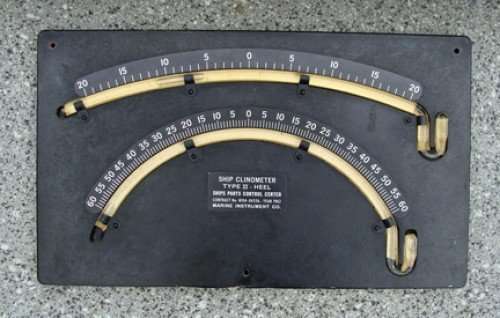
Angle of loll (AOL) is hard to detect. The best solution is to bring in an expert: call a naval architect. But naval architects are expensive. Maybe you want to check things yourself before opening the wallet. The following procedure helps indicate if your ship has an angle of loll. Just read all the warnings and if you have any safety concerns, a naval architect is the best route to go.
To test this, you will need the following:
The goal here is to fill the heeling tanks on deck until the ship changes from the list angle back to zero heel, and slightly past. If the ship has a true list, it will remain at the new angle. If the ship has an AOL, once you pass zero heel, it should very quickly continue to heel further. For an example, assume our problem ship has an initial heel of 2.5 deg to port.
This test gives you a clear and very noticeable distinction between AOL and genuine list.
This test does have some risks for the ship. For safety planning, assume you have an angle of loll (AOL). This means, when you create the counter moment, you created a list angle. The list angle will compound with the AOL and heel farther on the opposite side than you started with. This potentially leads to very large heel angles and possible deck edge immersion. This following video shows an excellent example of how that can happen.
Check your load cases before hand to ensure the vessel can tolerate the larger heel angle. If you are unsure about the safety aspects, consult with a naval architect.
Sometimes the do-it-yourself method doesn’t work. Test results may be inconclusive, or they show unhappy conclusions. In these cases, it is time to call the professionals. Bring in the consulting naval architects, who have advanced tests to get a much better picture of your situation.
At first glance, consulting naval architects seem to do the same tests described in this article. The main difference is accuracy. The naval architect can test with a great deal more accuracy, using much more precise measurements. The two main tests available to a naval architect are a deadweight survey and a stability test.
The deadweight survey will determine the total weight, longitudinal center of gravity (LCG), and transverse center of gravity (TCG) for your vessel. It does not determine the vertical center of gravity (VCG). The deadweight survey is excellent when checking for ship list. The naval architect can compare test results with the trim and stability booklet to help you identify the source of your list problem.
The naval architect uses the deadweight survey to determine the exact amount of weight added to the ship, and its general location (LCG, TCG). The deadweight survey does not provide a VCG, so you still have to check each deck. But combine these test results with a little logical deduction, and you can quickly isolate the source of your ship list.
The stability test gives you the exact information about the added weight and center of gravity. This includes LCG, TCG, and VCG. The naval architect can compare all this information to your trim and stability booklet to examine any changes in vessel stability. This is perfect when checking for angle of loll.
More important, the stability test also immediately identifies any unknown free surface moments. Any tanks with slack water or open cross connects will immediately appear in the stability test results. If you have an angle of loll, the stability test is the ultimate diagnostic tool. It both identifies the source of an angle of loll, and quantifies its impact on your stability.
We all want to know our money is well spent. These simple tests should help you confirm if you have a ship list or angle of loll before calling in the specialists.
 https://dmsonline.us/wp-content/uploads/2026/03/Clickbait.jpg
720
1280
Nicholas Barczak
/wp-content/uploads/2025/06/DMS-logo.svg
Nicholas Barczak2026-04-07 07:00:002026-06-01 10:09:14How a Seakeeper Works: Gyro Stabilization Explained
https://dmsonline.us/wp-content/uploads/2026/03/Clickbait.jpg
720
1280
Nicholas Barczak
/wp-content/uploads/2025/06/DMS-logo.svg
Nicholas Barczak2026-04-07 07:00:002026-06-01 10:09:14How a Seakeeper Works: Gyro Stabilization Explained https://dmsonline.us/wp-content/uploads/2025/08/Clickbait.jpg
720
1280
Nicholas Barczak
/wp-content/uploads/2025/06/DMS-logo.svg
Nicholas Barczak2025-11-11 07:00:002026-06-01 10:09:18How to Buy a Towing Tank: Purchase and Design Guide
https://dmsonline.us/wp-content/uploads/2025/08/Clickbait.jpg
720
1280
Nicholas Barczak
/wp-content/uploads/2025/06/DMS-logo.svg
Nicholas Barczak2025-11-11 07:00:002026-06-01 10:09:18How to Buy a Towing Tank: Purchase and Design Guide https://dmsonline.us/wp-content/uploads/2023/12/USCGC_Healy_WAGB-20_north_of_Alaska-scaled-1.jpg
633
1200
Nate Riggins
/wp-content/uploads/2025/06/DMS-logo.svg
Nate Riggins2024-05-14 09:00:002026-06-01 10:09:22Surviving the Arctic: Polar Class Icebreakers
https://dmsonline.us/wp-content/uploads/2023/12/USCGC_Healy_WAGB-20_north_of_Alaska-scaled-1.jpg
633
1200
Nate Riggins
/wp-content/uploads/2025/06/DMS-logo.svg
Nate Riggins2024-05-14 09:00:002026-06-01 10:09:22Surviving the Arctic: Polar Class Icebreakers https://dmsonline.us/wp-content/uploads/2023/12/MackinawIce1-scaled-1.jpg
883
1200
Nate Riggins
/wp-content/uploads/2025/06/DMS-logo.svg
Nate Riggins2024-03-19 09:00:002026-06-01 10:09:22Ramming the Ice: Icebreaker Propulsion
https://dmsonline.us/wp-content/uploads/2023/12/MackinawIce1-scaled-1.jpg
883
1200
Nate Riggins
/wp-content/uploads/2025/06/DMS-logo.svg
Nate Riggins2024-03-19 09:00:002026-06-01 10:09:22Ramming the Ice: Icebreaker Propulsion https://dmsonline.us/wp-content/uploads/2022/06/MVAltairGeneralArrangementPlan_SmallResolution.webp
299
640
Nate Riggins
/wp-content/uploads/2025/06/DMS-logo.svg
Nate Riggins2022-09-12 06:00:002025-09-30 07:31:20How to Design a Ship
https://dmsonline.us/wp-content/uploads/2022/06/MVAltairGeneralArrangementPlan_SmallResolution.webp
299
640
Nate Riggins
/wp-content/uploads/2025/06/DMS-logo.svg
Nate Riggins2022-09-12 06:00:002025-09-30 07:31:20How to Design a Ship https://dmsonline.us/wp-content/uploads/2022/02/ClickBait1_1.84.1.jpg
1080
1920
Nate Riggins
/wp-content/uploads/2025/06/DMS-logo.svg
Nate Riggins2022-02-21 06:00:002025-08-15 13:17:02Stability Letters Explained
https://dmsonline.us/wp-content/uploads/2022/02/ClickBait1_1.84.1.jpg
1080
1920
Nate Riggins
/wp-content/uploads/2025/06/DMS-logo.svg
Nate Riggins2022-02-21 06:00:002025-08-15 13:17:02Stability Letters Explained https://dmsonline.us/wp-content/uploads/2021/01/Seawise_University_wreck.jpg
1059
1412
Nate Riggins
/wp-content/uploads/2025/06/DMS-logo.svg
Nate Riggins2021-01-18 07:00:002026-06-01 10:09:25Free Surface Moment
https://dmsonline.us/wp-content/uploads/2021/01/Seawise_University_wreck.jpg
1059
1412
Nate Riggins
/wp-content/uploads/2025/06/DMS-logo.svg
Nate Riggins2021-01-18 07:00:002026-06-01 10:09:25Free Surface Moment https://dmsonline.us/wp-content/uploads/2021/06/PendulumSetup_500px.webp
422
500
Nate Riggins
/wp-content/uploads/2025/06/DMS-logo.svg
Nate Riggins2020-11-02 06:00:002026-06-01 10:09:26Practical Stability Test: Naval Architect’s Guide
https://dmsonline.us/wp-content/uploads/2021/06/PendulumSetup_500px.webp
422
500
Nate Riggins
/wp-content/uploads/2025/06/DMS-logo.svg
Nate Riggins2020-11-02 06:00:002026-06-01 10:09:26Practical Stability Test: Naval Architect’s Guide https://dmsonline.us/wp-content/uploads/2021/06/container-ship-2893480_1920.jpg
924
1386
Nate Riggins
/wp-content/uploads/2025/06/DMS-logo.svg
Nate Riggins2020-10-19 06:00:002026-06-01 10:09:26Stability Test Theory
https://dmsonline.us/wp-content/uploads/2021/06/container-ship-2893480_1920.jpg
924
1386
Nate Riggins
/wp-content/uploads/2025/06/DMS-logo.svg
Nate Riggins2020-10-19 06:00:002026-06-01 10:09:26Stability Test Theory