Keep An Even Keel: Dealing With Ship List
Why is Ship List Bad? If ignored, it continues grow and place your ship at risk. Be proactive and stop the list once you first suspect it. Your crew

Why is Ship List Bad? If ignored, it continues grow and place your ship at risk. Be proactive and stop the list once you first suspect it. Your crew
List is everywhere on your ship. You can see it when you look at the bubble level, or when you set down your coffee cup. You can feel it when you walk the deck, sit down at the mess, or fall asleep. List is a permanent heel angle, and it can make for a dangerous trip. (Figure 1‑1)
Ship list creeps in the dark corners of your bilges and lurks in foul smelling places. This is a consistent heel angle that always remains, even after you unload and load new cargo. The only way to eliminate ship list is to track down the source and eliminate it.
The main issue I have with ship list is that it discredits the trim and stability (T&S) booklet, sometimes also called the loading manual, or stability letter, depending on your vessel. Whatever you call it, the T&S book keeps you safe from two dangerous ends: ship capsizing, and the hull breaking in half. But with a permanent ship list, your drafts no longer match the predictions shown in the T&S book.
The T&S book is the major safety measure for structural limits and stability capacity. The accuracy of this book is critical, because these two properties are completely un-monitored, or only loosely estimated. Look around at the bridge of any ship, and you will find a cornucopia of sensors to report all aspects of the vessel health. Everything from engine output, to navigation and weather information, to fire alarm status. But nowhere can you find a sensor to report the current stress on the ship’s hull, or how close you are to capsizing. At best, a computer tries to estimate these properties.
But really, the T&S book is the major safety measure. Before your ship ever sailed, a naval architect considered all possible scenarios, and distilled them down to a series of loading limits for your T&S book. They even included standard loading conditions to checked and make sure your ship still matches the T&S book.
But what if the ship doesn’t match the T&S book? Without a reliable T&S book, you have no way to check your ship stability. Plus, ship list can reduce your available ship stability. Either way, best to track down the cause of that ship list.
First step is to double check that you have a consistent ship list. Easiest way to check for ship list is to log the vessel heel over several trips. You want to check at both the ballast load and heavy load conditions. These conditions are best checked just before departure, while still in harbor. Some things to note for each log entry:
If you have a genuine ship list, these log entries should show a pattern over time. Look for these two key characteristics.
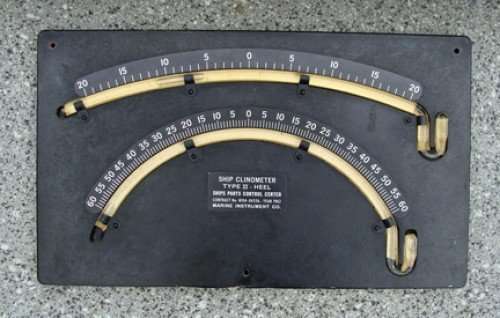
Ship list manifests from two major reasons: an angle of loll or added weight. You should always eliminate angle of loll first, because it indicates a much more serious problem with vessel stability.
An angle of loll is a symptom of more serious stability problems. We want the ship’s center of gravity to be vertically below the metacenter. With an angle of loll, when the ship is upright, the center of gravity is actually above the metacenter. End result: the ship is unstable within a small range of heel angles. That is very bad. I discuss angle of loll in greater detail in a later post, here. Barring angle of loll, 95% of all list cases are due to added weight.
The most likely culprit for ship list is added weight somewhere. This has to be in some location that you would not notice in normal ship checks. The tanks and voids are the most likely culprit. Start by manually sounding all the tanks on the ship, even the ones you don’t use anymore. Check bilges and anchor chain lockers. If the soundings don’t match your load tables, you found the problem tank.
If that failed, you need to physically check every single tank and void. (Figure 4‑1) They need to be gas free for human entry. Or if the tanks are large enough, you can use a drone to survey the tank, without any need to gas free. You are looking for any signs of liquid that you didn’t expect. It should be a large amount of liquid, and fairly obvious. When identifying the cause of ship list, leave no stone unturned or tank unopened.
Figure 4‑1: Down Into the Manholes


Sometimes a ship develops list through innocent weight growth. Hundreds of little changes to the structure and outfitting that shift the ship’s center of gravity slightly off centerline. In this case, the only solution is to install permanent fixed ballast, followed by a stability test.
Ship list creeps up on you like a disease. If you catch it and treat it early, ship list quickly fades as a minor problem. But if ignored, it continues grow and place your ship at risk. Be proactive and stop the list once you first suspect it. Your crew will sleep better.
 https://dmsonline.us/wp-content/uploads/2026/03/Clickbait.jpg
720
1280
Nicholas Barczak
/wp-content/uploads/2025/06/DMS-logo.svg
Nicholas Barczak2026-04-07 07:00:002026-06-01 10:09:14How a Seakeeper Works: Gyro Stabilization Explained
https://dmsonline.us/wp-content/uploads/2026/03/Clickbait.jpg
720
1280
Nicholas Barczak
/wp-content/uploads/2025/06/DMS-logo.svg
Nicholas Barczak2026-04-07 07:00:002026-06-01 10:09:14How a Seakeeper Works: Gyro Stabilization Explained https://dmsonline.us/wp-content/uploads/2025/08/Clickbait.jpg
720
1280
Nicholas Barczak
/wp-content/uploads/2025/06/DMS-logo.svg
Nicholas Barczak2025-11-11 07:00:002026-06-01 10:09:18How to Buy a Towing Tank: Purchase and Design Guide
https://dmsonline.us/wp-content/uploads/2025/08/Clickbait.jpg
720
1280
Nicholas Barczak
/wp-content/uploads/2025/06/DMS-logo.svg
Nicholas Barczak2025-11-11 07:00:002026-06-01 10:09:18How to Buy a Towing Tank: Purchase and Design Guide https://dmsonline.us/wp-content/uploads/2023/12/USCGC_Healy_WAGB-20_north_of_Alaska-scaled-1.jpg
633
1200
Nate Riggins
/wp-content/uploads/2025/06/DMS-logo.svg
Nate Riggins2024-05-14 09:00:002026-06-01 10:09:22Surviving the Arctic: Polar Class Icebreakers
https://dmsonline.us/wp-content/uploads/2023/12/USCGC_Healy_WAGB-20_north_of_Alaska-scaled-1.jpg
633
1200
Nate Riggins
/wp-content/uploads/2025/06/DMS-logo.svg
Nate Riggins2024-05-14 09:00:002026-06-01 10:09:22Surviving the Arctic: Polar Class Icebreakers https://dmsonline.us/wp-content/uploads/2023/12/MackinawIce1-scaled-1.jpg
883
1200
Nate Riggins
/wp-content/uploads/2025/06/DMS-logo.svg
Nate Riggins2024-03-19 09:00:002026-06-01 10:09:22Ramming the Ice: Icebreaker Propulsion
https://dmsonline.us/wp-content/uploads/2023/12/MackinawIce1-scaled-1.jpg
883
1200
Nate Riggins
/wp-content/uploads/2025/06/DMS-logo.svg
Nate Riggins2024-03-19 09:00:002026-06-01 10:09:22Ramming the Ice: Icebreaker Propulsion https://dmsonline.us/wp-content/uploads/2022/06/MVAltairGeneralArrangementPlan_SmallResolution.webp
299
640
Nate Riggins
/wp-content/uploads/2025/06/DMS-logo.svg
Nate Riggins2022-09-12 06:00:002025-09-30 07:31:20How to Design a Ship
https://dmsonline.us/wp-content/uploads/2022/06/MVAltairGeneralArrangementPlan_SmallResolution.webp
299
640
Nate Riggins
/wp-content/uploads/2025/06/DMS-logo.svg
Nate Riggins2022-09-12 06:00:002025-09-30 07:31:20How to Design a Ship https://dmsonline.us/wp-content/uploads/2022/02/ClickBait1_1.84.1.jpg
1080
1920
Nate Riggins
/wp-content/uploads/2025/06/DMS-logo.svg
Nate Riggins2022-02-21 06:00:002025-08-15 13:17:02Stability Letters Explained
https://dmsonline.us/wp-content/uploads/2022/02/ClickBait1_1.84.1.jpg
1080
1920
Nate Riggins
/wp-content/uploads/2025/06/DMS-logo.svg
Nate Riggins2022-02-21 06:00:002025-08-15 13:17:02Stability Letters Explained https://dmsonline.us/wp-content/uploads/2021/01/Seawise_University_wreck.jpg
1059
1412
Nate Riggins
/wp-content/uploads/2025/06/DMS-logo.svg
Nate Riggins2021-01-18 07:00:002026-06-01 10:09:25Free Surface Moment
https://dmsonline.us/wp-content/uploads/2021/01/Seawise_University_wreck.jpg
1059
1412
Nate Riggins
/wp-content/uploads/2025/06/DMS-logo.svg
Nate Riggins2021-01-18 07:00:002026-06-01 10:09:25Free Surface Moment https://dmsonline.us/wp-content/uploads/2021/06/PendulumSetup_500px.webp
422
500
Nate Riggins
/wp-content/uploads/2025/06/DMS-logo.svg
Nate Riggins2020-11-02 06:00:002026-06-01 10:09:26Practical Stability Test: Naval Architect’s Guide
https://dmsonline.us/wp-content/uploads/2021/06/PendulumSetup_500px.webp
422
500
Nate Riggins
/wp-content/uploads/2025/06/DMS-logo.svg
Nate Riggins2020-11-02 06:00:002026-06-01 10:09:26Practical Stability Test: Naval Architect’s Guide https://dmsonline.us/wp-content/uploads/2021/06/container-ship-2893480_1920.jpg
924
1386
Nate Riggins
/wp-content/uploads/2025/06/DMS-logo.svg
Nate Riggins2020-10-19 06:00:002026-06-01 10:09:26Stability Test Theory
https://dmsonline.us/wp-content/uploads/2021/06/container-ship-2893480_1920.jpg
924
1386
Nate Riggins
/wp-content/uploads/2025/06/DMS-logo.svg
Nate Riggins2020-10-19 06:00:002026-06-01 10:09:26Stability Test Theory