Marine Highways: Short Sea Shipping
Introduction
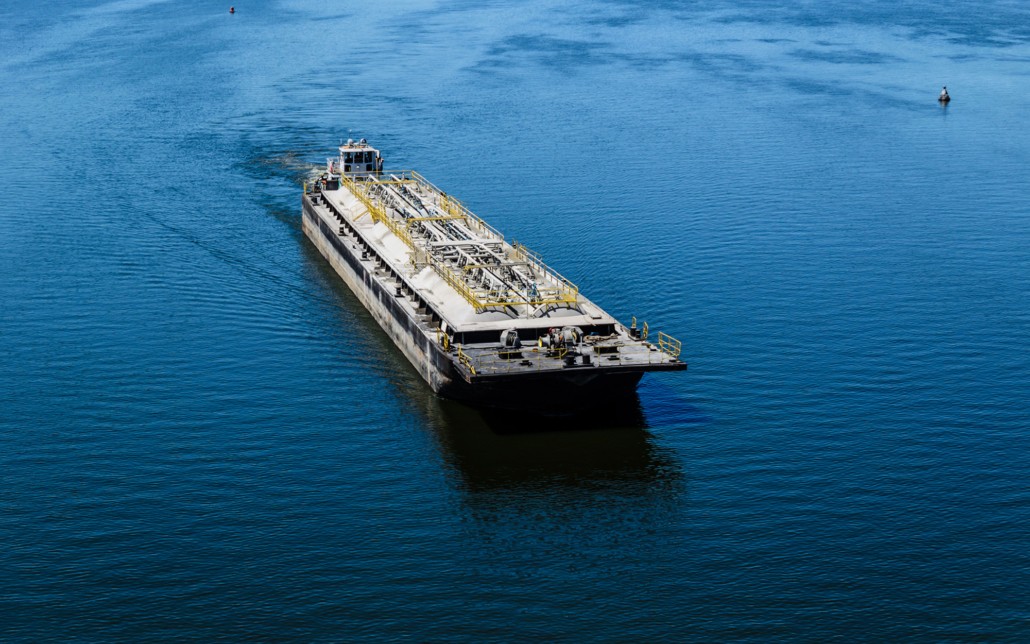
We have too many cars and trucks on the road. How do we relieve congestion? The National Marine Highway Program. What’s that? Well, a lot of the road traffic comes from commercial trucks. So we should shift some of that cargo to carry it on a ship instead of the road? That’s the idea behind the MARAD National Marine Highway Program. Create a fleet of ships designed for coastal and river routes, making frequent stops for cargo delivery. More commonly called short sea shipping.
Benefits of Short Sea Shipping
Short Sea Shipping offers plenty of benefits. A single ship carries the cargo equivalent of 100’s of trucks. That reduces congestion on the roads and cuts down on road maintenance. And the ships generally reduce engine emissions. Yes, we use bigger engines, but we carry far more cargo for those emissions.
But Ships are Slower?
Yes, ships trudge along slower than trucks. But the difference is not nearly so drastic. Commercial trucks don’t drive 24/7. Here in the USA, we place requirements on rest intervals. The Federal Motor Carrier Safety Administration stacks up a confusing set rest requirements depending on the length of the voyage. The big one requires the truck to rest for 10 hours after every 11 hours of driving. (The exact rule is more complicated. We’ll stick with the simplified version.)
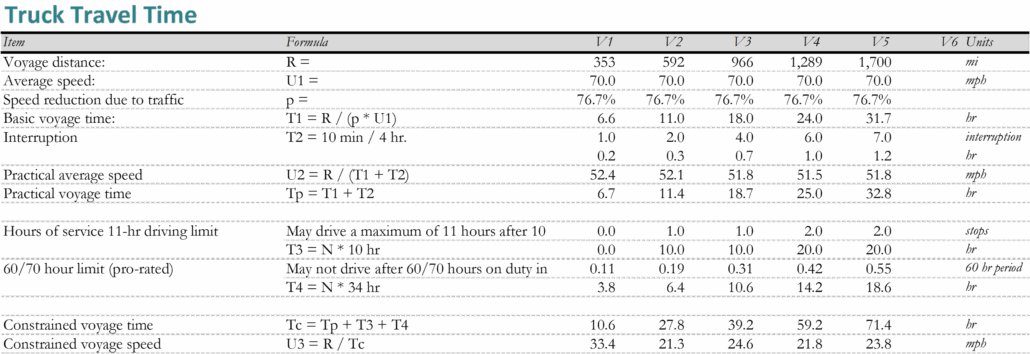
One top of rest requirements, we suffer practical constraints. Trucks frequently encounter traffic congestion, which slows them down. DMS reviewed traffic delays due at several cities along I-95, a major US freeway. On average, traffic only traveled at 77% of the posted traffic speeds. On top of that, we can’t expect a truck to travel 11 hours without the slightest pause. Drivers need to refuel, grab meals, stop and use the bathroom. These micro-stops seem small, but they reduce the average travel speed. The combination of traffic and micro-stops alone dropped the truck speed from 70 mph down to around 52 mph. (Posted speeds for trucks are normally 65 mph. I assumed the truck was speeding.)
Combine those small delays with the required rest periods, and the effective speed for a truck is much slower than you expect. It depends on the distance travelled, but for a short voyage of only 353 mi, the average travel speed was only 33 mph. For a long voyage of 1700 mi, the average speed dropped to just 24 mph. Some fast container ships travel at 24 mph (approximately 21 knots). And ships don’t stop. We don’t rest. We don’t pause. Our crew rotates out and the ship travels 24/7.
To be fair, 24 mph is still fast for a cargo ship. That takes a lot of fuel. A more reasonable ship speed would be 16 mph (14 knots). This still places the ship close enough to truck speeds for a competitive alternative. Figure 2‑1 compares the delivery times between trucks and ships for a range of different travel distances.
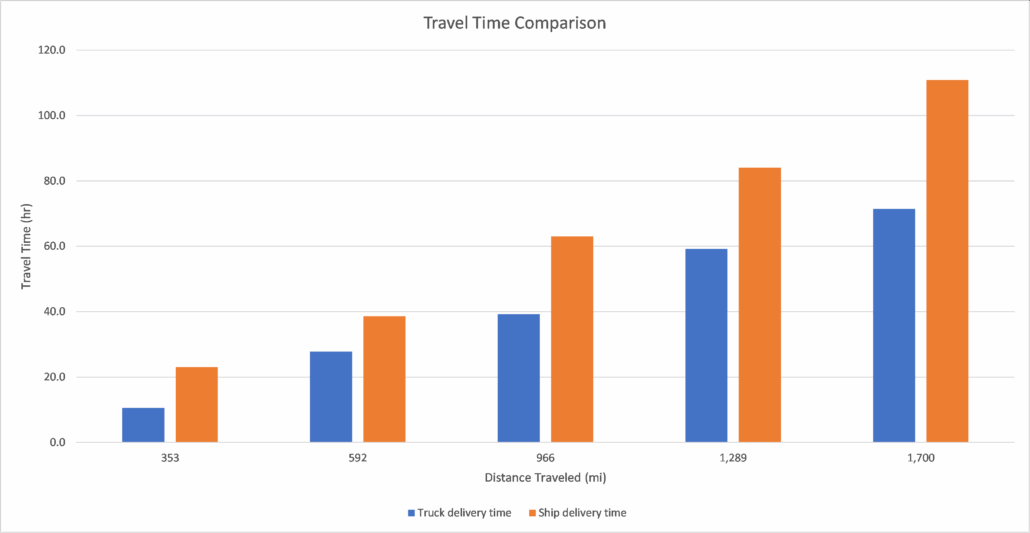
At the short distances, delivering within a state, trucks win hands down. The ship takes twice the delivery time. But compare the long travel distances of 1,700 mi. Now the ship only requires 50% longer for delivery time. The ship needs 39 hours longer than the truck for delivery. Instead of getting your cargo in 3 days, it takes 5 days to deliver. Some businesses can tolerate that delay, making short sea shipping a viable alternative.
When you need a package delivered in a hurry, put it on a truck. No argument, trucks will always fill the delivery role when time matters. They fill a cost effective niche between expensive air cargo and lumbering ship cargo. But not everyone needs their products in a hurry. Especially over long travel distances, the ship can effectively take over some of the truck market. Not all of it. Not even most of it. But enough to relieve highway congestion.
Environmental Concerns
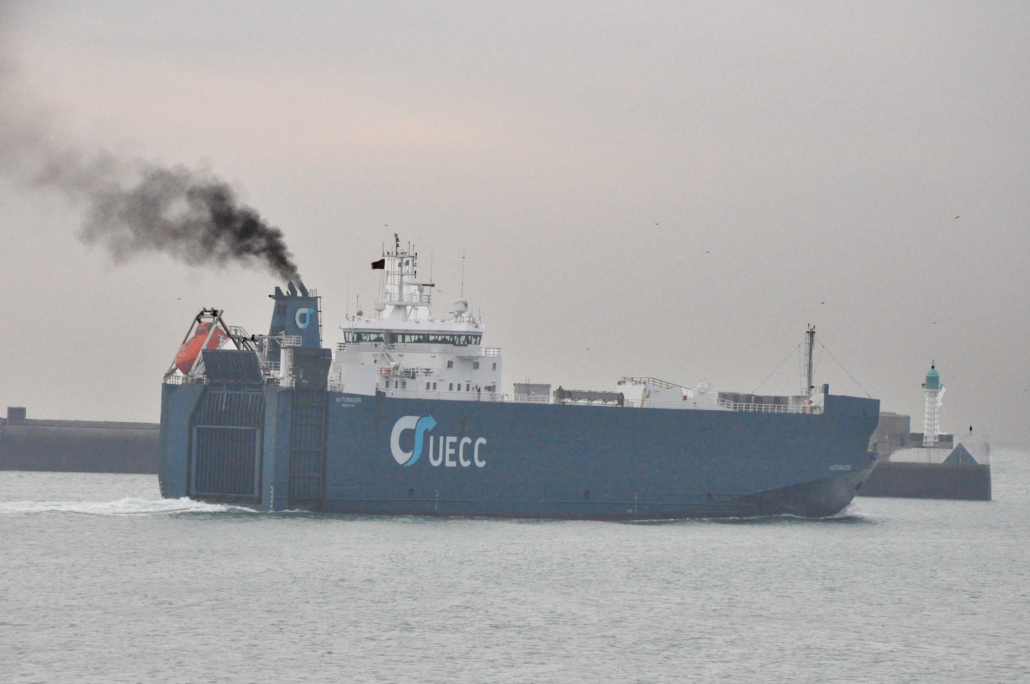
Surely trucks are better for the environment than a ship, right? Look at all the black smoke ships emit. Except they don’t do that. Some international ships with older engines ruin the image for the rest of us. Ships that travel within the US coastal waters broadly follow the same emission regulations as commercial trucks. For a brief time, the truck industry raced ahead of shipping in terms of pollution control, due to scale and economics. Bigger engines in ships mean more cost and effort to update their design. But now, the newest ships have broadly caught up with trucks. We both use the same diesel engine technology. It’s just a matter of scale.
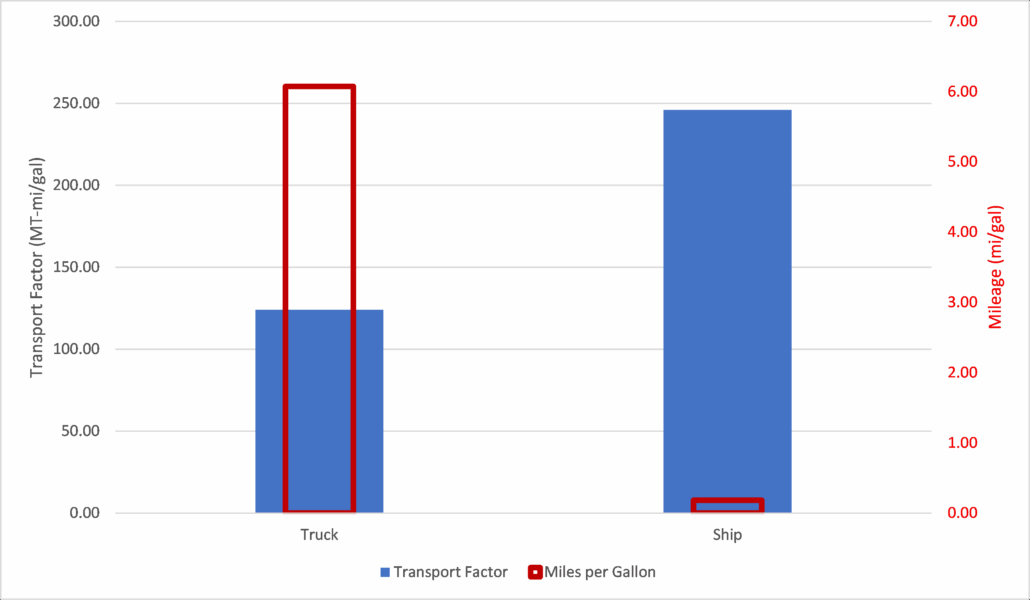
To properly compare the scale, we need to go beyond simple mileage. A typical car rates their fuel efficiency in terms of miles per gallon. In those terms, commercial trucks achieve somewhere in the range of 6.0 miles per gallon. Ships get along with a measly 0.20 miles per gallon. But it’s not just the distance. We need to consider the amount of cargo transported. Remember that single ship transports the equivalent cargo carried by dozens of trucks. Of course the ship needs more fuel to carry all that extra weight.
If we consider the cargo, which is more efficient: ship or truck? The metric to answer this is the transport factor. Basically, the miles per gallon, multiplied by the weight of cargo transported. (Figure 3‑1) A typical truck carries around 45,000 lb. (20.4 MT) of cargo. This gives a transport factor of 124 MT-mi/gal. But the ship carries 2976,000 lb. (1350 MT) of cargo. The equivalent of 66 truckloads in a single voyage. That grants the ship an impressive transport factor of 246 MT-mi/gal. In terms of fuel efficiency, the ship wins, with twice the transport factor of trucks.
You’re Coming for My Job
Whenever someone discusses changes to an industry like trucking, it always provokes a fear of new technology stealing people’s job. In this case, that isn’t possible. The trucking industry covers numerous segments that ships can never replace. All the truck routes that cross the continent, or don’t follow a major waterway. Ships can’t replace those. And even with suitable routes, ships are still slower than a truck. Many shippers still requires need the increased speed of a truck. Ships will never replace trucks. We can’t even take over the majority of trucks. Only a small portion of the truck industry. Hopefully enough to relieve congestion on major freeways.
Short sea shipping also offers an opportunity for retraining. A typical cargo ship requires 16 – 24 crew. Truck drivers retrain to become crew on a cargo ship. The ship travels along regular routes, returning home every few weeks. Regular chances to see your family. Plus, the ship offers better accommodation than a truck. You get regular sleeping hours, healthy meals prepared by a professional chef, your own cabin, a bathroom available whenever needed. Pretty nice working conditions.
The Problem of Infrastructure
Given the myriad benefits, why don’t we already have a wide network for short sea shipping? The problem is infrastructure. Most common cargo travels by intermodal container. TV’s, I-phones, lumber, auto parts, refrigerators, everything. It all loads onto a container and travels efficiently to your front door. Except that transit requires more than just a container ship. We rely on a vast network of infrastructure to transport these containers. One of the biggest components is a container terminal. A massive complex filled with expensive cranes to unload the ships, tele-handlers to move and stack the containers, rail yards and truck depots to load the containers. And this is the problem with short sea shipping.
If we want a small ship traveling up and down the coast, delivering to small towns along the way, then we need to create all that infrastructure at every delivery point. That’s ridiculous! It costs millions to develop a full container terminal. Even at small sizes, we still need all the equipment. The large cranes, telehandlers, weighing equipment, rail yards, etc. No tiny American town can afford to develop all that infrastructure.
To make short sea shipping a reality, we need a cheap infrastructure for loading and unloading containers. Something small scale that is easily built in towns all along the coastline.
Conclusion
Short sea shipping entices us with a win-win scenario. We relieve highway congestion, making work easier for the trucking industry. And we add to US maritime commerce. Even better, we can guarantee that ships won’t replace trucking. Many times, the ship moves too slows. But if you can tolerate that extra shipping time, a ship carries dozens times more cargo, far more efficiently than a truck. So what’s the holdup? Infrastructure. We can’t build expensive container terminals across the USA. We need a cheap method to unload container cargo. Something as cheap as a parking lot. Once we create that cheap infrastructure, short sea shipping genuinely seems like a good move for everyone.
References
| [1] | D. Porter, “Barges on the Mighty Mississippi River,” The Roaming Boomers, 27 Mar 2024. [Online]. Available: https://www.theroamingboomers.com/barges-on-the-mighty-mississippi-river/. [Accessed 21 Nov 2024]. |
| [2] | Vedant Khamesra, “What is the Average MPG for a Semi-Truck,” AtoB, 15 Nov 2022. [Online]. Available: https://www.atob.com/blog/average-mpg-for-a-semi-truck. [Accessed 22 Dec 2024]. |
| [3] | FreightWaves Staff, “How Much Weight Can a Big Rig Carry,” FreightWaves, 01 Jan 2020. [Online]. Available: https://www.freightwaves.com/news/how-much-weight-can-a-big-rig-carry. [Accessed 22 Dec 2024]. |
| [4] | Wikipedia Authors, “Autoracer in port of Le Havre,” Wikimedia Commons, 23 Nov 2014. [Online]. Available: https://commons.wikimedia.org/wiki/File:Autoracer_in_port_of_Le_Havre.jpg. [Accessed 5 Jan 2025]. |
| [5] | Wikipedia Authors, “Silja Symphony, 20220913, B4-Cabin 04,” Wikimedia Commons, 13 Sep 2022. [Online]. Available: https://commons.wikimedia.org/wiki/File:Silja_Symphony,_20220913,_B4-Cabin_04.jpg. [Accessed 05 Jan 2025]. |
| [6] | A. Needham, “Port of Shanghai, Yangshan Deep-water Harbour Zone,” Wikimedia Commons, 25 Feb 2008. [Online]. Available: https://commons.wikimedia.org/wiki/File:Port_of_Shanghai,_Yangshan_Deep-water_Harbour_Zone,_02.jpg. [Accessed 30 Dec 2024]. |