Time for an upgrade! Far beyond the single purpose testing facility, the modern towing tank expanded into a Swiss Army knife of experiments. Armed with new gadgets and advanced capabilities. Time to see what new tricks the tank holds for us!
1.0 Introduction
Time for an upgrade! The towing tank started with basic resistance and speed predictions, but as ship science advanced, our use of the towing tank also expanded. New gadgets and advanced capabilities. Far beyond the single purpose testing facility, the modern towing tank expanded into a Swiss Army knife of experiments, pushing the boundaries of confidence for naval architecture. Time to see what new tricks the old tank holds for us.
2.0 What is a Towing Tank?
Towing tanks are experimental facilities, used to test models of ships. Start by imagining a bathtub, and now scale that up to a giant basin of water several hundred meters long, deeper than a person, and wide as a car. Next dump a LOT of bromine into the water so that algae doesn’t grow. (safety warning: you do not want to swim in a towing tank.) Place that basin inside a climate controlled building. We need this because the experiments are so sensitive that even a 0.3° C change in water temperature affects the readings.
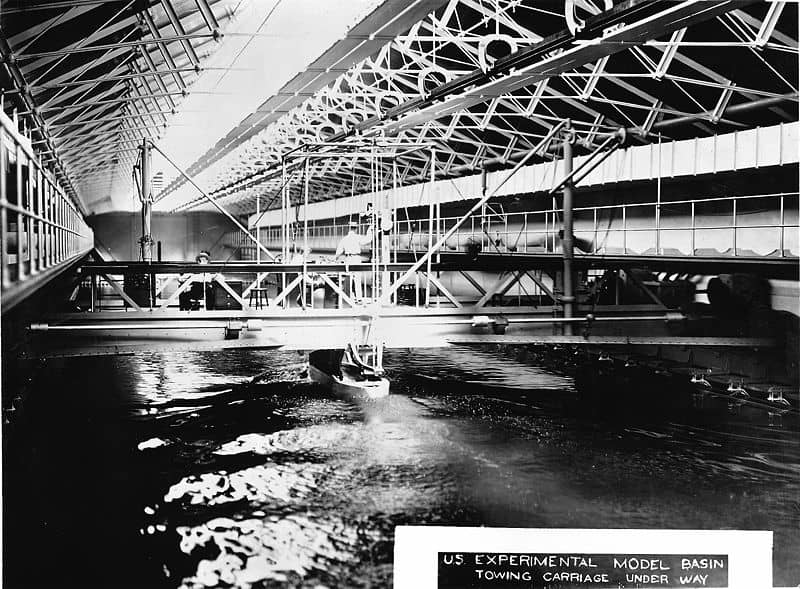
Next add the towing carriage, which is a large movable platform that stretches across the basin of water. (Figure 2‑1) Think of it as a moving laboratory that runs on rails. We tow the ship models from the carriage, but the scientists also ride on the carriage. All the sensors to record the experiment feed to computers mounted on the carriage. And these are no ordinary sensors. Everything in a towing tank demands accuracy and precision. All focused on one goal: obtaining accurate measurements from the ship model as we tow it down a basin of water.
3.0 Advanced Towing Tank Tests
The towing tank started with basic resistance and speed predictions, but as ship science advanced, our use of the towing tank also expanded. The humble towing tank now includes advanced tests for the discerning naval architect.
3.1 Seakeeping Test
The first advancement added waves to the towing tank. (Figure 3‑1) Wave generators create specific combinations of waves, which combine with the model traveling down the tank. This allows us to test the ship response to bow waves. We calculate the average increase in resistance due to waves. Most important to passenger comfort, we also measure the acceleration and magnitude of the ship’s heave and pitch. These measurements become critical for preventing seasickness.
Figure 3‑1: Example of Wave Generator [2]
The beauty behind this system is generalization. Measurements for a single wave system don’t do much good. What are the odds that you will encounter that exact combination of waves on the open ocean? Instead, designers use the towing tank measurements to generate a generic profile for the ship’s response to any wave system. Those measurements now work for anything from a gentle ripple to monster waves, but they still represent customized measurements for our specific ship.
Unfortunately, towing tanks only work for bow waves. That limitation comes from the dimensions of the towing tank; the tanks are long and narrow. We would need to turn the model sideways for beam waves or quartering waves. But if we turn the model sideways, we block the passage of the waves between the model and the sides of the tank. This blockage effect alters the wave physics and distorts the measurements.
Fortunately, bow waves happen to be relevant to many ship operators. In large storms, you point the ship’s bow into the waves. This is why most towing tanks come equipped with wave generators.
3.2 Maneuvering Coefficients Test
Towing tanks also added a maneuvering coefficients test. Imagine you designed a new submarine or warship, and you needed to guarantee precise maneuvering capability. To achieve that, you need the full maneuvering coefficients for the hull. These coefficients relate the force required for each motion of the hull. For example: you require 50 t-m to turn in yaw at 5 deg/s. And another 30 t-m to accelerate in yaw at 3 deg/s2. We combine those coefficients with some fancy math to determine how much force the rudder needs to generate, leading to a correct design for the rudder size.
Unfortunately, I just picked those numbers at random. To establish real coefficients, we need a maneuvering study.
To achieve the maneuvering study, we add a new gizmo in the towing tank: the planar motion mechanism (PMM). The PMM sways the hull side to side in a snake like motion as the carriage travels down the towing tank. (Figure 3‑2) While this happens, we record the forces that the model exerts on the PMM posts. In simple terms, the side to side motion is the input of our maneuvering motion (actually combining multiple maneuvers into one). And the sensors record the required force to achieve that motion. Add in some math to process the measurements, and we get our maneuvering coefficients.
Figure 3‑2: Planar Motion Mechanism [3]
3.3 Icebreaking Test
Even icebreakers need somewhere to go. And model scale icebreakers need model scale ice to test on. (Figure 3‑3) Specialized towing tanks include facilities to fabricate ice to the specified thickness and strength for testing. The details change, depending on the full scale ice that you need to mimic in the tank.
The model testing allows designers to record the speed through ice of various thickness, and power required. As you might expect, these facilities are expensive since you need to create new ice after every run. Imagine how long a hockey game would take if they needed to refreeze the ice rink after every play. Something similar happens in the ice tank.
https://www.youtube.com/watch?v=G18jlFS9BeU
Figure 3‑3: Example of Ice Tank Testing [4]
4.0 Maneuvering Basin
When the towing tank will not do, we need to add more water! Enter the maneuvering basin. This goes by many names: maneuvering basin, ocean basin, FloWave tank, etc. The maneuvering basin gets around the blockage problem of narrow tanks by building a WIDE and gigantic pool! (Figure 4‑1)
Figure 4‑1: Maneuvering Basin Breakdown [5]
You find maneuvering basins less commonly than towing tanks, because these mammoths come with a high price. Not just due to the size, but also from all their gadgets:
Wave makers lining the walls, ready to produce multi-directional wave spectra
Imagine two wave sets crisscrossing to produce a very complicated pattern . . . and you get real life sea conditions
Giant fans to simulate ocean wind in the worst hurricane
Massive underwater propellers to generate underwater currents, which can change direction
An adjustable tank bottom, to simulate different water depths
Maneuvering basins see most of their work in the offshore industry, testing responses of moored offshore oil rigs, floating assets, or other critical mission operations. Other applications include general seakeeping studies, similar to the towing tank, but now we have the space to check all the wave headings. In recent years, even the offshore wind industry employed the maneuvering basin to simulate the combination of marine waves and offshore wind for floating wind turbines. The common element for all these projects was large budgets and critical mission assets. You go to the maneuvering basin to answer complicated questions, when failure is not an option.
5.0 Conclusion
Maneuvering, ice testing, and seakeeping all expanded the towing tank, until we needed even more. For the truly ambitious, nothing will suffice but the all encompassing maneuvering basin. With these expanded test facilities, designers gained the ability to customize and re-imagine new tests to answer many of our modern questions in ship design. Each of these advanced facilities grew to fill new needs from redefining the capabilities of maritime technology. Advanced ship design means advanced testing. So what will we imagine next?
6.0 References
[1]
Wikimedia Authors, “Experimental Model Basin, Washington Navy Yard, Washington, DC – interior view, c. 1900. This was the first model basin (towing tank) for the United States Navy.,” Wikimedia Commons, 19 Aug 2007. . Available: https://en.wikipedia.org/wiki/File:US_Experimental_Model_Basin_-_interior_view,_c._1900.jpg. .
[2]
YouTube Creator: TalTech Meremajanduse keskus, “Small Craft Centre Towing Tank Wave Generator,” YouTube, 1 Mar 2017. . Available: https://www.youtube.com/watch?v=3LqRfEKdNdA. .
[3]
YouTube Creator: froudedude, “FFG 7 Tow Tank Model Test,” YouTube, 8 Dec 2008. . Available: https://www.youtube.com/watch?v=iHGGSdGM7Xk. .
[4]
Defense Media Network, “Scale Icebreaker Breaks Scale Ice,” YouTube, 26 Oct 2017. . Available: https://www.youtube.com/watch?v=G18jlFS9BeU. .
[5]
FloWave Ocean Energy Research Facility, “How FloWave Works Animation,” YouTube, 1 Mar 2015. . Available: https://www.youtube.com/watch?v=ePB7PVA42Fs. .
[6]
J. Carlton, Marine Propellers and Propulsion, London: Butterworth-Heinemann Publications, 2007.
[7]
FloWave Ocean Energy Research Facility, “FloWave Exhibition Video 2014,” YouTube, 1 Mar 2015. . Available: https://www.youtube.com/watch?v=WffR6HrEqTA. .
https://dmsonline.us/wp-content/uploads/2025/06/Laramie-Test-1.jpg12502000Abstrakt Marketing/wp-content/uploads/2025/06/DMS-logo.svgAbstrakt Marketing2026-08-07 08:19:052026-08-07 08:19:06Computational Fluid Dynamics (CFD): What Is It and How Is It Used in Ship Design?
https://dmsonline.us/wp-content/uploads/2025/08/Clickbait-1.jpg7201280Nicholas Barczak/wp-content/uploads/2025/06/DMS-logo.svgNicholas Barczak2025-12-02 07:07:002026-06-01 10:09:17What to Buy for a Towing Tank: Shopping List for Components
https://dmsonline.us/wp-content/uploads/2025/08/Clickbait.jpg7201280Nicholas Barczak/wp-content/uploads/2025/06/DMS-logo.svgNicholas Barczak2025-11-11 07:00:002026-06-01 10:09:18How to Buy a Towing Tank: Purchase and Design Guide
https://dmsonline.us/wp-content/uploads/2023/12/USCGC_Healy_WAGB-20_north_of_Alaska-scaled-1.jpg6331200Nate Riggins/wp-content/uploads/2025/06/DMS-logo.svgNate Riggins2024-05-14 09:00:002026-06-01 10:09:22Surviving the Arctic: Polar Class Icebreakers
https://dmsonline.us/wp-content/uploads/2022/06/Clickbait_2.63.1.jpg10801920Nate Riggins/wp-content/uploads/2025/06/DMS-logo.svgNate Riggins2022-07-11 06:00:002025-08-15 10:45:34The Value of Life
We may request cookies to be set on your device. We use cookies to let us know when you visit our websites, how you interact with us, to enrich your user experience, and to customize your relationship with our website.
Click on the different category headings to find out more. You can also change some of your preferences. Note that blocking some types of cookies may impact your experience on our websites and the services we are able to offer.
Essential Website Cookies
These cookies are strictly necessary to provide you with services available through our website and to use some of its features.
Because these cookies are strictly necessary to deliver the website, refusing them will have impact how our site functions. You always can block or delete cookies by changing your browser settings and force blocking all cookies on this website. But this will always prompt you to accept/refuse cookies when revisiting our site.
We fully respect if you want to refuse cookies but to avoid asking you again and again kindly allow us to store a cookie for that. You are free to opt out any time or opt in for other cookies to get a better experience. If you refuse cookies we will remove all set cookies in our domain.
We provide you with a list of stored cookies on your computer in our domain so you can check what we stored. Due to security reasons we are not able to show or modify cookies from other domains. You can check these in your browser security settings.
Other external services
We also use different external services like Google Webfonts, Google Maps, and external Video providers. Since these providers may collect personal data like your IP address we allow you to block them here. Please be aware that this might heavily reduce the functionality and appearance of our site. Changes will take effect once you reload the page.