Datawave Marine Solutions
  • Dms Logo
  • Services
    • Vessel Design
      • Concept Design
    • Naval Architecture
    • Advanced Analysis
    • Marine Systems
    • Civil Engineering
  • Marine Operations
    • Passenger Vessels
    • Work Boats
    • Research Boats
    • Shipyards
    • Marine Startups
    • Waterway Maintenance
    • Autonomous Vessels
  • Portfolio
  • About Us
  • Resources
    • Blog
    • GHS Tutorials
    • FAQs
  • Contact
  • Menu Menu

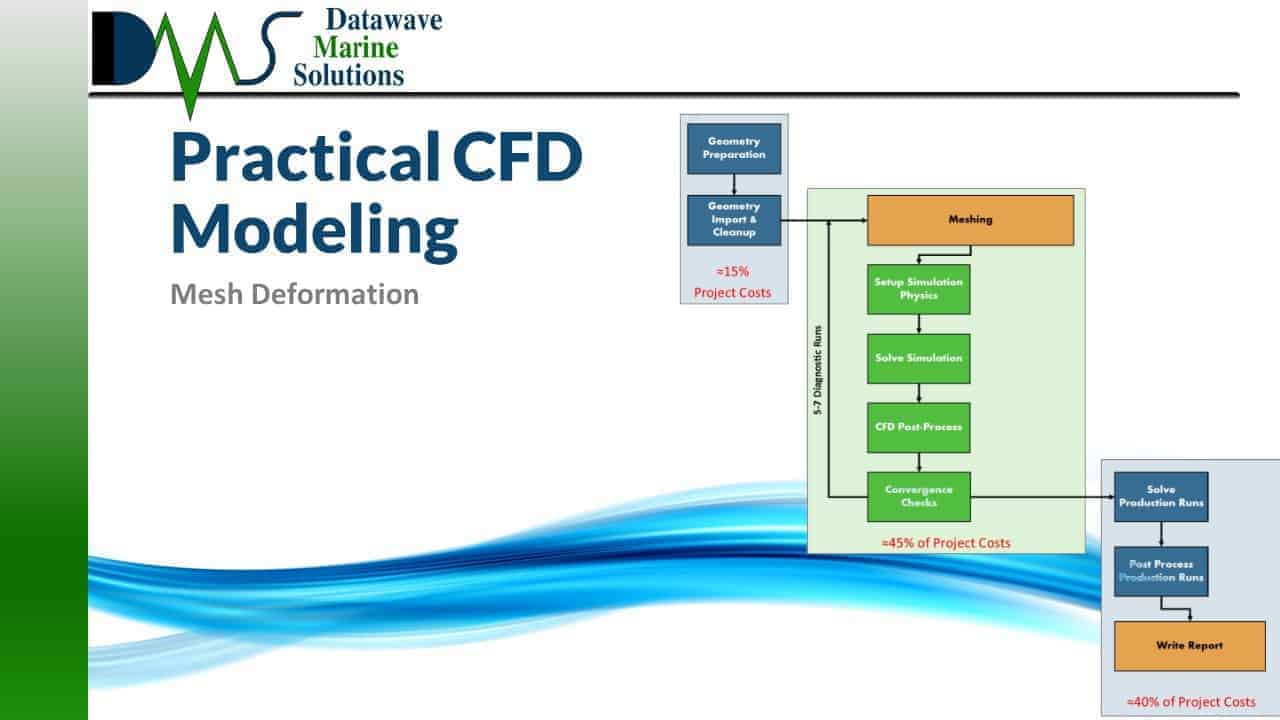
Practical CFD Modeling: Mesh Deformation

Mesh deformation is incredibly frustrating, complicated, unstable . . . and unavoidable if you want to incorporate body motions into CFD. Modeling body motion demands mesh deformation, changing the mesh on the fly, while using it to solve transport equations. As you might expect, that brings a host of new challenges. This reviews several new strategies that the CFD engineers needs to consider.

1.0 Introduction

Mesh deformation is incredibly frustrating, complicated, unstable . . . and unavoidable if you want to incorporate body motions into computational fluid dynamics. (CFD)  In some simulations, we need to move the actual body.  For example, dropping a payload from under the wing of an airplane.  The payload physically separates from the wing, while still experiencing fluid forces of airflow.  Modeling these scenarios requires mesh deformation, changing the mesh on the fly, while still using that mesh to solve transport equations.  Piece of cake, right?  Let’s discuss some practical tips for modeling mesh deformation.

2.0 General Modeling Guidance

Mesh deformation greatly destabilizes your simulation.  Expect increased residuals and large problems with simulation convergence.  Plan ample time in your project for debugging, more debugging, and still more debugging.  To combat the instability of mesh deformation, first craft your simulation without mesh deformation.  Create a rock-solid stable setup, with excellent convergence and no problems at all.  That forms the starting point to add in mesh deformation.

The problems with simulation stability arise from the changes in cell quality.  Mesh deformation cannot automatically preserve the quality of the cells in the mesh.  Cell quality deteriorates, and simulation stability suffers as a result.  But not all cell changes pose equal trouble.  Pure changes in volume remain relatively harmless.  Changes in aspect ratio are safe in moderation.  They lead to trouble when the aspect ratio starts to double from its original value.  But the greatest villain is cell skew, usually generated by rotational mesh deformation.  The key to protecting cell quality is picking the method of cell deformation.  CFD engineers attempt to format the mesh and the motion so that most cells deform in the safer modes.
3.0 General Meshing Strategy

The CFD engineer must form a new level of meshing strategy.  You must form the mesh at the beginning of the simulation to ensure a good quality mesh will result at end of the mesh deformation process.  For example, if the mesh needs to stretch linearly, you may form an extruded mesh with the cells clustered near one end.  As the mesh stretches, the concentrated cells stretch out, matching the aspect ratio on the rest of the mesh.  The CFD engineer plans to achieve a mesh at the final shape, not the initial state.

3.1 Minimize Cell Distortion

Of course, the best strategy for mesh deformation is to minimize the distortion to the individual cells.  We achieve this with large cells.  Excessively large cells.  The large volume permits large physical movement with minimal deformation to each individual cell.  Sadly, large cell size contradicts the mesh resolution requirements to accurately resolve the transport equations near the body.  Accurate resolution needs small cell sizes.  Meeting both demands ends with two regions to the mesh.  CFD engineers frequently designate an inner domain, with fine resolution mesh for the transport equations, and an outer domain used primarily to accommodate deformation and physical movement.  As a result, the domain gets even larger for mesh deformation simulations. 

3.2 Meshing for Linear Motion

When meshing for linear motion, like a piston compressing in a combustion cylinder, the main concern is elongated cell aspect ratio.  To guard against this, CFD engineers typically employ extruded meshes.  Bias the mesh in one direction, adding extra cells to accommodate the eventual mesh stretching.  When the mesh stretches, these compressed cells stretch out to a normal aspect ratio, preserving the mesh quality. 

3.3 Meshing for Rotational Motion

With rotational motion, like a ship pitching in waves, you need to minimize cell skew.  Try to maintain equal spacing between boundaries, this helps to ensure equal movement for each degree of rotation.  The best strategy is to enclose your body inside an inner domain.  Place all your major mesh refinements inside this inner domain.  The inner domain should be cylindrical or spherically shaped.  And then surround that with a much larger outer domain, also shaped as a cylinder or sphere.  The cells in the outer domain are the only cells that actually deform, leaving the entire inner domain to move as a rigid body.  This preserves cell quality near the body, giving you more freedom to mesh strictly for mesh deformation in the outer domain.

4.0 Conclusion

Mesh deformation requires patience and strategy.  The simulation will likely crash on the first attempt, and the second attempt.  The key to mesh deformation is to create extremely large cells, which creates another set of challenges that the CFD engineer works around.  Rotational motion presents one of the largest challenges in mesh deformation, because it generates skew in the mesh cells.  These are some of the many challenges that CFD engineers must balance when modeling for mesh deformation.  Like any balancing act, the trick lies with patience and practice.

5.0 References

[1] TCFD, “Axial Compressor CFD,” TCFD, 31 Dec 2018. . Available: https://www.cfdsupport.com/axial-compressor-cfd-simulation.html. .
[2] Atsushi Ueyama, “Progress of Time,” Cradle MSC Software Company, 31 Dec 2018. . Available: https://www.cradle-cfd.com/tec/column01/017.html. .
[3] YouTube Author: Holzmann CFD, “Holzmann CFD & OpenFOAM® – Dynamic Meshes in Multiphase Flows #2 (Topology Change, Ship Simulation),” YouTube, 10 Feb 2018. . Available: https://www.youtube.com/watch?v=B9KjnyDpsx0. .

Share This Post

  • Share on Facebook
  • Share on X
  • Share on WhatsApp
  • Share on Pinterest
  • Share on LinkedIn
  • Share on Tumblr
  • Share on Vk
  • Share on Reddit
  • Share by Mail

More Like This

Seakeeper Clickbait

How a Seakeeper Works: Gyro Stabilization Explained

Fluid Dynamics, Fluid Loads, Fluids, Miscellaneous, Naval Architecture, Ship Motion Control
https://dmsonline.us/wp-content/uploads/2026/03/Clickbait.jpg 720 1280 Nicholas Barczak /wp-content/uploads/2025/06/DMS-logo.svg Nicholas Barczak2026-04-07 07:00:002026-06-01 10:09:14How a Seakeeper Works: Gyro Stabilization Explained
How to Buy a Towing Tank

How to Buy a Towing Tank: Purchase and Design Guide

Fluids, Fluids Special Methods, Miscellaneous, Towing Tank
https://dmsonline.us/wp-content/uploads/2025/08/Clickbait.jpg 720 1280 Nicholas Barczak /wp-content/uploads/2025/06/DMS-logo.svg Nicholas Barczak2025-11-11 07:00:002026-06-01 10:09:18How to Buy a Towing Tank: Purchase and Design Guide
050618 G 3721c 067

Surviving the Arctic: Polar Class Icebreakers

Design Support, Fluids, Mechanical, Propulsion, Special Purpose Mechanical Systems, Structural
https://dmsonline.us/wp-content/uploads/2023/12/USCGC_Healy_WAGB-20_north_of_Alaska-scaled-1.jpg 633 1200 Nate Riggins /wp-content/uploads/2025/06/DMS-logo.svg Nate Riggins2024-05-14 09:00:002026-06-01 10:09:22Surviving the Arctic: Polar Class Icebreakers
Mackinawice1

Ramming the Ice: Icebreaker Propulsion

Energy Generation, Fluids, Hull Structure, Propulsion, Propulsion Plant, Propulsion Units, Propulsors, Structural, Transmission and Propulsor Systems
https://dmsonline.us/wp-content/uploads/2023/12/MackinawIce1-scaled-1.jpg 883 1200 Nate Riggins /wp-content/uploads/2025/06/DMS-logo.svg Nate Riggins2024-03-19 09:00:002026-06-01 10:09:22Ramming the Ice: Icebreaker Propulsion
Ever Given Repaired

Ever Given: What We Don’t Know

Command and Surveillance, Fluid Dynamics, Miscellaneous, Ship Maneuvering, Ship Motion Control, Ship Response
https://dmsonline.us/wp-content/uploads/2022/03/Ever-Given-repaired.webp 667 1000 Nate Riggins /wp-content/uploads/2025/06/DMS-logo.svg Nate Riggins2022-03-21 08:00:002025-07-23 09:49:47Ever Given: What We Don’t Know
Clickbait1 1.84.1

Stability Letters Explained

Fluids, Hydrostatics, Integration / Engineering
https://dmsonline.us/wp-content/uploads/2022/02/ClickBait1_1.84.1.jpg 1080 1920 Nate Riggins /wp-content/uploads/2025/06/DMS-logo.svg Nate Riggins2022-02-21 06:00:002025-08-15 13:17:02Stability Letters Explained
Seawise University Wreck

Free Surface Moment

Fluids, Fluids Testing, Hydrostatics, Stability Test
https://dmsonline.us/wp-content/uploads/2021/01/Seawise_University_wreck.jpg 1059 1412 Nate Riggins /wp-content/uploads/2025/06/DMS-logo.svg Nate Riggins2021-01-18 07:00:002026-06-01 10:09:25Free Surface Moment
Stability Test Pendulum Setup

Practical Stability Test: Naval Architect’s Guide

Fluids, Fluids Testing, Stability Test
https://dmsonline.us/wp-content/uploads/2021/06/PendulumSetup_500px.webp 422 500 Nate Riggins /wp-content/uploads/2025/06/DMS-logo.svg Nate Riggins2020-11-02 06:00:002026-06-01 10:09:26Practical Stability Test: Naval Architect’s Guide
Container Ship Just Exiting Port

Stability Test Theory

Fluids, Fluids Testing, Stability Test
https://dmsonline.us/wp-content/uploads/2021/06/container-ship-2893480_1920.jpg 924 1386 Nate Riggins /wp-content/uploads/2025/06/DMS-logo.svg Nate Riggins2020-10-19 06:00:002026-06-01 10:09:26Stability Test Theory
Previous Previous Previous Next Next Next

Categories

  • 3D Modeling
  • Arrangements
  • Auxiliary Systems
  • Command and Surveillance
  • Design Support
  • Drafting
  • Economics
  • Elastic Static Loading
  • Electrical
  • Energy Generation
  • Engineering Business
  • Equipment Integration
  • Fatigue
  • FEA / Numerical Methods
  • Fluid Dynamics
  • Fluid Loads
  • Fluids
  • Fluids Special Methods
  • Fluids Testing
  • Green Ship Design
  • Hiring Consultant
  • Hull Decks
  • Hull Structural Bulkheads
  • Hull Structure
  • Human Ergonomics
  • Hydrostatics
  • Insurance
  • Integration / Engineering
  • Legal
  • Marine Entrepreneurship
  • Masts, Kingposts, Service Platforms
  • Materials
  • Mechanical
  • Mechanical Handling Systems
  • Miscellaneous
  • Naval Architecture
  • Passenger Vessel
  • Piping
  • Production Engineering
  • Project Management
  • Propulsion
  • Propulsion Plant
  • Propulsion Units
  • Propulsor Shrouds and Ducts
  • Propulsors
  • Quality Assurance
  • Recreation
  • Regulations
  • Replenishment Systems
  • Resistance
  • Seakeeping / Fluid Structure Interaction
  • Shell and Supporting Structure
  • Ship Control Systems
  • Ship Maneuvering
  • Ship Motion Control
  • Ship Response
  • Shipyard And Support Services
  • Special Methods
  • Special Purpose Mechanical Systems
  • Special Purpose Structure
  • Stability Test
  • Structural
  • Support Services
  • Sustainable Marine Technology
  • Towing Tank
  • Transmission and Propulsor Systems
  • Unmanned Vessels
  • USCG
  • Vessel Design
  • Waterjet Propulsors

Our Socials

About Us

Ship designs tailored to your mission. Engineering that advances profits.

Dms Logo Negatives

What We Do

Vessel Design

Naval Architecture

Advanced Analysis

Marine Systems

Civil Engineering

Contact Us

(616) 504-1619

[email protected]

Website by Abstrakt Marketing Group ©
  • Privacy Policy
  • Sitemap
Scroll to top Scroll to top Scroll to top

This site uses cookies. By continuing to browse the site, you are agreeing to our use of cookies.

AcceptLearn more

Cookie and Privacy Settings


How we use cookies

We may request cookies to be set on your device. We use cookies to let us know when you visit our websites, how you interact with us, to enrich your user experience, and to customize your relationship with our website.

Click on the different category headings to find out more. You can also change some of your preferences. Note that blocking some types of cookies may impact your experience on our websites and the services we are able to offer.

Essential Website Cookies

These cookies are strictly necessary to provide you with services available through our website and to use some of its features.

Because these cookies are strictly necessary to deliver the website, refusing them will have impact how our site functions. You always can block or delete cookies by changing your browser settings and force blocking all cookies on this website. But this will always prompt you to accept/refuse cookies when revisiting our site.

We fully respect if you want to refuse cookies but to avoid asking you again and again kindly allow us to store a cookie for that. You are free to opt out any time or opt in for other cookies to get a better experience. If you refuse cookies we will remove all set cookies in our domain.

We provide you with a list of stored cookies on your computer in our domain so you can check what we stored. Due to security reasons we are not able to show or modify cookies from other domains. You can check these in your browser security settings.

Other external services

We also use different external services like Google Webfonts, Google Maps, and external Video providers. Since these providers may collect personal data like your IP address we allow you to block them here. Please be aware that this might heavily reduce the functionality and appearance of our site. Changes will take effect once you reload the page.

Google Webfont Settings:

Google Map Settings:

Google reCaptcha Settings:

Vimeo and Youtube video embeds:

Accept settingsHide notification only