Datawave Marine Solutions
  • Dms Logo
  • Services
    • Vessel Design
      • Concept Design
    • Naval Architecture
    • Advanced Analysis
    • Marine Systems
    • Civil Engineering
  • Marine Operations
    • Passenger Vessels
    • Work Boats
    • Research Boats
    • Shipyards
    • Marine Startups
    • Waterway Maintenance
    • Autonomous Vessels
  • Portfolio
  • About Us
  • Resources
    • Blog
    • GHS Tutorials
    • FAQs
  • Contact
  • Menu Menu

Practical Stability Test: Master’s Guide

Smooth stability tests require planning, and practicality. As the vessel Master, you want to prepare for this thing that completely disrupts vessel operations. But you are a busy person, and engineers are very long winded. Instead, this guide provides a brief overview, focusing on the major elements that concern you with a stability test.

1.0 Introduction

Unless you know the plan, stability tests look like choreographed chaos.  They completely disrupt the vessel and operations.  They frequently require that we adapt to changing conditions.  All this adds to a stressful and unpleasant experience.  Unless.  If you know the plan, things get much better.  This article provides a brief guide on stability tests:  highlighting the key points for the vessel master.

2.0 Sequence of Events

First, we should lay out the general sequence of events for a stability test.  Table 2‑1 summarizes the test events.

Event Action on Your Part
1 Receive a copy of the approved test procedure. Skim through this.  Much of the procedure contains useful information to explain coordination for the test, including contact information for all the key players.  (Some of the procedure is just boiler plate language required by regulations.)
2 (About 1 week before test) Remove deadweight items from the ship and store securely off the ship
3 Advisory Survey (About 1 week before test) Meet with the Test Coordinator.  Ask questions.  They will survey your ship and identify any deadweight items that need to come off before the test.
4 Deadweight survey (1-2 days before test) Ensure the officer on duty has someone ready to open any locked doors on the ship.
5 Day of the test Get non-essential people off the ship Arrange for: Line handlersTug / small boat
6 After the test Arrange to get a temporary stability letter from USCG so you can resume operations. Test Coordinator can help with this
Table 2‑1: General Sequence of Events

3.1 Remove Deadweight

Practically every ship carries too much deadweight for a stability test.  Some of it needs to come off and store pier-side, at least temporarily.  (This also makes a great opportunity for spring cleaning on the ship).  Shipping containers provide great options for secure storage.  Specifically focus on cleaning out three types of spaces:

  1. Bosun’s stores.
  2. Engine room tools and spares (nuts, bolts, and other small items.)
  3. Any other storage spaces.

3.2 No Ship Services

During the day of the stability test, all ship services will be offline.  No water, no galley, no toilets.  Plan for alternative arrangements that day.  Portable toilets, pack lunches / order pizza, bring jugs of water.  This may be something the Test Coordinator can handle for you.

3.3 Muster Stations During the Test

During the test, people need to stay in the same place.  But it seems a little cruel to make someone stand in one spot for the entire day, and unnecessary.  During the day of the stability test, we spend the majority of the time organizing and coordinating logistics.  Spaced throughout the day, we have brief critical periods, when the naval architects take measurements.  These are the only times when people need to be at designated locations.  The remainder of the time, everyone is free to move around the ship. 

To allow some freedom, we ask that anyone who is onboard during the test pick a location for their muster station at the beginning of the day:  someplace that they can stand while we take measurements.  Before we start the test, we record the location of every person at every muster station.  Generally, we don’t care where they are located; they just need to go back to the same location each time.

3.4 Ship’s Crane

The stability test will require a crane to move weights transversely across the deck.  In some cases, the ship has an onboard crane with sufficient capacity to move the weights.  The smart vessel owner wants to use that onboard crane and eliminate the cost of renting a pier-side crane.  In these cases, yes, we can use the onboard crane.  But the onboard crane must be returned to its stowed position each time before we can take measurements.

4.0 Deadweight Survey Access

During the deadweight survey, the Test Coordinator and their staff will need access to every room, storage compartment, and cabin on the vessel.  This includes all the locked rooms, and the storage closet that no one opened in six months.  Ensure keys are available to open all rooms and make arrangements to address any privacy concerns with crew cabins.

5.1 Fenders

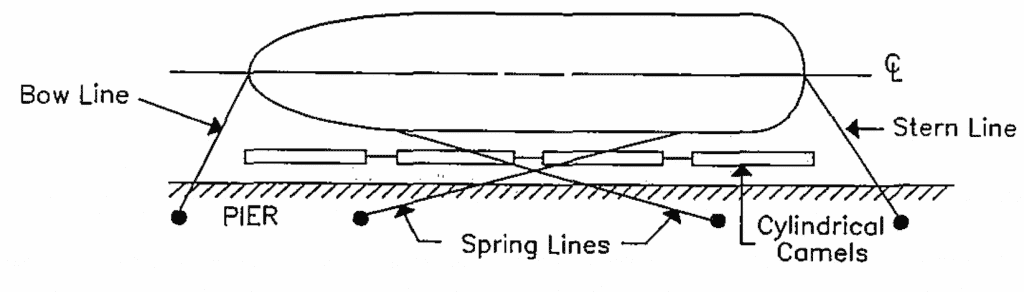
During the stability test, the mooring plan needs to let the vessel float free, without the mooring lines affecting the vessel heel in any way.  The best arrangement is a set of camels or Yokahama fenders, set at the waterline.  (Current waterline of the vessel, not the painted waterline.)

5.2 Mooring Lines

Figure 5‑1 shows a typical mooring arrangement for the stability test.

During the stability test, tension from the mooring lines may heel the vessel just a tiny amount, which biases the test results.  The easiest solution is to slack the mooring lines before each measurement.  Slack means very slack, with lots of droop, almost touching the water.  The sequence for slacking lines will go like this:

  1. Test Coordinator gets ready to take a measurement and signals that lines need to now be slack.
  2. When ready, Master commands all lines go dead slack (the vessel usually drifts a slight amount).
    1. If no fenders were used, the vessel will be pulled away from the pier at this point.
  3. Coordinator takes measurement.  This usually takes 1 – 2 minutes.
  4. Measurement done.  Master commands tension in the lines and stops any vessel motions.
  5. Re-position vessel and prepare to repeat for next measurement.
Mooring Arrangement

6.0 Personnel

Anyone not directly involved in the stability test needs to be off the vessel on the day of the stability test.  This includes crew, shipyard workers, and visitors.  Once the test starts, the gangway is removed, and no one can get on or off the vessel until the test finishes.  People on-board should prepare for a long day.  The test typically takes around 8 hours to finish, but in extreme cases may go as long as 16 – 18 hours.  All ship services will be offline during the test.  No water, no galley, no toilets.  Everyone is encouraged to pack some food and water near their station to eat during the day. 

7.0 Conclusion

Smooth stability tests require planning, and practicality.  This guide highlighted some of the more common practical concerns for a stability test.  Be sure to talk with your Test Coordinator.  Ask questions, clarify division of labor.  I wish you a smooth and successful stability test.

8.0 References

[1] ASTM, “Standard Guide for Conducting a Stability Test (Lightweight Survey and Inclining Experiment) to Determine the Light Ship Displacement and Centers of Gravity of a Vessel,” ASTM F1321-92, West Conshohocken, PA, 2004.
[2] Marine Safety Center, “Lightship Change Determination: Weight – Moment Calculations vs. Deadweight Survey vs. Full Stability Test,” in Marine Safety Center Technical Note (MTN) No. 04-95, Ch-2, Washington, DC, United States Coast Guard, Jan 11, 2016.
[3] United States Coast Guard, “Stability Tests (46 CFR 170, Subpart F),” Marine Safety Manual, vol. VI, pp. 6-18 to 6-27, Sep 29, 2004.
[4] United States Coast Guard, “MSC Guidelines for the Submission of Stability Test Procedures,” Procedure Number: GEN-05, Washington D.C., Sep 27, 2012.
[5] A. Kumar, “Ship Stability: Stiff and Tender Ship, Angle of Loll & Inclining Experiment,” Mariner Desk, 11 Dec 2017. . Available: https://www.marinerdesk.com/stiff-and-tender-ship/. .
[6] Wikipedia Authors, “Garage Workbench Clutter,” Wikimedia Commons, 05 Dec 2019. . Available: https://commons.wikimedia.org/wiki/File:Garage_Workbench_Clutter.jpg. .
[7] Wikipedia Authors, “2016 Port de Barcelona,” Wikimedia Commons, 28 Jul 2016. . Available: https://commons.wikimedia.org/wiki/File:2016_Port_de_Barcelona_-_70.jpg. .
[8] Wikipedia Authors, “Pota Potty by David Shankbone,” Wikimedia Commons, 14 May 2007. . Available: https://commons.wikimedia.org/wiki/File:Porta_Potty_by_David_Shankbone.jpg. .
[9] Wikipedia Authors, “North Korea – Workers as Taedong River,” Wikimedia Commons, 16 Mar 2014. . Available: https://commons.wikimedia.org/wiki/File:North_Korea_-_Workers_at_Taedong_River_(5822416464).jpg#filelinks. .

Share This Post

  • Share on Facebook
  • Share on X
  • Share on WhatsApp
  • Share on Pinterest
  • Share on LinkedIn
  • Share on Tumblr
  • Share on Vk
  • Share on Reddit
  • Share by Mail

More Like This

Seakeeper Clickbait

How a Seakeeper Works: Gyro Stabilization Explained

Fluid Dynamics, Fluid Loads, Fluids, Miscellaneous, Naval Architecture, Ship Motion Control
https://dmsonline.us/wp-content/uploads/2026/03/Clickbait.jpg 720 1280 Nicholas Barczak /wp-content/uploads/2025/06/DMS-logo.svg Nicholas Barczak2026-04-07 07:00:002026-06-01 10:09:14How a Seakeeper Works: Gyro Stabilization Explained
When Do You Need A Vessel Stability Test

When Do You Need a Vessel Stability Test? Understanding Requirements, Risks, and Your Options

Stability Test
https://dmsonline.us/wp-content/uploads/2026/02/When-Do-You-Need-a-Vessel-Stability-Test.jpg 1250 2000 Abstrakt Marketing /wp-content/uploads/2025/06/DMS-logo.svg Abstrakt Marketing2026-02-25 15:02:392026-06-01 10:09:16When Do You Need a Vessel Stability Test? Understanding Requirements, Risks, and Your Options
Laramie Test 4

Why Vessel Stability Tests Are Essential for Safe Marine Operations

Stability Test
https://dmsonline.us/wp-content/uploads/2025/06/Laramie-Test-4.jpg 1250 2000 Abstrakt Marketing /wp-content/uploads/2025/06/DMS-logo.svg Abstrakt Marketing2026-02-25 14:54:082026-06-01 10:09:16Why Vessel Stability Tests Are Essential for Safe Marine Operations
Understanding Stability Basics For First Time Vessel Owners

Vessel Stability Basics: A Crash Course

Naval Architecture, Stability Test
https://dmsonline.us/wp-content/uploads/2026/01/Understanding-Stability-Basics-for-First-Time-Vessel-Owners.jpg 1250 2000 Abstrakt Marketing /wp-content/uploads/2025/06/DMS-logo.svg Abstrakt Marketing2025-12-19 13:50:392026-06-01 10:09:17Vessel Stability Basics: A Crash Course
How to Buy a Towing Tank

How to Buy a Towing Tank: Purchase and Design Guide

Fluids, Fluids Special Methods, Miscellaneous, Towing Tank
https://dmsonline.us/wp-content/uploads/2025/08/Clickbait.jpg 720 1280 Nicholas Barczak /wp-content/uploads/2025/06/DMS-logo.svg Nicholas Barczak2025-11-11 07:00:002026-06-01 10:09:18How to Buy a Towing Tank: Purchase and Design Guide
050618 G 3721c 067

Surviving the Arctic: Polar Class Icebreakers

Design Support, Fluids, Mechanical, Propulsion, Special Purpose Mechanical Systems, Structural
https://dmsonline.us/wp-content/uploads/2023/12/USCGC_Healy_WAGB-20_north_of_Alaska-scaled-1.jpg 633 1200 Nate Riggins /wp-content/uploads/2025/06/DMS-logo.svg Nate Riggins2024-05-14 09:00:002026-06-01 10:09:22Surviving the Arctic: Polar Class Icebreakers
Mackinawice1

Ramming the Ice: Icebreaker Propulsion

Energy Generation, Fluids, Hull Structure, Propulsion, Propulsion Plant, Propulsion Units, Propulsors, Structural, Transmission and Propulsor Systems
https://dmsonline.us/wp-content/uploads/2023/12/MackinawIce1-scaled-1.jpg 883 1200 Nate Riggins /wp-content/uploads/2025/06/DMS-logo.svg Nate Riggins2024-03-19 09:00:002026-06-01 10:09:22Ramming the Ice: Icebreaker Propulsion
Clickbait1 1.84.1

Stability Letters Explained

Fluids, Hydrostatics, Integration / Engineering
https://dmsonline.us/wp-content/uploads/2022/02/ClickBait1_1.84.1.jpg 1080 1920 Nate Riggins /wp-content/uploads/2025/06/DMS-logo.svg Nate Riggins2022-02-21 06:00:002025-08-15 13:17:02Stability Letters Explained
Seawise University Wreck

Free Surface Moment

Fluids, Fluids Testing, Hydrostatics, Stability Test
https://dmsonline.us/wp-content/uploads/2021/01/Seawise_University_wreck.jpg 1059 1412 Nate Riggins /wp-content/uploads/2025/06/DMS-logo.svg Nate Riggins2021-01-18 07:00:002026-06-01 10:09:25Free Surface Moment
Previous Previous Previous Next Next Next

Categories

  • 3D Modeling
  • Arrangements
  • Auxiliary Systems
  • Command and Surveillance
  • Design Support
  • Drafting
  • Economics
  • Elastic Static Loading
  • Electrical
  • Energy Generation
  • Engineering Business
  • Equipment Integration
  • Fatigue
  • FEA / Numerical Methods
  • Fluid Dynamics
  • Fluid Loads
  • Fluids
  • Fluids Special Methods
  • Fluids Testing
  • Green Ship Design
  • Hiring Consultant
  • Hull Decks
  • Hull Structural Bulkheads
  • Hull Structure
  • Human Ergonomics
  • Hydrostatics
  • Insurance
  • Integration / Engineering
  • Legal
  • Marine Entrepreneurship
  • Masts, Kingposts, Service Platforms
  • Materials
  • Mechanical
  • Mechanical Handling Systems
  • Miscellaneous
  • Naval Architecture
  • Passenger Vessel
  • Piping
  • Production Engineering
  • Project Management
  • Propulsion
  • Propulsion Plant
  • Propulsion Units
  • Propulsor Shrouds and Ducts
  • Propulsors
  • Quality Assurance
  • Recreation
  • Regulations
  • Replenishment Systems
  • Resistance
  • Seakeeping / Fluid Structure Interaction
  • Shell and Supporting Structure
  • Ship Control Systems
  • Ship Maneuvering
  • Ship Motion Control
  • Ship Response
  • Shipyard And Support Services
  • Special Methods
  • Special Purpose Mechanical Systems
  • Special Purpose Structure
  • Stability Test
  • Structural
  • Support Services
  • Sustainable Marine Technology
  • Towing Tank
  • Transmission and Propulsor Systems
  • Unmanned Vessels
  • USCG
  • Vessel Design
  • Waterjet Propulsors

Our Socials

About Us

Ship designs tailored to your mission. Engineering that advances profits.

Dms Logo Negatives

What We Do

Vessel Design

Naval Architecture

Advanced Analysis

Marine Systems

Civil Engineering

Contact Us

(616) 504-1619

[email protected]

Website by Abstrakt Marketing Group ©
  • Privacy Policy
  • Sitemap
Scroll to top Scroll to top Scroll to top

This site uses cookies. By continuing to browse the site, you are agreeing to our use of cookies.

AcceptLearn more

Cookie and Privacy Settings


How we use cookies

We may request cookies to be set on your device. We use cookies to let us know when you visit our websites, how you interact with us, to enrich your user experience, and to customize your relationship with our website.

Click on the different category headings to find out more. You can also change some of your preferences. Note that blocking some types of cookies may impact your experience on our websites and the services we are able to offer.

Essential Website Cookies

These cookies are strictly necessary to provide you with services available through our website and to use some of its features.

Because these cookies are strictly necessary to deliver the website, refusing them will have impact how our site functions. You always can block or delete cookies by changing your browser settings and force blocking all cookies on this website. But this will always prompt you to accept/refuse cookies when revisiting our site.

We fully respect if you want to refuse cookies but to avoid asking you again and again kindly allow us to store a cookie for that. You are free to opt out any time or opt in for other cookies to get a better experience. If you refuse cookies we will remove all set cookies in our domain.

We provide you with a list of stored cookies on your computer in our domain so you can check what we stored. Due to security reasons we are not able to show or modify cookies from other domains. You can check these in your browser security settings.

Other external services

We also use different external services like Google Webfonts, Google Maps, and external Video providers. Since these providers may collect personal data like your IP address we allow you to block them here. Please be aware that this might heavily reduce the functionality and appearance of our site. Changes will take effect once you reload the page.

Google Webfont Settings:

Google Map Settings:

Google reCaptcha Settings:

Vimeo and Youtube video embeds:

Accept settingsHide notification only