Stability Fails at Seakeeping
Stability and seakeeping are frequently misunderstood. To understand the limits of these sciences, we must unveil the motivation behind their development. How to guarantee ship safety on an uncertain ocean?
Stability and seakeeping are frequently misunderstood. To understand the limits of these sciences, we must unveil the motivation behind their development. How to guarantee ship safety on an uncertain ocean?
Why would I refuse a client who asked me to relate a stability analysis to seakeeping predictions? This innocent question encroached into the void between stability analysis and seakeeping. Many people misunderstand the limits of these sciences. I see stability analysis and seakeeping as tools to aid the master of the ship, not as restrictions or guarantees. To understand the boundaries of these sciences, we must unveil the motivation behind their development. It began with a basic engineering question: how to guarantee ship safety on an uncertain ocean? Stability and seakeeping developed as two approaches to answer this question, and neither approach fully predicted safety.
To guarantee safety, naval architects first needed methods to predict ship motions. This ventured into the field of dynamics: predicting behavior of moving objects. Dynamics refined the subject of ship motions into two fields of study: the magnitude of motion, and will things return to normal? The branch of seakeeping analysis predicted the magnitude of ship motions. And stability analysis addressed the question of returning to normal (upright).
Seakeeping predicted typical magnitudes of response, given a specified wave system. But this was only accurate for small ship motions. (The definition of small motion requires a more extensive discussion on seakeeping, which is beyond this article.) Stability analysis stepped in to predict large responses to single events. Stability analysis focused on safety in extreme events. We don’t need to know the exact motion second by second. Instead, the naval architect just needed to ensure that the ship did not capsize. These two strategies allowed efficient approaches to address the overarching question of ship motions.
We begin the see the divergence of stability and seakeeping. Refinement of these two sciences uncovered further complications that lead to greater separation.
Stability essentially asks: if the ship gets hit by a wave, will it come back upright? The answer depended on the magnitude of the wave, and a host of other factors. Compound this with a range of ship loading conditions and trims. When predicting stability, a ship presented like an infinitely variable machine, constantly changing the specific details. We had the math to analyze any specific combination, but how to encompass every single situation?
Seakeeping offered different challenges. The problem of seakeeping centered on the weather: we can’t guarantee it. Guarantees are important when protecting human lives. Ship science possessed the tools to predict the ship’s response to any given wave. But no one could predict exactly which waves the ship encountered on any given day. This was why any honest prediction of seakeeping included a probability level associated with each prediction.
Both seakeeping and stability suffered from the uncertainty of waves and weather. We had the science to predict each scenario, but how to select the right scenario that guaranteed safety? All the seakeeping models required us to select a probability level when predicting the weather. Which probability do you pick? Do you want a 10% chance that the ship will sink? 2%? How lucky do you feel?
We cannot approach the safety of the ship like a night of gambling. Seakeeping offered no guarantees, only probable predictions. Predictions were useful, but to protect life we needed more certainty. Stability analysis held the potential for that certainty, but it depended on selecting the right test conditions. We needed a new way to measure stability, separated from the weather forecast.
Naval architects quickly realized that stability was too complicated to provide a universal guarantee of safety. The unsinkable ship never exists. But how to address the question of ship safety? We still needed some reliable indicator.
Naval architects developed a new strategy for ship stability. Instead of guaranteeing absolute safety, we focused on an achievable goal: reasonable safety. Still in practice today, modern stability aimed to provide the vessel master with guidelines on the vessel limits, instead of promising an unsinkable ship. We then trusted the master to operate the ship safely, aided by those guidelines.
But the weather remained a problem. A robust stability analysis required us to consider every major weather condition. This quickly multiplied into thousands of analysis cases; far too onerous for a regular stability analysis. Instead, naval architects reviewed the properties of dozens of vessel casualties. We focused on various stability criteria that could be easily measured and compared the distribution of those casualties against these criteria. (Figure 3‑1)
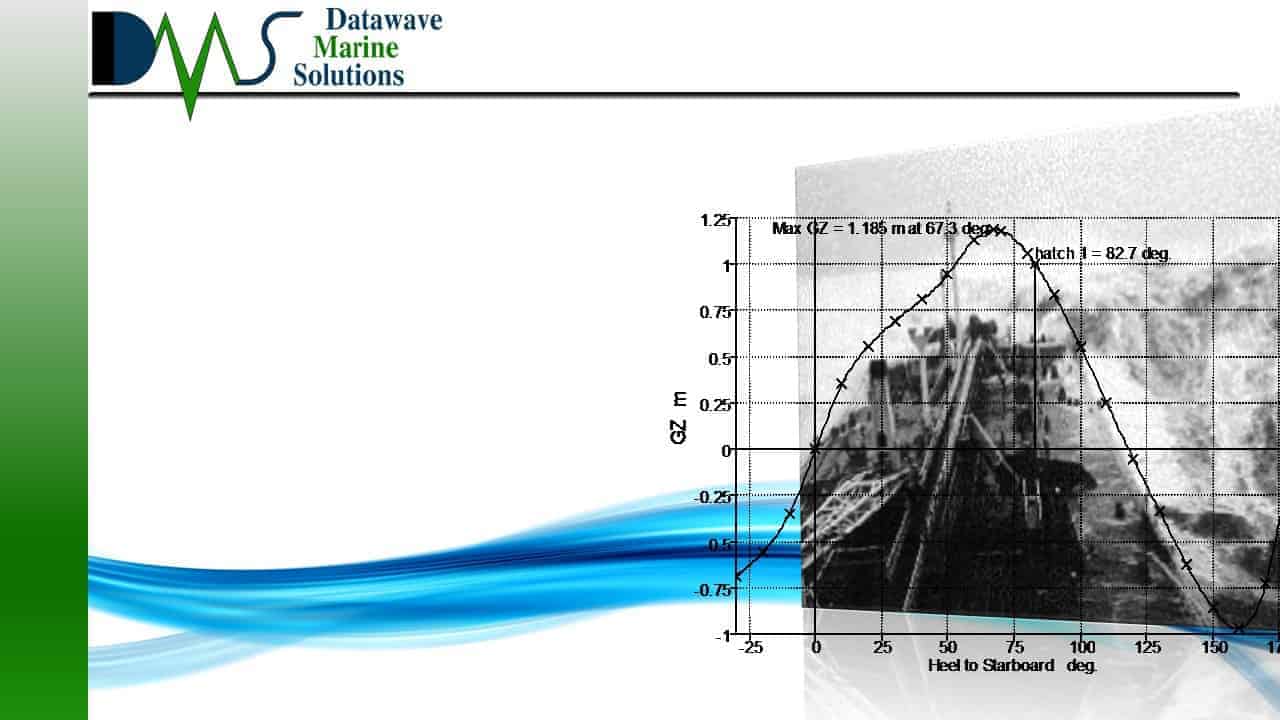
The GZ curve became the primary tool of measurement. It measured the amount of righting moment generated as the hull heeled over. (Figure 3‑2) Even better, the GZ curve factored out the ship displacement. Compared on this basis, all vessels had the same general shape for a GZ curve. This formed the basis to compare ships and decide what made a ship “safe”.
Trends began to emerge from comparing GZ curves. Based on these trends, regulatory groups developed a series of regulations. In the USA, the US Coast Guard took charge. Internationally, the IMO was responsible. Each country had similar regulatory bodies, all writing rules. Each set of rules addressed a specific scenario or concern.
For example, 46 CFR 170.170 provided general regulations to handle typical ocean weather. [2] Something more specific, 46 CFR 171.050 addressed passenger heeling moments. [3] This applied to large cruise ships or ferries. If hundreds of passengers ran to one side due to some attraction, that generated a large heeling moment. Thanks to the regulations, we already measured and predicted the ship response to this scenario.
The key word here is measurable. Each regulation gave equations to describe required characteristics for the GZ curve. We can measure the GZ curve and predict it at the design stage. It created a consistent metric to measure the safety of ship motions. Some people may disagree on the minimum levels for stability, but at least we all use the same measurement methods.
This consistency was extremely important for the masters of the vessels. As they travel from one ship to the next, their experience still applied. All vessels were designed to the same standard of stability requirements. Each ship was still a little different, and masters learned the quirks of their own ship. But the stability regulations made those ships relatively similar in how they handled on the ocean. These rules gave the vessel master the tools to create informed decisions about their own vessel safety.


Stability regulations provided a tool, but not the absolute guarantee of safety. This is why naval architects get very careful with our words when discussing stability. We can’t guarantee that the ship “is safe”; we can only promise that it meets the regulations. Stability shifted its focus to a discussion of legal requirements.
Naval architects also avoid comparisons between seakeeping and stability, because the disciplines addressed separate goals. Seakeeping examined vessel motions from the perspective of comfort and operability. Seasick passengers were far less dangerous than a sinking ship, so we tolerated some uncertainty in those predictions. But stability addressed safety and guarantees of survival. We intentionally separated it from ocean weather and seakeeping.
Short of perfection, the stability rules give the master of the vessel the tools to decide their own fate. When a naval architect performs a stability analysis, they create operating limits to keep the ship within the expectations of a good seaworthy ship. But the naval architect can’t quantify the limits of “seaworthy”. The master decides those limits, based on their specific situation: weather for the day, loading condition, geographic region, nearby vessel traffic, vessel maintenance. They utilize their expertise to ensure safe operation, supported by the tools of the stability analysis.
It falls short of a perfect system. But when we remember the intention and limitations of stability and seakeeping, we arm the master with consistent guidance, rather than unrealistic expectations.
| [1] | Maritime Safety Committee, “Explanatory Notes to the International Code on Intact Stability, 2008,” MSC.1/Circ.1281, London, UK, 9 December 2008. |
| [2] | US Code of Federal Regulations, “Weather Criteria,” 46 CFR 170.170, Washington, D.C. USA, 2018. |
| [3] | US Code of Federal Regulations, “Passenger Heel Requirements for a Mechanically Propelled or a Non-Self Propelled Vessel,” 46 CFR 171.050, Washington, D.C., USA, 2018. |
| [4] | J. Journee and W. W. Massie, Offshore Hydromechanics, First Edition, Amsterdam, January 2001. |
| [5] | Wikipedia Authors, “Hurricane Rita Lake Charles Radar,” Wikimedia Commons, 24 September 2005. . Available: https://commons.wikimedia.org/wiki/File:Hurricane_Rita_Lake_Charles_radar.gif. . |
 https://dmsonline.us/wp-content/uploads/2026/10/How-to-Know-When-You-Need-a-Seakeeping-Analysis.jpg
1250
2000
Abstrakt Marketing
/wp-content/uploads/2025/06/DMS-logo.svg
Abstrakt Marketing2026-10-08 11:18:482026-10-08 11:18:50How to Know When You Need a Seakeeping Analysis
https://dmsonline.us/wp-content/uploads/2026/10/How-to-Know-When-You-Need-a-Seakeeping-Analysis.jpg
1250
2000
Abstrakt Marketing
/wp-content/uploads/2025/06/DMS-logo.svg
Abstrakt Marketing2026-10-08 11:18:482026-10-08 11:18:50How to Know When You Need a Seakeeping Analysis https://dmsonline.us/wp-content/uploads/2026/03/Clickbait.jpg
720
1280
Nicholas Barczak
/wp-content/uploads/2025/06/DMS-logo.svg
Nicholas Barczak2026-04-07 07:00:002026-06-01 10:09:14How a Seakeeper Works: Gyro Stabilization Explained
https://dmsonline.us/wp-content/uploads/2026/03/Clickbait.jpg
720
1280
Nicholas Barczak
/wp-content/uploads/2025/06/DMS-logo.svg
Nicholas Barczak2026-04-07 07:00:002026-06-01 10:09:14How a Seakeeper Works: Gyro Stabilization Explained https://dmsonline.us/wp-content/uploads/2024/06/Research-Drone-ChancePicture.jpg
1250
2000
Abstrakt Marketing
/wp-content/uploads/2025/06/DMS-logo.svg
Abstrakt Marketing2026-03-27 15:51:192026-06-01 10:09:16Drone Design Considerations for an Autonomous Vessel Focused on Seabed Mapping
https://dmsonline.us/wp-content/uploads/2024/06/Research-Drone-ChancePicture.jpg
1250
2000
Abstrakt Marketing
/wp-content/uploads/2025/06/DMS-logo.svg
Abstrakt Marketing2026-03-27 15:51:192026-06-01 10:09:16Drone Design Considerations for an Autonomous Vessel Focused on Seabed Mapping https://dmsonline.us/wp-content/uploads/2025/08/Clickbait.jpg
720
1280
Nicholas Barczak
/wp-content/uploads/2025/06/DMS-logo.svg
Nicholas Barczak2025-11-11 07:00:002026-06-01 10:09:18How to Buy a Towing Tank: Purchase and Design Guide
https://dmsonline.us/wp-content/uploads/2025/08/Clickbait.jpg
720
1280
Nicholas Barczak
/wp-content/uploads/2025/06/DMS-logo.svg
Nicholas Barczak2025-11-11 07:00:002026-06-01 10:09:18How to Buy a Towing Tank: Purchase and Design Guide https://dmsonline.us/wp-content/uploads/2023/12/USCGC_Healy_WAGB-20_north_of_Alaska-scaled-1.jpg
633
1200
Nate Riggins
/wp-content/uploads/2025/06/DMS-logo.svg
Nate Riggins2024-05-14 09:00:002026-06-01 10:09:22Surviving the Arctic: Polar Class Icebreakers
https://dmsonline.us/wp-content/uploads/2023/12/USCGC_Healy_WAGB-20_north_of_Alaska-scaled-1.jpg
633
1200
Nate Riggins
/wp-content/uploads/2025/06/DMS-logo.svg
Nate Riggins2024-05-14 09:00:002026-06-01 10:09:22Surviving the Arctic: Polar Class Icebreakers https://dmsonline.us/wp-content/uploads/2023/12/MackinawIce1-scaled-1.jpg
883
1200
Nate Riggins
/wp-content/uploads/2025/06/DMS-logo.svg
Nate Riggins2024-03-19 09:00:002026-06-01 10:09:22Ramming the Ice: Icebreaker Propulsion
https://dmsonline.us/wp-content/uploads/2023/12/MackinawIce1-scaled-1.jpg
883
1200
Nate Riggins
/wp-content/uploads/2025/06/DMS-logo.svg
Nate Riggins2024-03-19 09:00:002026-06-01 10:09:22Ramming the Ice: Icebreaker Propulsion https://dmsonline.us/wp-content/uploads/2022/06/MVAltairGeneralArrangementPlan_SmallResolution.webp
299
640
Nate Riggins
/wp-content/uploads/2025/06/DMS-logo.svg
Nate Riggins2022-09-12 06:00:002025-09-30 07:31:20How to Design a Ship
https://dmsonline.us/wp-content/uploads/2022/06/MVAltairGeneralArrangementPlan_SmallResolution.webp
299
640
Nate Riggins
/wp-content/uploads/2025/06/DMS-logo.svg
Nate Riggins2022-09-12 06:00:002025-09-30 07:31:20How to Design a Ship https://dmsonline.us/wp-content/uploads/2022/02/ClickBait1_1.84.1.jpg
1080
1920
Nate Riggins
/wp-content/uploads/2025/06/DMS-logo.svg
Nate Riggins2022-02-21 06:00:002025-08-15 13:17:02Stability Letters Explained
https://dmsonline.us/wp-content/uploads/2022/02/ClickBait1_1.84.1.jpg
1080
1920
Nate Riggins
/wp-content/uploads/2025/06/DMS-logo.svg
Nate Riggins2022-02-21 06:00:002025-08-15 13:17:02Stability Letters Explained https://dmsonline.us/wp-content/uploads/2021/01/Seawise_University_wreck.jpg
1059
1412
Nate Riggins
/wp-content/uploads/2025/06/DMS-logo.svg
Nate Riggins2021-01-18 07:00:002026-06-01 10:09:25Free Surface Moment
https://dmsonline.us/wp-content/uploads/2021/01/Seawise_University_wreck.jpg
1059
1412
Nate Riggins
/wp-content/uploads/2025/06/DMS-logo.svg
Nate Riggins2021-01-18 07:00:002026-06-01 10:09:25Free Surface Moment