• Dms Logo
  • Services
    • Vessel Design
      • Concept Design
    • Naval Architecture
    • Advanced Analysis
    • Marine Systems
    • Civil Engineering
  • Marine Operations
    • Passenger Vessels
    • Work Boats
    • Research Boats
    • Shipyards
    • Marine Startups
    • Waterway Maintenance
    • Autonomous Vessels
  • Portfolio
  • About Us
  • Resources
    • Blog
    • GHS Tutorials
    • FAQs
  • Contact
  • Menu Menu

The Hidden Enemy Below the Waterline: How Marine Corrosion Works and How Engineers Fight It

Corrosion can be one of the most expensive failure modes in the marine industry. It’s not that corrosion is unpredictable, it’s that it’s too often treated as a maintenance problem instead of a design problem. Vessels that end up with serious corrosion damage usually were designed poorly, without enough attention to how materials, systems, and the marine environment interact over time.

Understanding how corrosion works is the first step toward preventing it. Here’s what’s actually happening below the waterline and what you can do about it.

What Marine Corrosion Actually Is

Corrosion is an electrochemical process. Metals naturally want to return to a more stable state (their oxidized form) and the marine environment provides near-optimal conditions for that process to accelerate. It goes beyond rust, and it doesn’t only affect steel.

The three types that matter most in marine applications:

Uniform corrosion involves Oxygen as the corrosive agent. It is general surface degradation across a broad area. It’s the most visible form and the easiest to monitor, but it can still cause significant material loss over time, particularly on steel hulls and unprotected fittings.

Galvanic corrosion is caused by dissimilar metals in electrical contact through an electrolyte. Saltwater is an excellent electrolyte, which is why this type is so prevalent and destructive in marine environments. More on this below.

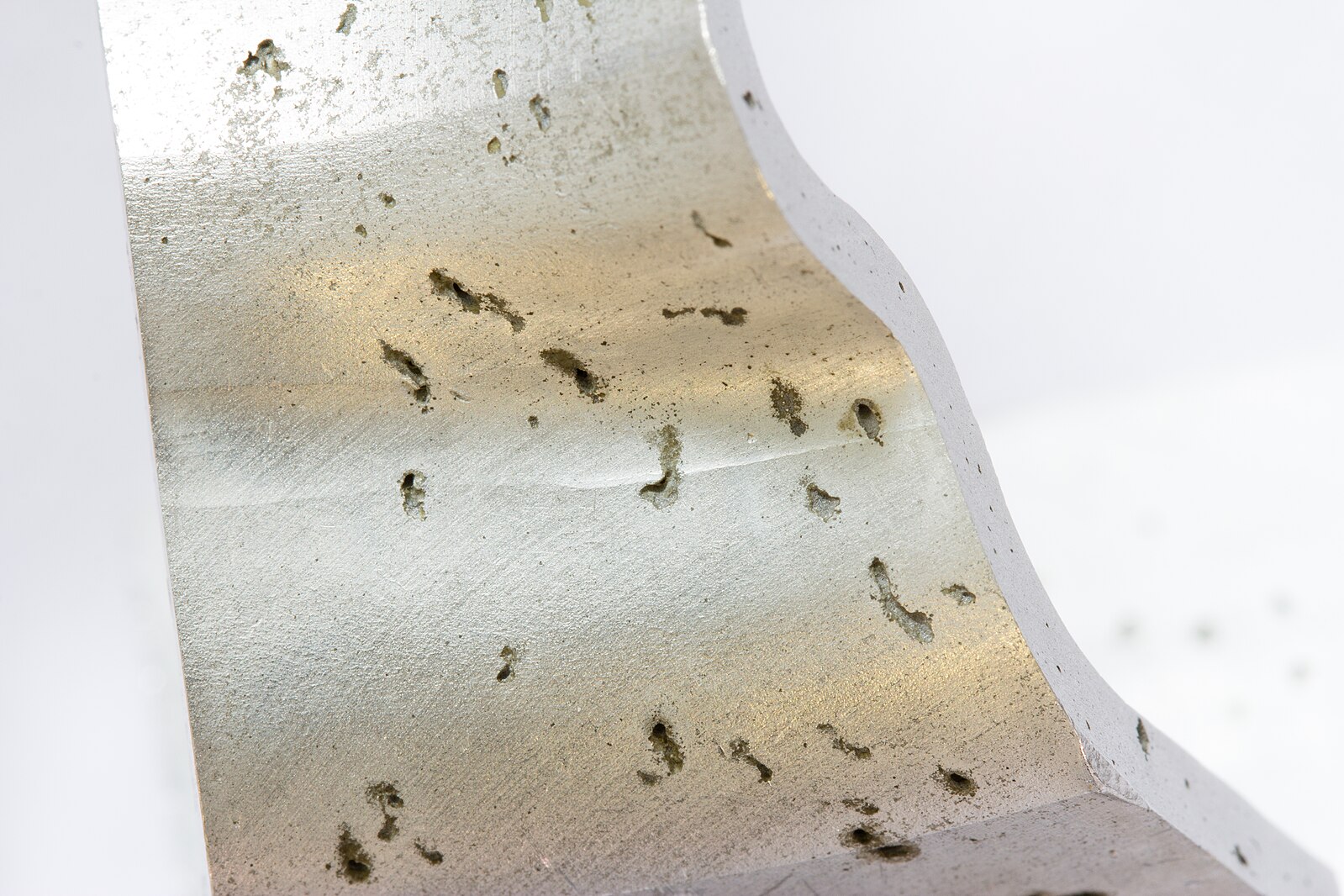
Crevice corrosion again uses Oxygen. But now it focuses on a localized attack in tight spaces, under gaskets, beneath fouling, or in areas where oxygen levels differ from surrounding surfaces. This type is particularly insidious because the damage is often hidden and progresses faster than surface appearance suggests.

Each type requires a different response, which is why treating corrosion as a single problem to be solved with a single solution rarely works as well as a more systematic approach.

Why Saltwater Makes Everything Worse

Fresh water corrodes metals too, but saltwater does it faster and more aggressively. The reasons are electrochemical: dissolved salts increase the conductivity of the water, which accelerates the flow of current between dissimilar metals and speeds up the underlying reactions.

Several other factors compound the problem in the marine environment:

  • Dissolved oxygen levels in seawater vary with temperature and depth, creating the differential oxygen concentrations that drive crevice corrosion.
  • Biological fouling like barnacles, algae, and biofilm create localized chemical environments that can accelerate corrosion and undermine coatings.
  • The splash zone, where a vessel cycles repeatedly between wet and dry, sees some of the most aggressive corrosion activity. The combination of oxygen, moisture, and salt creates conditions that neither fully submerged nor fully dry surfaces experience.
  • Temperature variation affects both the rate of electrochemical reactions and the performance of protective coatings, particularly on vessels that operate across different climate zones.

The marine environment is variably harsh in ways that require proactive, design-level thinking, not just maintenance reactions.

Galvanic Corrosion: The One That Sinks Budgets

Of all the corrosion mechanisms in the marine environment, galvanic corrosion is the one most likely to cause expensive, premature failures — and the one most often created by design or installation decisions rather than simple wear.

The mechanics are straightforward. Every metal has a natural electrical potential. When two metals with different potentials are placed in electrical contact and immersed in an electrolyte, a current flows between them. The less noble metal becomes the anode and corrodes preferentially. The more noble metal is protected at the anode’s expense.

This is the galvanic series in action. Bronze is more noble than aluminum. Stainless steel is more noble than mild steel. Carbon fiber is more noble than almost everything. When these materials are in contact in a marine environment, the less noble material corrodes, sometimes rapidly.

The practical problem is that modern vessels are full of mixed-metal connections. A bronze through-hull in an aluminum hull. Stainless steel fasteners in an aluminum deck fitting. Carbon fiber structural members bonded near aluminum frames. Each of these creates a galvanic cell, and each one requires either isolation, cathodic protection, or material substitution to manage effectively.

What makes galvanic corrosion particularly costly is the combination of location and speed. It tends to attack structural and safety-critical components and can progress quickly when the galvanic couple is significant and the electrolyte conductivity is high. A fitting that looks sound from the outside may be severely compromised internally.

Concerned about corrosion exposure on a new build or existing vessel? DMS can help you evaluate the risk and design a prevention strategy that holds up over time.

Schedule a Consultation

How Engineers Fight It: Marine Corrosion Prevention Strategies

Marine corrosion prevention isn’t a single action—it’s a layered strategy that addresses different corrosion mechanisms through different means. The most effective approaches combine several tools rather than relying on any one.

Material selection is the foundation. Choosing compatible metals, specifying alloys with appropriate corrosion resistance for the application, and avoiding galvanic couples where possible eliminates a large share of the risk before any protective system is required. This is a design-phase decision, and getting it right is far more effective than compensating for poor material choices with coatings or anodes later.

Coatings and barrier protection slow the rate of uniform corrosion and protect metal surfaces from direct contact with seawater. Epoxy barrier coats, antifouling systems, and specialized marine coatings all play a role. Coatings are not, however, a substitute for sound material selection or cathodic protection — they provide a barrier that requires maintenance, can be breached, and doesn’t address galvanic activity in areas where it exists.

Sacrificial anodes provide the next layer of protection. Zinc, aluminum, or magnesium anodes are attached to the hull and underwater fittings. Because these materials are less noble than the metals they’re protecting, they corrode preferentially, sacrificing themselves to protect the more valuable structure. Anodes need to be sized correctly for the surface area they’re protecting and replaced on a regular schedule before they’re fully depleted.

Impressed current cathodic protection (ICCP) takes a different approach: rather than sacrificial anodes, a low-level electrical current counteracts the corrosion current. These systems are more common on larger commercial vessels and offer more consistent protection, but they require proper installation, monitoring, and calibration to avoid overprotection — which can cause its own damage to coatings and some metals.

Isolation and insulation break the electrical circuit between dissimilar metals. Dielectric fittings, isolation flanges, non-conductive bushings, and properly applied sealants prevent the electrical contact that galvanic corrosion requires. This is often the most elegant solution — remove the galvanic cell rather than manage its effects.

Where Corrosion Problems Actually Come From

Most serious corrosion failures in marine vessels aren’t the result of using the wrong materials or skipping protection entirely. They’re the result of integration errors that weren’t anticipated and aren’t addressed by the protection systems in place.

Common sources include:

  • Mixed-metal connections that weren’t identified as galvanic couples during design such as copper pipe in aluminum structures, bronze fittings on a steel hull without isolation, carbon fiber components near aluminum frames.
  • Electrical bonding system errors that inadvertently connect components that should be electrically isolated, or fail to connect components that should share the same potential.
  • Anode systems that are undersized, incorrectly placed, or not maintained on schedule. WIth these, protection that exists on paper but doesn’t cover the actual surface area at risk.
  • Coating failures at penetrations, welds, and fastener locations where surface preparation was inadequate or the coating system wasn’t appropriate for the exposure conditions.
  • Retrofit and repair work that introduces new material combinations without evaluating their galvanic compatibility with the existing vessel systems.

The common thread is that these failures are design and integration problems, not maintenance problems. A vessel that’s correctly specified will perform well with routine maintenance. One that has underlying design errors will keep corroding regardless of how diligently the anodes are replaced.

That’s the argument for treating corrosion as an engineering problem from the start of a project, not a problem to be managed after the vessel is already in the water.

Get Corrosion Protection Right the First TIme

Corrosion protection that works starts in the design phase. If you’re planning a new build or evaluating a vessel with corrosion exposure, DMS brings the engineering background to help you get it right the first time.

Share This Post

  • Share on Facebook
  • Share on X
  • Share on WhatsApp
  • Share on Pinterest
  • Share on LinkedIn
  • Share on Tumblr
  • Share on Vk
  • Share on Reddit
  • Share by Mail

More Like This

Marine Corrosion Prevention

Why Your Boat Is Slowly Destroying Itself — And What to Do About It

Vessel Design
https://dmsonline.us/wp-content/uploads/2026/07/Marine-Corrosion-Prevention.jpg 1250 2000 Abstrakt Marketing /wp-content/uploads/2025/06/DMS-logo.svg Abstrakt Marketing2026-07-30 07:51:192026-07-30 07:51:21Why Your Boat Is Slowly Destroying Itself — And What to Do About It
Demystifying Jet Boats

Is Waterjet Propulsion Right for Your Vessel? A Practical Guide for Commercial Operators

Vessel Design, Waterjet Propulsors
https://dmsonline.us/wp-content/uploads/2026/07/Demystifying-Jet-Boats.jpg 1250 2000 Abstrakt Marketing /wp-content/uploads/2025/06/DMS-logo.svg Abstrakt Marketing2026-07-29 07:42:142026-07-30 07:49:28Is Waterjet Propulsion Right for Your Vessel? A Practical Guide for Commercial Operators
Designing An Autonomous Surface Vessel

Designing an Autonomous Surface Vessel: What’s Actually Different from a Traditional Ship?

Autonomous Ships, Unmanned Vessels, Vessel Design
https://dmsonline.us/wp-content/uploads/2026/07/Designing-an-Autonomous-Surface-Vessel.jpg 1250 2000 Abstrakt Marketing /wp-content/uploads/2025/06/DMS-logo.svg Abstrakt Marketing2026-07-27 07:32:532026-07-30 07:49:21Designing an Autonomous Surface Vessel: What’s Actually Different from a Traditional Ship?
Future Mine Hunting System Comes To Clyde Mod Autonomous VesselLPhot Stevie Burke/MOD

Autonomous Surface Vessels: Is an ASV the Right Tool for Your Operation?

Vessel Design
https://dmsonline.us/wp-content/uploads/2025/08/FUTURE_MINE_HUNTING_SYSTEM_COMES_TO_CLYDE_MOD_Autonomous-Vessel.jpg 1250 2000 Abstrakt Marketing /wp-content/uploads/2025/06/DMS-logo.svg Abstrakt Marketing2026-06-02 14:36:482026-06-02 14:36:49Autonomous Surface Vessels: Is an ASV the Right Tool for Your Operation?
How Gyro Stabilization Works

How Gyro Stabilization Works and Why It’s Changing the Way We Experience the Water

Vessel Design
https://dmsonline.us/wp-content/uploads/2026/04/How-Gyro-Stabilization-Works.jpg 1250 2000 Abstrakt Marketing /wp-content/uploads/2025/06/DMS-logo.svg Abstrakt Marketing2026-04-30 08:50:162026-06-01 10:09:14How Gyro Stabilization Works and Why It’s Changing the Way We Experience the Water
Which Ship Stabilization System Is Right For Your Boat

Gyro Stabilizers vs. Fin Stabilizers vs. Bilge Keels: Which Ship Stabilizer Is Right for You?

Vessel Design
https://dmsonline.us/wp-content/uploads/2026/04/Which-Ship-Stabilization-System-is-Right-for-Your-Boat.jpg 1250 2000 Abstrakt Marketing /wp-content/uploads/2025/06/DMS-logo.svg Abstrakt Marketing2026-04-29 09:02:382026-06-01 10:09:14Gyro Stabilizers vs. Fin Stabilizers vs. Bilge Keels: Which Ship Stabilizer Is Right for You?
Future Mine Hunting System Comes To Clyde Mod Autonomous VesselLPhot Stevie Burke/MOD

Hybrid-Electric Systems: The Best Renewable Energy Option for Yachts?

Electrical, Vessel Design
https://dmsonline.us/wp-content/uploads/2025/08/FUTURE_MINE_HUNTING_SYSTEM_COMES_TO_CLYDE_MOD_Autonomous-Vessel.jpg 1250 2000 Abstrakt Marketing /wp-content/uploads/2025/06/DMS-logo.svg Abstrakt Marketing2026-03-29 20:35:482026-07-30 07:48:29Hybrid-Electric Systems: The Best Renewable Energy Option for Yachts?
Reviewing The Most Affordable Vessel Designs For Startups On A Budget

Reviewing the Most Affordable Vessel Designs for Startups on a Budget

Vessel Design
https://dmsonline.us/wp-content/uploads/2026/02/Reviewing-the-Most-Affordable-Vessel-Designs-for-Startups-on-a-Budget.jpg 1250 2000 Abstrakt Marketing /wp-content/uploads/2025/06/DMS-logo.svg Abstrakt Marketing2026-02-03 07:32:352026-06-01 10:09:16Reviewing the Most Affordable Vessel Designs for Startups on a Budget
How Small Vessel Operators Can Transition To Hybrid Electric

How Small Vessel Operators Can Transition to Hybrid-Electric

Green Ship Design, Vessel Design
https://dmsonline.us/wp-content/uploads/2026/01/How-Small-Vessel-Operators-Can-Transition-to-Hybrid-Electric.jpg 1250 2000 Abstrakt Marketing /wp-content/uploads/2025/06/DMS-logo.svg Abstrakt Marketing2025-11-14 14:26:442026-06-01 10:09:18How Small Vessel Operators Can Transition to Hybrid-Electric
Previous Previous Previous Next Next Next

Categories

  • 3D Modeling
  • Arrangements
  • Autonomous Ships
  • Auxiliary Systems
  • Command and Surveillance
  • Design Support
  • Drafting
  • Economics
  • Elastic Static Loading
  • Electrical
  • Energy Generation
  • Engineering Business
  • Equipment Integration
  • Fatigue
  • FEA / Numerical Methods
  • Fluid Dynamics
  • Fluid Loads
  • Fluids
  • Fluids Special Methods
  • Fluids Testing
  • Green Ship Design
  • Hiring Consultant
  • Hull Decks
  • Hull Structural Bulkheads
  • Hull Structure
  • Human Ergonomics
  • Hydrostatics
  • Insurance
  • Integration / Engineering
  • Legal
  • Marine Entrepreneurship
  • Masts, Kingposts, Service Platforms
  • Materials
  • Mechanical
  • Mechanical Handling Systems
  • Miscellaneous
  • Naval Architecture
  • Passenger Vessel
  • Piping
  • Production Engineering
  • Project Management
  • Propulsion
  • Propulsion Plant
  • Propulsion Units
  • Propulsor Shrouds and Ducts
  • Propulsors
  • Quality Assurance
  • Recreation
  • Regulations
  • Replenishment Systems
  • Resistance
  • Seakeeping / Fluid Structure Interaction
  • Shell and Supporting Structure
  • Ship Control Systems
  • Ship Maneuvering
  • Ship Motion Control
  • Ship Response
  • Shipyard And Support Services
  • Special Methods
  • Special Purpose Mechanical Systems
  • Special Purpose Structure
  • Stability Test
  • Structural
  • Support Services
  • Sustainable Marine Technology
  • Towing Tank
  • Transmission and Propulsor Systems
  • Unmanned Vessels
  • USCG
  • Vessel Design
  • Waterjet Propulsors

Our Socials

About Us

Ship designs tailored to your mission. Engineering that advances profits.

Dms Logo Negatives

What We Do

Vessel Design

Naval Architecture

Advanced Analysis

Marine Systems

Civil Engineering

Contact Us

(616) 504-1619

[email protected]

Website by Abstrakt Marketing Group ©
  • Privacy Policy
  • Sitemap
Scroll to top Scroll to top Scroll to top

This site uses cookies. By continuing to browse the site, you are agreeing to our use of cookies.

AcceptLearn more

Cookie and Privacy Settings


How we use cookies

We may request cookies to be set on your device. We use cookies to let us know when you visit our websites, how you interact with us, to enrich your user experience, and to customize your relationship with our website.

Click on the different category headings to find out more. You can also change some of your preferences. Note that blocking some types of cookies may impact your experience on our websites and the services we are able to offer.

Essential Website Cookies

These cookies are strictly necessary to provide you with services available through our website and to use some of its features.

Because these cookies are strictly necessary to deliver the website, refusing them will have impact how our site functions. You always can block or delete cookies by changing your browser settings and force blocking all cookies on this website. But this will always prompt you to accept/refuse cookies when revisiting our site.

We fully respect if you want to refuse cookies but to avoid asking you again and again kindly allow us to store a cookie for that. You are free to opt out any time or opt in for other cookies to get a better experience. If you refuse cookies we will remove all set cookies in our domain.

We provide you with a list of stored cookies on your computer in our domain so you can check what we stored. Due to security reasons we are not able to show or modify cookies from other domains. You can check these in your browser security settings.

Other external services

We also use different external services like Google Webfonts, Google Maps, and external Video providers. Since these providers may collect personal data like your IP address we allow you to block them here. Please be aware that this might heavily reduce the functionality and appearance of our site. Changes will take effect once you reload the page.

Google Webfont Settings:

Google Map Settings:

Google reCaptcha Settings:

Vimeo and Youtube video embeds:

Accept settingsHide notification only