• Dms Logo
  • Services
    • Vessel Design
      • Concept Design
    • Naval Architecture
    • Advanced Analysis
    • Marine Systems
    • Civil Engineering
  • Marine Operations
    • Passenger Vessels
    • Work Boats
    • Research Boats
    • Shipyards
    • Marine Startups
    • Waterway Maintenance
    • Autonomous Vessels
  • Portfolio
  • About Us
  • Resources
    • Blog
    • GHS Tutorials
    • FAQs
  • Contact
  • Menu Menu

Is Waterjet Propulsion Right for Your Vessel? A Practical Guide for Commercial Operators

Waterjets show up on everything from Navy patrol craft to island ferries, and the marketing around them makes a convincing case: high speed, great maneuverability, no exposed propeller. But “great for fast boats” isn’t enough to justify a six-figure propulsion decision.
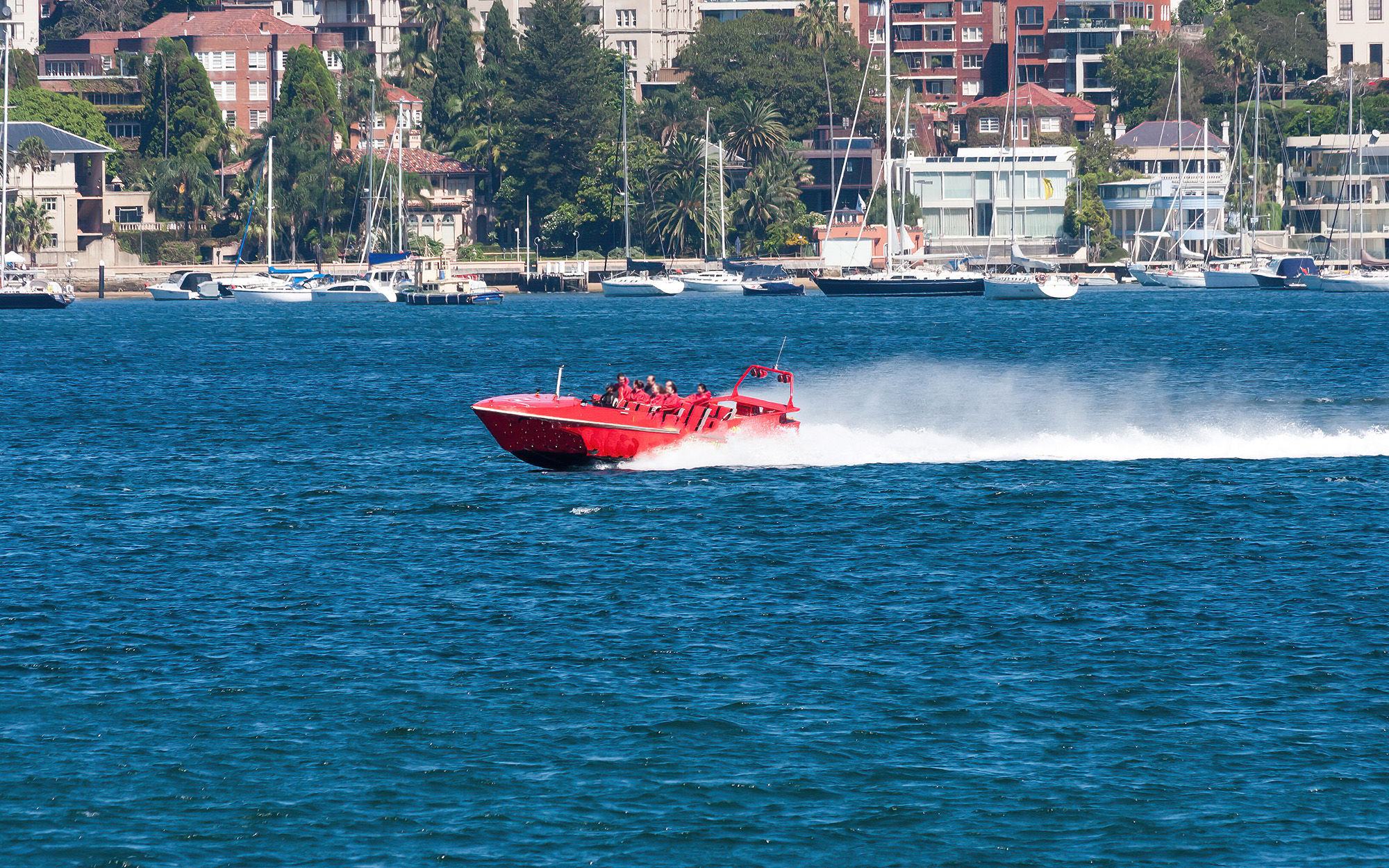
The real question is whether your vessel type, operating environment, and speed profile actually match what waterjet propulsion is designed to do. This post works through that question application by application.

First, the Mechanics in 60 Seconds

This post focuses on applications: not physics. If you want the full technical breakdown on how waterjets generate thrust, how efficiency shifts with speed, and why velocity ratio matters, that’s covered in depth in our waterjet technical explainer.

Nick (our owner + founder) also walks through the fundamentals on the DMS YouTube channel : worth a watch before making any propulsion decision.

Button: Watch the Youtube Video

The Vessel Types That Get the Most Out of Jet Drive

Waterjet propulsion doesn’t benefit every vessel equally. The ones that gain the most share a common profile: they run at higher speeds, need precise handling, or work in environments where an exposed propeller creates real problems.

High-Speed Passenger Ferries and Water Taxis

Passenger ferries running scheduled routes at 30-plus knots are one of the clearest use cases for waterjet propulsion. The efficiency advantage at speed is real, the ride is smoother without propeller vibration, and the maneuvering control at the dock makes frequent port calls substantially easier.

Water taxis in congested urban waterways get the same benefits.

Patrol, Rescue, and Government Craft

Government and military operators have relied on waterjets for decades on patrol and rescue vessels. The combination of high top speed and crash-stop capability is difficult to match with conventional propeller systems. A waterjet can redirect thrust without changing engine speed, giving operators precise control in situations where reaction time matters.

Shallow Draft and River Operations

Waterjets sit flush inside the hull with nothing hanging below the keel. That makes them the obvious choice for work boats and other vessels operating in shallow rivers, tidal channels, and coastal waterways where propeller strikes on debris or bottom structure are a consistent risk.

Research and Autonomous Vessels

Research vessels and autonomous surface vessels often operate in debris-heavy or biologically sensitive environments where a spinning propeller creates problems beyond mechanical damage. Waterjets eliminate that exposure. For autonomous vessels, the precise thrust vectoring a waterjet provides also simplifies certain navigation and station-keeping tasks.

Operating Environment Matters as Much as Vessel Type

Two vessels with identical hulls can have very different propulsion needs depending on where and how they run. Vessel type gets you part of the way to the right answer. The operating environment gets you the rest.

Debris-Heavy Waterways and Protected Inlets

In waterways with floating debris, submerged hazards, or active fishing gear, an unprotected propeller is a liability. The flush intake design of a waterjet is naturally more forgiving in these conditions, though intake clogging is still a real maintenance consideration that good intake geometry helps manage.

Frequent Docking and Tight-Space Work

The bucket reversal system on a waterjet redirects thrust into reverse without changing engine RPM, giving operators a level of low-speed control that a conventional propeller and rudder can’t replicate. For vessels that dock frequently or work around other boats and infrastructure, that control reduces incident risk and speeds up port turnarounds.

Speed Profile: What You Cruise At Beats What You Can Top Out At

This is where a lot of propulsion decisions go wrong. A vessel with a 40-knot top speed that spends 80 percent of its time at 12 knots is not a good waterjet candidate. Waterjet efficiency drops sharply at lower speeds, and selecting a system based on peak performance rather than actual operating profile results in chronic fuel overconsumption. Your daily cruise speed drives this call more than anything else on the spec sheet.

Choosing the right propulsion system starts with an honest look at how your vessel actually operates. DMS is ready to work through that analysis as part of every vessel design engagement.

Explore Vessel Design Services

Where Waterjets Don’t Make Sense

For all their advantages in the right application, waterjets are a poor choice in several common commercial scenarios.

Heavy Displacement, Cargo, and Towing Work

Waterjets are built for acceleration and high-speed efficiency. Heavy displacement vessels operating at low speeds under sustained load — tankers, barges, heavy cargo ships — are exactly where waterjet efficiency breaks down. Towing applications compound the problem further. Conventional propellers handle sustained low-speed, high-load work significantly better.

Low-Speed Operations Where Fuel Costs Compound

Fuel represents 30 to 70 percent of annual vessel operating costs for many operators. A propulsion system running outside its efficient speed range adds to that cost every hour the vessel is underway. For operations with tight margins, a mismatched waterjet installation isn’t a technical footnote — it shows up on the balance sheet.

Long-Range Passage Making

Offshore passage at moderate cruise speeds favors propeller propulsion for fuel efficiency. Vessels that spend extended time at sea, far from refueling, need every efficiency advantage available. Waterjets don’t provide that at the speeds typical of long-range cruising.

The 20-30 Knot Gray Zone

Below 20 knots, propellers win. Above 30, waterjets win. In the 20-30 knot range — which also happens to be one of the most common design speed bands for commercial vessels — the right answer depends on details that don’t show up in a manufacturer’s brochure.

Why Spec Sheets Aren’t Enough Here

In this speed range, small differences in hull form, operating profile, load conditions, and the specific jet model under consideration can tip the efficiency comparison either way. Operators who make this call based on general guidance rather than actual analysis regularly end up with the wrong system for their vessel.

What a Real Propulsion Evaluation Covers

A proper review looks at your full operational profile — actual cruise speed distribution, load conditions, docking frequency, and fuel cost structure — not just design speed. This analysis is part of how DMS approaches concept design and naval architecture projects where propulsion hasn’t been locked in yet.

Make the Right Call Before the Build

Propulsion is one of the decisions that’s expensive to revisit. Getting it right means matching the system to how the vessel actually operates, not how it reads on a performance curve.

DMS brings engineering analysis to propulsion decisions at the point in a project when it still matters: before the build. If you’re evaluating propulsion options for a new vessel or a repower, reach out for a free consultation and let’s work through what your operating profile actually calls for.

Share This Post

  • Share on Facebook
  • Share on X
  • Share on WhatsApp
  • Share on Pinterest
  • Share on LinkedIn
  • Share on Tumblr
  • Share on Vk
  • Share on Reddit
  • Share by Mail

More Like This

Marine Corrosion Prevention

Why Your Boat Is Slowly Destroying Itself — And What to Do About It

Vessel Design
https://dmsonline.us/wp-content/uploads/2026/07/Marine-Corrosion-Prevention.jpg 1250 2000 Abstrakt Marketing /wp-content/uploads/2025/06/DMS-logo.svg Abstrakt Marketing2026-07-30 07:51:192026-07-30 07:51:21Why Your Boat Is Slowly Destroying Itself — And What to Do About It
Corrosión Por Picadura En Aluminio 01

The Hidden Enemy Below the Waterline: How Marine Corrosion Works and How Engineers Fight It

Vessel Design
https://dmsonline.us/wp-content/uploads/2026/03/Corrosion_por_picadura_en_aluminio_-_01.jpg 1066 1599 Abstrakt Marketing /wp-content/uploads/2025/06/DMS-logo.svg Abstrakt Marketing2026-07-28 07:22:322026-07-30 07:49:13The Hidden Enemy Below the Waterline: How Marine Corrosion Works and How Engineers Fight It
Designing An Autonomous Surface Vessel

Designing an Autonomous Surface Vessel: What’s Actually Different from a Traditional Ship?

Autonomous Ships, Unmanned Vessels, Vessel Design
https://dmsonline.us/wp-content/uploads/2026/07/Designing-an-Autonomous-Surface-Vessel.jpg 1250 2000 Abstrakt Marketing /wp-content/uploads/2025/06/DMS-logo.svg Abstrakt Marketing2026-07-27 07:32:532026-07-30 07:49:21Designing an Autonomous Surface Vessel: What’s Actually Different from a Traditional Ship?
Future Mine Hunting System Comes To Clyde Mod Autonomous VesselLPhot Stevie Burke/MOD

Autonomous Surface Vessels: Is an ASV the Right Tool for Your Operation?

Vessel Design
https://dmsonline.us/wp-content/uploads/2025/08/FUTURE_MINE_HUNTING_SYSTEM_COMES_TO_CLYDE_MOD_Autonomous-Vessel.jpg 1250 2000 Abstrakt Marketing /wp-content/uploads/2025/06/DMS-logo.svg Abstrakt Marketing2026-06-02 14:36:482026-06-02 14:36:49Autonomous Surface Vessels: Is an ASV the Right Tool for Your Operation?
How Gyro Stabilization Works

How Gyro Stabilization Works and Why It’s Changing the Way We Experience the Water

Vessel Design
https://dmsonline.us/wp-content/uploads/2026/04/How-Gyro-Stabilization-Works.jpg 1250 2000 Abstrakt Marketing /wp-content/uploads/2025/06/DMS-logo.svg Abstrakt Marketing2026-04-30 08:50:162026-06-01 10:09:14How Gyro Stabilization Works and Why It’s Changing the Way We Experience the Water
Which Ship Stabilization System Is Right For Your Boat

Gyro Stabilizers vs. Fin Stabilizers vs. Bilge Keels: Which Ship Stabilizer Is Right for You?

Vessel Design
https://dmsonline.us/wp-content/uploads/2026/04/Which-Ship-Stabilization-System-is-Right-for-Your-Boat.jpg 1250 2000 Abstrakt Marketing /wp-content/uploads/2025/06/DMS-logo.svg Abstrakt Marketing2026-04-29 09:02:382026-06-01 10:09:14Gyro Stabilizers vs. Fin Stabilizers vs. Bilge Keels: Which Ship Stabilizer Is Right for You?
Future Mine Hunting System Comes To Clyde Mod Autonomous VesselLPhot Stevie Burke/MOD

Hybrid-Electric Systems: The Best Renewable Energy Option for Yachts?

Electrical, Vessel Design
https://dmsonline.us/wp-content/uploads/2025/08/FUTURE_MINE_HUNTING_SYSTEM_COMES_TO_CLYDE_MOD_Autonomous-Vessel.jpg 1250 2000 Abstrakt Marketing /wp-content/uploads/2025/06/DMS-logo.svg Abstrakt Marketing2026-03-29 20:35:482026-07-30 07:48:29Hybrid-Electric Systems: The Best Renewable Energy Option for Yachts?
Reviewing The Most Affordable Vessel Designs For Startups On A Budget

Reviewing the Most Affordable Vessel Designs for Startups on a Budget

Vessel Design
https://dmsonline.us/wp-content/uploads/2026/02/Reviewing-the-Most-Affordable-Vessel-Designs-for-Startups-on-a-Budget.jpg 1250 2000 Abstrakt Marketing /wp-content/uploads/2025/06/DMS-logo.svg Abstrakt Marketing2026-02-03 07:32:352026-06-01 10:09:16Reviewing the Most Affordable Vessel Designs for Startups on a Budget
How Small Vessel Operators Can Transition To Hybrid Electric

How Small Vessel Operators Can Transition to Hybrid-Electric

Green Ship Design, Vessel Design
https://dmsonline.us/wp-content/uploads/2026/01/How-Small-Vessel-Operators-Can-Transition-to-Hybrid-Electric.jpg 1250 2000 Abstrakt Marketing /wp-content/uploads/2025/06/DMS-logo.svg Abstrakt Marketing2025-11-14 14:26:442026-06-01 10:09:18How Small Vessel Operators Can Transition to Hybrid-Electric
Previous Previous Previous Next Next Next

Categories

  • 3D Modeling
  • Arrangements
  • Autonomous Ships
  • Auxiliary Systems
  • Command and Surveillance
  • Design Support
  • Drafting
  • Economics
  • Elastic Static Loading
  • Electrical
  • Energy Generation
  • Engineering Business
  • Equipment Integration
  • Fatigue
  • FEA / Numerical Methods
  • Fluid Dynamics
  • Fluid Loads
  • Fluids
  • Fluids Special Methods
  • Fluids Testing
  • Green Ship Design
  • Hiring Consultant
  • Hull Decks
  • Hull Structural Bulkheads
  • Hull Structure
  • Human Ergonomics
  • Hydrostatics
  • Insurance
  • Integration / Engineering
  • Legal
  • Marine Entrepreneurship
  • Masts, Kingposts, Service Platforms
  • Materials
  • Mechanical
  • Mechanical Handling Systems
  • Miscellaneous
  • Naval Architecture
  • Passenger Vessel
  • Piping
  • Production Engineering
  • Project Management
  • Propulsion
  • Propulsion Plant
  • Propulsion Units
  • Propulsor Shrouds and Ducts
  • Propulsors
  • Quality Assurance
  • Recreation
  • Regulations
  • Replenishment Systems
  • Resistance
  • Seakeeping / Fluid Structure Interaction
  • Shell and Supporting Structure
  • Ship Control Systems
  • Ship Maneuvering
  • Ship Motion Control
  • Ship Response
  • Shipyard And Support Services
  • Special Methods
  • Special Purpose Mechanical Systems
  • Special Purpose Structure
  • Stability Test
  • Structural
  • Support Services
  • Sustainable Marine Technology
  • Towing Tank
  • Transmission and Propulsor Systems
  • Unmanned Vessels
  • USCG
  • Vessel Design
  • Waterjet Propulsors

Our Socials

About Us

Ship designs tailored to your mission. Engineering that advances profits.

Dms Logo Negatives

What We Do

Vessel Design

Naval Architecture

Advanced Analysis

Marine Systems

Civil Engineering

Contact Us

(616) 504-1619

[email protected]

Website by Abstrakt Marketing Group ©
  • Privacy Policy
  • Sitemap
Scroll to top Scroll to top Scroll to top

This site uses cookies. By continuing to browse the site, you are agreeing to our use of cookies.

AcceptLearn more

Cookie and Privacy Settings


How we use cookies

We may request cookies to be set on your device. We use cookies to let us know when you visit our websites, how you interact with us, to enrich your user experience, and to customize your relationship with our website.

Click on the different category headings to find out more. You can also change some of your preferences. Note that blocking some types of cookies may impact your experience on our websites and the services we are able to offer.

Essential Website Cookies

These cookies are strictly necessary to provide you with services available through our website and to use some of its features.

Because these cookies are strictly necessary to deliver the website, refusing them will have impact how our site functions. You always can block or delete cookies by changing your browser settings and force blocking all cookies on this website. But this will always prompt you to accept/refuse cookies when revisiting our site.

We fully respect if you want to refuse cookies but to avoid asking you again and again kindly allow us to store a cookie for that. You are free to opt out any time or opt in for other cookies to get a better experience. If you refuse cookies we will remove all set cookies in our domain.

We provide you with a list of stored cookies on your computer in our domain so you can check what we stored. Due to security reasons we are not able to show or modify cookies from other domains. You can check these in your browser security settings.

Other external services

We also use different external services like Google Webfonts, Google Maps, and external Video providers. Since these providers may collect personal data like your IP address we allow you to block them here. Please be aware that this might heavily reduce the functionality and appearance of our site. Changes will take effect once you reload the page.

Google Webfont Settings:

Google Map Settings:

Google reCaptcha Settings:

Vimeo and Youtube video embeds:

Accept settingsHide notification only