• Dms Logo
  • Services
    • Vessel Design
      • Concept Design
    • Naval Architecture
    • Advanced Analysis
    • Marine Systems
    • Civil Engineering
  • Marine Operations
    • Passenger Vessels
    • Work Boats
    • Research Boats
    • Drone Carriers
    • Shipyards
    • Marine Startups
    • Waterway Maintenance
    • Autonomous Vessels
  • Portfolio
  • About Us
  • Resources
    • Blog
    • GHS Tutorials
    • FAQs
  • Contact
  • Menu Menu

The Role of Redundancy in Ship Design

A lube oil pump clogs on a vessel with no backup in place, and the engine stops. You’re seconds away from disaster. But on a commercial vessel, built with redundancy in mind, a sensor flags the pressure drop from the pump, an alarm reaches the engineer on watch, and a second pump takes over before anyone on deck even notices a problem.

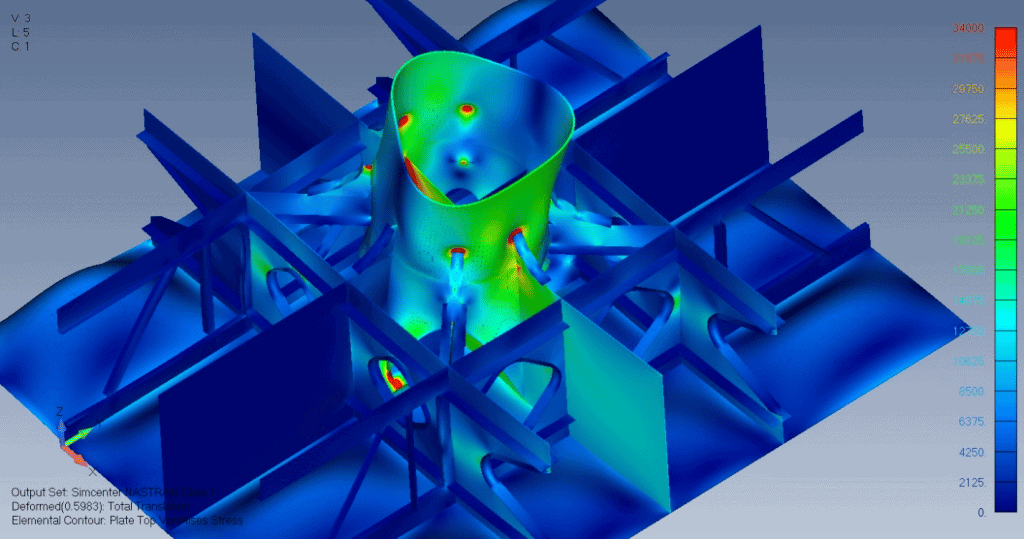
3D Render Fig5 5 1024x539.png

That difference, catching a failure early instead of living with the consequences, is what redundancy in ship design is actually about. It isn’t extra equipment for its own sake. It’s a system built to fail safely instead of catastrophically.

What Redundancy Actually Means in Ship Design

Redundancy gets treated like a budget line item: more equipment, more weight, more cost. That framing misses the point. Real redundancy is a design decision made early, before a single hull frame is cut, about which systems can never be allowed to fail completely: steering, propulsion, watertight integrity, and how the ship will detect and respond when a component fails anyway.

In commercial shipping, we expect things to fail, and single component breakdowns should not become disasters.

Catching Problems Before They Cascade

Redundancy only works if someone finds out a component has failed before it takes something else down with it. That’s the half of the equation that gets skipped most often, because it’s less visible than the backup equipment itself.

Sensors and Alarms That Flag Trouble Early

Modern monitoring systems track pressure, temperature, and vibration on critical equipment continuously, not just during scheduled rounds. A reading that drifts outside normal range triggers an alert long before the component actually fails, giving the crew time to respond instead of reacting to a shutdown.

The Backup Systems That Keep a Ship Running

Detection only matters if a backup is ready to take over the moment something fails. This is where redundancy becomes physical, not just electronic.

Duplicated Critical Components

A duplex fuel filter lets an engineer switch to a second cartridge with one turn of a valve, no need to stop the engine to do it. SOLAS Chapter II-1 requires this kind of thinking at the regulatory level too. The main steering gear runs on two independent power units so a single fault in one line can’t disable steering entirely. Ships even carry emergency steering capable of taking over if the main system fails.

For all the critical systems, we don’t allow a single failure to stop service.

Backup Power and Propulsion

Losing propulsion or steering in close quarters isn’t an inconvenience, it’s a safety event. Backup generators, redundant power units, and secondary control paths exist so one component failure doesn’t strand the vessel or put the crew at risk.

Redundancy decisions made after a ship is built are expensive, and some can’t be added at all without disrupting the hull or systems already in place. Datawave Marine Solutions builds detection and backup planning into the design process from day one, when it’s still a decision instead of a retrofit.

Schedule a Consultation

Automatic Backup

Some backups, like a fuel filter, require a manual change. Someone has to physically turn the valve. But for more critical systems, like the electrical grid, we can’t tolerate the delay of manual intervention. If we lose electricity, lights go out over the entire ship. The crew can’t see. And every pump, navigation system, and control system just stopped working. For those scenarios, the backups can’t wait for human decisions.

Automatic transfer systems kick in when seconds matter. If the ship loses electric power, the backups only wait a few seconds before they start the emergency generator and switch the entire ship to emergency power. It takes less than a minute to go from an emergency to restoring control over the ship. All without human intervention. Automatic backups mean reliable safety.
Redundancy Built Into the Hull

Not every backup system runs on electricity. Some of the most important redundancy in ship design happens in the structure itself, long before anything gets wired.

Watertight Subdivision and Compartmentalization

The hull of a vessel is divided into watertight compartments so a breach in one section doesn’t flood the entire ship. SOLAS requires this subdivision to be dense enough that a damaged passenger vessel can still remain afloat and stable. This buys you time. Time to make emergency repairs, pump out the damaged section. Time is the most critical asset in any emergency, and the structural design includes extra time built with no machinery required. That is the most reliable form of redundancy.

Bend Before Breaking: Structural Warnings

Most ships don’t include sensors on the hull. No way to tell if the storm stressed your ship to its limits. And honestly, no sensor in the world can measure all the factors that make up ship strength. So what do we do? Just wait, where the first sign of trouble is a giant tear in the side of the hull? No.

Structural redundancy means we design the ship with lots of reserve strength. For normal operations, we only stress the hull to about 70%-80% of the normal limit (normal stress levels before any permanent bends). That already gives you a safety factor.

Then we break out the hidden advantage of metal hulls: they bend before they break. Your average steel plate requires stresses of about double the bending limit before it finally tears. Each part of the hull is built to handle twice the design loads. Every time a ship miraculously survives a collision: that wasn’t luck. It was structural redundancy.

What Happens When Redundancy Gets Skipped

Skip the backup and the detection, and a minor issue has nowhere to go but up. A clogged filter without a second cartridge doesn’t get caught early, it becomes an engine failure in open water. A structural member without a safety factor doesn’t bend; it just breaks without warning. Without redundancy, the first sign of a problem becomes the emergency.

A vessel that loses propulsion in a shipping lane or a storm isn’t dealing with an inconvenience, it’s dealing with an emergency that redundancy was supposed to prevent. This is what redundancy actually buys you: the difference between a small, manageable issue and the reason a vessel doesn’t make it back on schedule, or at all.

Redundancy Has to Start at the Design Stage

Retrofitting redundancy onto an existing vessel is possible, but it’s rarely as effective, or as affordable, as designing it from the start. Every major decision in designing a ship, hull layout, system routing, equipment selection, either leaves room for backups and detection or closes the door on them later. That’s why redundancy belongs in the earliest design conversations, right alongside propulsion, capacity, and mission.

Build a Ship That Fails Safely, Not Catastrophically

Redundancy in ship design isn’t about doubling every system for its own sake. It’s about knowing which failures a vessel absolutely cannot afford, and making sure those points have both a way to get caught early and a way to keep running when they do happen.

Nick Barczak, DMS’s licensed professional engineer, builds that thinking into every vessel design from the first conversation, not as an add-on once the hull is already drawn. If you’re planning a new build or want a second opinion on where your current vessel’s single points of failure sit, reach out and let’s talk through what your ship actually needs.

Share This Post

  • Share on Facebook
  • Share on X
  • Share on WhatsApp
  • Share on Pinterest
  • Share on LinkedIn
  • Share on Tumblr
  • Share on Vk
  • Share on Reddit
  • Share by Mail

More Like This

Close Up View Of An Anchor

Dispelling Myths Around Anchoring

Vessel Design
https://dmsonline.us/wp-content/uploads/2026/10/close-up-view-of-an-anchor.jpg 1250 2000 Abstrakt Marketing /wp-content/uploads/2025/06/DMS-logo.svg Abstrakt Marketing2026-10-01 15:37:532026-10-01 15:37:56Dispelling Myths Around Anchoring
Beyond The Rough Ride

Beyond the Rough Ride: How Modern Boat Stabilizer Technology Is Making Boating More Accessible (and More Fun)

Vessel Design
https://dmsonline.us/wp-content/uploads/2026/09/Beyond-the-Rough-Ride.jpg 1250 2000 Abstrakt Marketing /wp-content/uploads/2025/06/DMS-logo.svg Abstrakt Marketing2026-09-02 14:32:342026-09-02 14:32:36Beyond the Rough Ride: How Modern Boat Stabilizer Technology Is Making Boating More Accessible (and More Fun)
Marine Corrosion Prevention

Why Your Boat Is Slowly Destroying Itself — And What to Do About It

Vessel Design
https://dmsonline.us/wp-content/uploads/2026/07/Marine-Corrosion-Prevention.jpg 1250 2000 Abstrakt Marketing /wp-content/uploads/2025/06/DMS-logo.svg Abstrakt Marketing2026-07-30 07:51:192026-07-30 07:51:21Why Your Boat Is Slowly Destroying Itself — And What to Do About It
Demystifying Jet Boats

Is Waterjet Propulsion Right for Your Vessel? A Practical Guide for Commercial Operators

Vessel Design, Waterjet Propulsors
https://dmsonline.us/wp-content/uploads/2026/07/Demystifying-Jet-Boats.jpg 1250 2000 Abstrakt Marketing /wp-content/uploads/2025/06/DMS-logo.svg Abstrakt Marketing2026-07-29 07:42:142026-07-30 07:49:28Is Waterjet Propulsion Right for Your Vessel? A Practical Guide for Commercial Operators
Corrosión Por Picadura En Aluminio 01

The Hidden Enemy Below the Waterline: How Marine Corrosion Works and How Engineers Fight It

Vessel Design
https://dmsonline.us/wp-content/uploads/2026/03/Corrosion_por_picadura_en_aluminio_-_01.jpg 1066 1599 Abstrakt Marketing /wp-content/uploads/2025/06/DMS-logo.svg Abstrakt Marketing2026-07-28 07:22:322026-07-30 07:49:13The Hidden Enemy Below the Waterline: How Marine Corrosion Works and How Engineers Fight It
Designing An Autonomous Surface Vessel

Designing an Autonomous Surface Vessel: What’s Actually Different from a Traditional Ship?

Autonomous Ships, Unmanned Vessels, Vessel Design
https://dmsonline.us/wp-content/uploads/2026/07/Designing-an-Autonomous-Surface-Vessel.jpg 1250 2000 Abstrakt Marketing /wp-content/uploads/2025/06/DMS-logo.svg Abstrakt Marketing2026-07-27 07:32:532026-07-30 07:49:21Designing an Autonomous Surface Vessel: What’s Actually Different from a Traditional Ship?
Future Mine Hunting System Comes To Clyde Mod Autonomous VesselLPhot Stevie Burke/MOD

Autonomous Surface Vessels: Is an ASV the Right Tool for Your Operation?

Vessel Design
https://dmsonline.us/wp-content/uploads/2025/08/FUTURE_MINE_HUNTING_SYSTEM_COMES_TO_CLYDE_MOD_Autonomous-Vessel.jpg 1250 2000 Abstrakt Marketing /wp-content/uploads/2025/06/DMS-logo.svg Abstrakt Marketing2026-06-02 14:36:482026-06-02 14:36:49Autonomous Surface Vessels: Is an ASV the Right Tool for Your Operation?
How Gyro Stabilization Works

How Gyro Stabilization Works and Why It’s Changing the Way We Experience the Water

Vessel Design
https://dmsonline.us/wp-content/uploads/2026/04/How-Gyro-Stabilization-Works.jpg 1250 2000 Abstrakt Marketing /wp-content/uploads/2025/06/DMS-logo.svg Abstrakt Marketing2026-04-30 08:50:162026-06-01 10:09:14How Gyro Stabilization Works and Why It’s Changing the Way We Experience the Water
Which Ship Stabilization System Is Right For Your Boat

Gyro Stabilizers vs. Fin Stabilizers vs. Bilge Keels: Which Ship Stabilizer Is Right for You?

Vessel Design
https://dmsonline.us/wp-content/uploads/2026/04/Which-Ship-Stabilization-System-is-Right-for-Your-Boat.jpg 1250 2000 Abstrakt Marketing /wp-content/uploads/2025/06/DMS-logo.svg Abstrakt Marketing2026-04-29 09:02:382026-06-01 10:09:14Gyro Stabilizers vs. Fin Stabilizers vs. Bilge Keels: Which Ship Stabilizer Is Right for You?
Previous Previous Previous Next Next Next

Categories

  • 3D Modeling
  • Arrangements
  • Autonomous Ships
  • Auxiliary Systems
  • Command and Surveillance
  • Design Support
  • Drafting
  • Economics
  • Elastic Static Loading
  • Electrical
  • Energy Generation
  • Engineering Business
  • Equipment Integration
  • Fatigue
  • FEA / Numerical Methods
  • Fluid Dynamics
  • Fluid Loads
  • Fluids
  • Fluids Special Methods
  • Fluids Testing
  • Green Ship Design
  • Hiring Consultant
  • Hull Decks
  • Hull Structural Bulkheads
  • Hull Structure
  • Human Ergonomics
  • Hydrostatics
  • Insurance
  • Integration / Engineering
  • Legal
  • Marine Entrepreneurship
  • Masts, Kingposts, Service Platforms
  • Materials
  • Mechanical
  • Mechanical Handling Systems
  • Miscellaneous
  • Naval Architecture
  • Passenger Vessel
  • Piping
  • Production Engineering
  • Project Management
  • Propulsion
  • Propulsion Plant
  • Propulsion Units
  • Propulsor Shrouds and Ducts
  • Propulsors
  • Quality Assurance
  • Recreation
  • Regulations
  • Replenishment Systems
  • Resistance
  • Seakeeping / Fluid Structure Interaction
  • Shell and Supporting Structure
  • Ship Control Systems
  • Ship Maneuvering
  • Ship Motion Control
  • Ship Response
  • Shipyard And Support Services
  • Special Methods
  • Special Purpose Mechanical Systems
  • Special Purpose Structure
  • Stability Test
  • Structural
  • Support Services
  • Sustainable Marine Technology
  • Towing Tank
  • Transmission and Propulsor Systems
  • Unmanned Vessels
  • USCG
  • Vessel Design
  • Waterjet Propulsors

Our Socials

About Us

Ship designs tailored to your mission. Engineering that advances profits.

Dms Logo Negatives

What We Do

Vessel Design

Naval Architecture

Advanced Analysis

Marine Systems

Civil Engineering

Contact Us

(616) 504-1619

[email protected]

Website by Abstrakt Marketing Group ©
  • Privacy Policy
  • Sitemap
Scroll to top Scroll to top Scroll to top

This site uses cookies. By continuing to browse the site, you are agreeing to our use of cookies.

AcceptLearn more

Cookie and Privacy Settings


How we use cookies

We may request cookies to be set on your device. We use cookies to let us know when you visit our websites, how you interact with us, to enrich your user experience, and to customize your relationship with our website.

Click on the different category headings to find out more. You can also change some of your preferences. Note that blocking some types of cookies may impact your experience on our websites and the services we are able to offer.

Essential Website Cookies

These cookies are strictly necessary to provide you with services available through our website and to use some of its features.

Because these cookies are strictly necessary to deliver the website, refusing them will have impact how our site functions. You always can block or delete cookies by changing your browser settings and force blocking all cookies on this website. But this will always prompt you to accept/refuse cookies when revisiting our site.

We fully respect if you want to refuse cookies but to avoid asking you again and again kindly allow us to store a cookie for that. You are free to opt out any time or opt in for other cookies to get a better experience. If you refuse cookies we will remove all set cookies in our domain.

We provide you with a list of stored cookies on your computer in our domain so you can check what we stored. Due to security reasons we are not able to show or modify cookies from other domains. You can check these in your browser security settings.

Other external services

We also use different external services like Google Webfonts, Google Maps, and external Video providers. Since these providers may collect personal data like your IP address we allow you to block them here. Please be aware that this might heavily reduce the functionality and appearance of our site. Changes will take effect once you reload the page.

Google Webfont Settings:

Google Map Settings:

Google reCaptcha Settings:

Vimeo and Youtube video embeds:

Accept settingsHide notification only