Commercial Ship Safety
Commercial ships are a world apart from recreational yachts. They contend with tougher requirements, and they need far more safety features. But what are those differences? How is the commercial ship safer?
Commercial ships are a world apart from recreational yachts. They contend with tougher requirements, and they need far more safety features. But what are those differences? How is the commercial ship safer?
Why do commercial ships cost so much more than a comparable yacht? Commercial ships are a world apart from recreational yachts. Comparing the two is like comparing the space shuttle to a Cessna airplane. Both are technically flying vehicles, but built for very different missions. The same is true for commercial ships. They contend with tougher requirements, and they need far more safety features. But what are those differences? How is the commercial ship safer?
If a yacht crashes into a concrete pier, the yacht gets damaged and we file some insurance claims. When a 300 m long commercial ship crashes into a concrete pier . . . the pier disappears and we dig a new shoreline. Big ships mean big risk. Lots of equipment that all needs to work consistently. Dependable operation is key. Equipment failure is not an option.
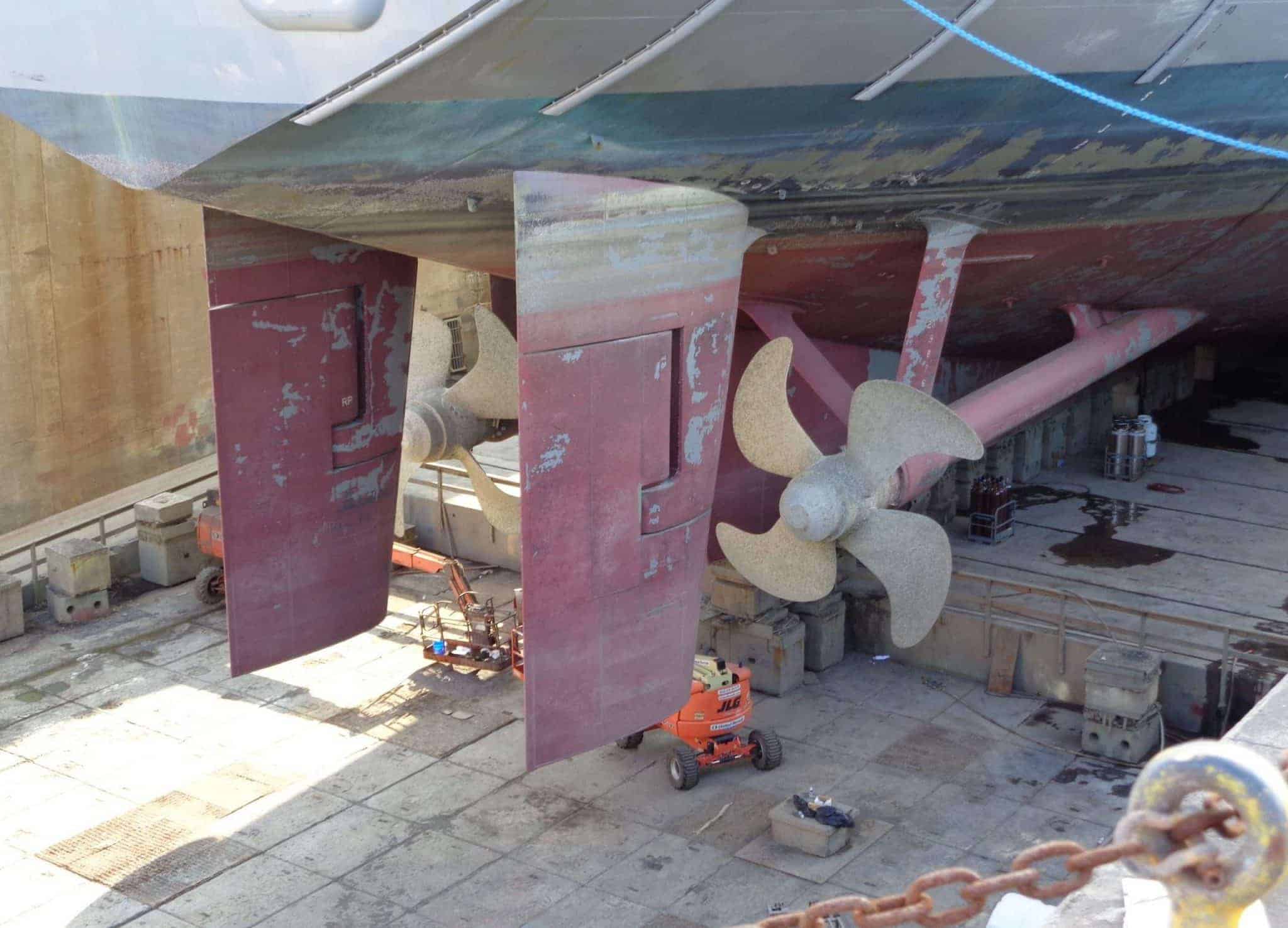
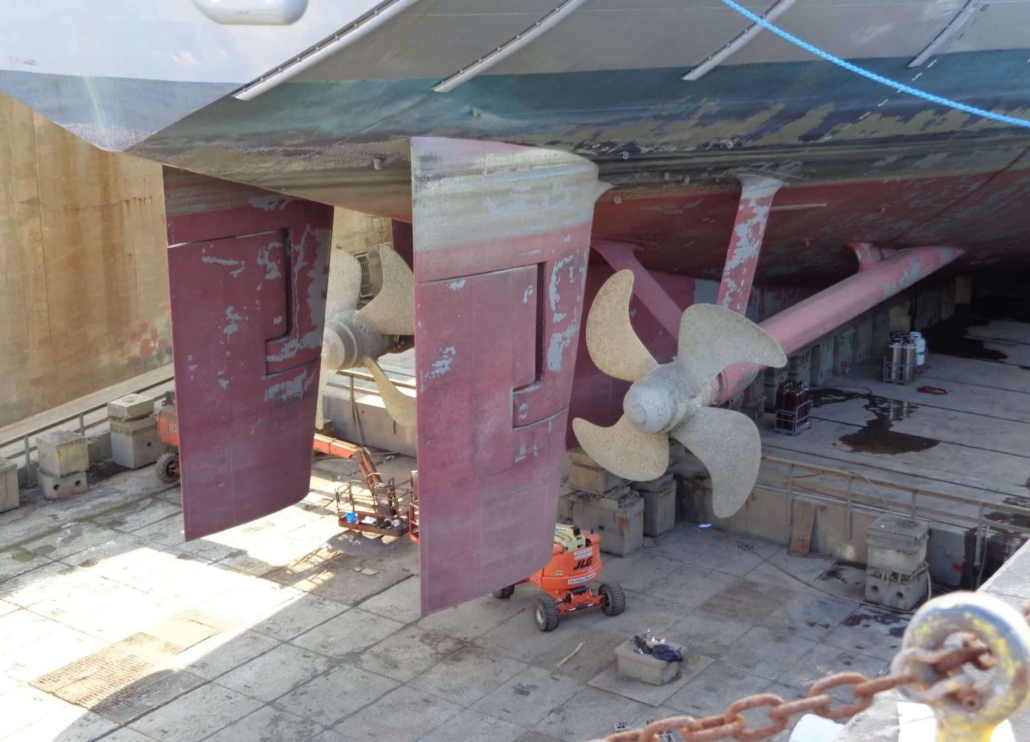
With very few exceptions, every component on a ship gets duplicated. There are two places to steer the ship, two radars, two radios, etc. All the smaller equipment gets fully duplicated. And much of the larger equipment as well. Many commercial ships include two propellers, two independent engines, and two rudders. Everything has a backup.
Redundancy is critical to commercial shipping. In that critical moment of an emergency, you can’t wait 1 hour to repair the rudder hydraulics. This is why the rudder has a redundant hydraulic system. And the same for all other critical ship systems. Unfortunately, this does require you to buy twice as much equipment. This redundancy not only provides a backup against equipment failures. It also allows maintenance on a ship that never stops working.
Commercial ships are designed for constant service. Consider the life of a normal yacht. The owner works five days a week and uses the yacht maybe every other weekend. That means the yacht only sees service about 4 days out of 30. A typical yacht spends roughly 86% of its life sitting in the marina. With commercial ships, the opposite is true. They only spend around 10% of their life in drydock or sitting in a harbor. These ships rarely stop for maintenance. And they rarely tolerate weather delays. Rain or shine, the ship sails through all weather. That constant exposure requires a whole new approach to vessel design.
The ship never stops. So how do we performance routine maintenance on a ship that never shuts down? Consider the fuel filters on a typical yacht. These get clogged and need to be changed. Simple enough on a yacht. Turn off the engine, unscrew the filter cap, and change the filter.
That same process on a commercial ship means I need to disable my ship and stop operations. Not happening. We do not turn off the engine. That engine supplies power and maneuvering control to the ship. It runs for 99% of the ship’s life. Solution: more redundancy. In the case of the fuel filter, each fuel line has two filters (technically called a duplex filter). When we need to change a filter, turn a valve to switch from one filter cartridge to another, all without ever stopping the engine.
Redundancy is great, but only if we plan for it in advance. From day 1, the system needs the flexibility to handle any scenario in the next 50 years of operation, while still delivering constant service. Consider all the possible scenarios for a commercial fuel system:
The fuel system is not just a pipe. It’s a carefully planned network designed to achieve a lifetime of capabilities. An engineer needs to consider all these tasks and plan how the system will accomplish each one. There may be extra valves in the fuel system that you only use once per year for a single task. But they still need to be part of the system from the very first day. Because we can’t stop to add a valve.
The flexibility required from the fuel system adds components and increases design effort. All that adds cost. The same is true for every system on the ship. Fuel, lube oil, cooling water, drinking water, sewage, electrical power . . . the list goes on. Every system on the ship offers a Swiss-army knife of capabilities, all to ensure easy and continuous operation.
Do you think your yacht is strong? Not by half. Commercial ships require far stronger structure than a yacht. This is a safety feature for the ship to survive a storm.
When ships spend the majority of their life out at sea, sooner or later, they encounter a storm. Yachts have the flexibility to avoid storms by delaying their departure or adjusting the cruising schedule to avoid the stormy season. Good yacht captains take advantage of this to reduce the chances of encountering large storms. Commercial ships don’t have that luxury. They operate on tight shipping schedules that make them travel, regardless of the weather. Captains have some discretion to ensure vessel safety. But no commercial captain will turn and hide in harbor every time the weather looks bad.
To combat stormy weather, we build commercial ships tough. Impressively tough. Storm waves can punch with the force of a concrete brick. A yacht may try to ride with the wave and limits its impact. Commercial ships just take the hit. We reinforce the bow to punch back and break through the wave. And the ship can continue to do that. Wave after wave, unscathed. For commercial ships, storms are just part of the job.
Yachts are built to handle far less. Many like argue the strength of yachts by pointing to the European Recreational Craft Directive, which specifies different craft categories based on wave height. (Figure 3‑1) The top level, category A, should handle significant wave heights over 4 m. Except everyone forgets the footnotes, which exclude “abnormal conditions”, like storms or any type of bad weather.
Yachts are not meant to handle a storm on the open ocean. I heard many stories of good captains that successfully weathered a storm in a yacht. But that speaks to the skill of the captain, not the yacht. In the commercial world, we take the attitude that a captain should not need to compensate for bad design. Yachts do best to avoid storms. Commercial ships can just go through the storm (within reason).

Every commercial ship is born with a death date, thanks to fatigue. Ships on the ocean constantly flex with the ocean waves. This tiny movement creates fatigue in the ship structure, slowly degrading the hull. In general, the fatigue limits for the steel structure are around 35% to 60% of the strength limits. [2] [3] In certain key areas, fatigue governs the structure, not strength. And a long fatigue life requires stronger structure.
Yacht fatigue barely compares to commercial ships. Yachts spend most of their life in a marina, protected from large waves. This generates far less fatigue, which is one of the main reasons yachts last so long. We again see that ships have stronger structure because their constant service leads to far more wear and tear. Commercial ships are built to handle a tough life.
Fire and flooding rank as the two biggest dangers to a ship. In the case of fire on a yacht, everyone evacuates to a life raft (if the yacht has one). In the case of flooding, the yacht may remain floating. But the entire interior will be flooded and full of cold seawater. You can’t survive in that. Hypothermia would kill you quickly. In these scenarios, the best survival plan is to evacuate. And the yacht is toast.
Commercial ships don’t die so easily. Commercial ships travel far from land, isolated from help. We design the ships to recover from a fire or flood and limp to the nearest port. These ships allow self-rescue. Evacuation to the lifeboat is your last option; the ship gives much better chances of survival than in the lifeboat. In a commercial ship, you save yourself.
On a yacht, a punctured hull is a short stop away from abandoning ship. Bilge pumps on a yacht don’t compete against flooding. Some yachts are designed to remain floating, even with a flooded interior. But “floating” means sitting barely above the waterline, with an interior full of freezing seawater and no safe refuge for the crew. The cockpit provides no protection from the waves with the ship barely floating. At best, a yacht gives you time to dig out the life raft and abandon ship.
Commercial ships are specifically designed to survive flooding in major portions of their hull and still remain floating. This is the magic of the watertight bulkheads. We very carefully select the positions of those bulkheads to control the volume of sections between the bulkheads. This limits the damage and lets the ship fight to recover.
Even with major flooding, a commercial ship can recover. Many of these ships include massive pumps designed solely for emergency. Not a puny bilge pump. These water suckers get tied to the main engine and pull the water out just as fast as it can enter (for limited holes in the hull). These strategies don’t always save the ship. But on a commercial ship, a punctured hull doesn’t doom the boat. On the contrary, the battle has just started.
Some battles end quickly and the ship sinks in mere minutes, allowing no time for the crew to react. Even on its way to the bottom, a commercial ship still fights for the crew. We included life rafts on the side of the ship, designed to automatically release when submerged. Hydrostatic triggers release when the raft sinks about 4.0 m deep [4], and the raft automatically inflates. Without any action from the crew, a fully deployed life raft appears on the surface. Along with the life raft, the ship includes an emergency radio beacon (EPIRB), which also automatically deploys when submerged. When seconds count, commercial ships increase the odds of survival.

On a commercial ship, you don’t call the fire department. You are the fire department. Commercial ships include extensive systems to fight a fire. Some of the highlights include:
My favorite is the CO2 system. (Figure 4‑1) Fire needs three things to exist: fuel, oxygen, and heat. For high risk spaces like the engine room, we have a full proof system to stop fire immediately: remove the oxygen. Commercial ships include a gas system designed to flood the engine room with CO2 (or Halon on older ships), displacing all the oxygen. Remove the oxygen and even the hottest fire stops in its tracks. Removing the oxygen also becomes a problem for any people still in the engine room, which is why CO2 systems include warning alarms and can only be manually triggered. But I love the effectiveness. When the CO2 goes off, the fire is done.
If all the extinguishing systems fail, commercial ships have a backup plan to contain the fire. One of the reasons we build commercial ships from steel is that very few fires burn hot enough to significantly weaken steel. Every room in the ship is made of steel. If a fire grows out of control, just close the doors and trap it inside a steel box. This is the principle of structural fire protection. We design specific walls to be fire boundaries, to trap the fire. The boundaries also include special insulation to protect the steel against a prolonged fire. You need a very big fire to take down these ships.
With yachts, it takes far less. First off, yachts rarely come with any of the systems that I listed for commercial ships. And if your yacht is made from fiberglass, I have bad news. The resin in your fiberglass is flammable. It burns, and releases toxic smoke. And all that beautiful furniture in your yacht, also flammable. Commercial ships go the other way. Even the furniture on commercial ships is specifically chosen from materials that can’t burn. Commercial ships are built to contain and fight fires, with multiple protective systems and trained crew. Yachts . . . make sure you know where the fire extinguisher is.

The final major feature of commercial ships: paperwork. I don’t think this is a positive feature, but undeniable. Big ships mean big money. And with big money, governments usually want a piece of the pie. Commercial ships suffer from numerous regulations, with multiple different agencies. Everyone wants us to prove the ship is safe, with lots of engineering analysis, detailed reports, plenty of drawings.
Safety is good, but it costs a lot of money when we need to prove it to several organizations. When commercial ships get sold, the paperwork can be just as valuable as the ship itself. I don’t think anyone likes it. But unless you have your own country, the governments make the rules. And we need to follow them, despite the large costs involved.
Commercial ships are not yachts; they aren’t comparable. They serve completely different missions. Yachts focus on minimal exposure to the sea, and minimal cost for the owners. Commercial ships do just the opposite. Always working, always at sea, designed to drive into a storm and punch right through. Commercial ships don’t give up easily, with redundant systems, on-the-go maintenance, and an array of strategies to fight emergencies. Commercial ships cost so much more because cost saving was not the primary goal. Safety and endurance guide the design of commercial ships.
| [1] | Official Journal of the European Union, “Annex 1: Essential Requirements,” in Recreational Craft Directive, 20 Nov 2013, p. 354/114. |
| [2] | Engineering Toolbox, “Endurance limits and fatigue stress for steels.,” Engineering Toolbox, . Available: https://www.engineeringtoolbox.com/steel-endurance-limit-d_1781.html. . |
| [3] | ASM International , Elements of Metallurgy and Engineering Alloys, ASM International, 2008. |
| [4] | T-ISS Safety Supplies, “Product Spotlight: Hydrostatic Release Unit (HRU),” T-ISS Safety Supplies, 19 Nov 2018. . Available: https://t-iss.com/2018/11/19/product-spotlight-hydrostatic-release-unit-hru/. . |
| [5] | Infinity 8 PTE LTD, “Fixed CO2 Fire Suppression System,” Infinity 8 PTE LTD, . Available: https://infinity8.com.sg/fixed-co2-fire-supp-sys/. . |
| [6] | Parker, “Marine Fuel Filter Water Separator – Racor Turbine Series,” Parker, . Available: https://ph.parker.com/us/en/marine-fuel-filter-water-separator-turbine-series/75900max2. . |
| [7] | Quick PS, “A Ship Transports Gas in the Middle of a Storm,” Unsplash, 20 Aug 2021. . Available: https://unsplash.com/photos/vANkoyL5Rm4. . |
| [8] | “The Beaufort Wind Scale,” . Available: https://www.delta-s.org/weer/beaufort.html. . |
| [9] | Wikipedia Authors, “EPIRB,” Wikimedia Commons, 01 May 2013. . Available: https://en.m.wikipedia.org/wiki/File:[email protected]. . |
| [10] | Safe T Made, “HRU LR-2,” Safe T Made, . Available: https://safetmade.com/en/products/hydrostatic-release-units/hru-lr-2/. . |
| [11] | Wikipedia Authors, “Bavaria Cruiser 45,” Wikimedia Commons, 05 Mar 2012. . Available: https://commons.wikimedia.org/wiki/File:Bavaria_Cruiser_45.jpg. . |
 https://dmsonline.us/wp-content/uploads/2026/03/AI-Image-Corrosion.png
1024
1024
Nicholas Barczak
/wp-content/uploads/2025/06/DMS-logo.svg
Nicholas Barczak2026-06-09 07:00:002026-03-26 11:07:47Avoiding Rust: Science of Corrosion on Ships
https://dmsonline.us/wp-content/uploads/2026/03/AI-Image-Corrosion.png
1024
1024
Nicholas Barczak
/wp-content/uploads/2025/06/DMS-logo.svg
Nicholas Barczak2026-06-09 07:00:002026-03-26 11:07:47Avoiding Rust: Science of Corrosion on Ships https://dmsonline.us/wp-content/uploads/2023/12/HabbakukCover-Small-1.jpg
489
500
Nate Riggins
/wp-content/uploads/2025/06/DMS-logo.svg
Nate Riggins2024-09-24 09:18:002026-06-01 10:09:21Project Habbakuk: A Ship from Ice!
https://dmsonline.us/wp-content/uploads/2023/12/HabbakukCover-Small-1.jpg
489
500
Nate Riggins
/wp-content/uploads/2025/06/DMS-logo.svg
Nate Riggins2024-09-24 09:18:002026-06-01 10:09:21Project Habbakuk: A Ship from Ice! https://dmsonline.us/wp-content/uploads/2023/12/Icebreaker_SpoonBow.webp
217
598
Nate Riggins
/wp-content/uploads/2025/06/DMS-logo.svg
Nate Riggins2024-07-16 09:00:002026-06-01 10:09:21Strong as Ice: Icebreaker Structure
https://dmsonline.us/wp-content/uploads/2023/12/Icebreaker_SpoonBow.webp
217
598
Nate Riggins
/wp-content/uploads/2025/06/DMS-logo.svg
Nate Riggins2024-07-16 09:00:002026-06-01 10:09:21Strong as Ice: Icebreaker Structure https://dmsonline.us/wp-content/uploads/2023/12/MackinawIce1-scaled-1.jpg
883
1200
Nate Riggins
/wp-content/uploads/2025/06/DMS-logo.svg
Nate Riggins2024-03-19 09:00:002026-06-01 10:09:22Ramming the Ice: Icebreaker Propulsion
https://dmsonline.us/wp-content/uploads/2023/12/MackinawIce1-scaled-1.jpg
883
1200
Nate Riggins
/wp-content/uploads/2025/06/DMS-logo.svg
Nate Riggins2024-03-19 09:00:002026-06-01 10:09:22Ramming the Ice: Icebreaker Propulsion https://dmsonline.us/wp-content/uploads/2023/12/MackinawIce2-scaled-1.jpg
1200
985
Nate Riggins
/wp-content/uploads/2025/06/DMS-logo.svg
Nate Riggins2024-01-16 09:00:002026-06-01 10:09:23Breaking the Ice: Icebreakers
https://dmsonline.us/wp-content/uploads/2023/12/MackinawIce2-scaled-1.jpg
1200
985
Nate Riggins
/wp-content/uploads/2025/06/DMS-logo.svg
Nate Riggins2024-01-16 09:00:002026-06-01 10:09:23Breaking the Ice: Icebreakers https://dmsonline.us/wp-content/uploads/2021/11/palfinger_marine_Foldable-Knuckle-Boom-Crane_PK150002M.png
900
1350
Nate Riggins
/wp-content/uploads/2025/06/DMS-logo.svg
Nate Riggins2021-11-01 10:19:092025-07-23 09:50:19Cranes on Ships: Introduction to Crane Integration
https://dmsonline.us/wp-content/uploads/2021/11/palfinger_marine_Foldable-Knuckle-Boom-Crane_PK150002M.png
900
1350
Nate Riggins
/wp-content/uploads/2025/06/DMS-logo.svg
Nate Riggins2021-11-01 10:19:092025-07-23 09:50:19Cranes on Ships: Introduction to Crane Integration https://dmsonline.us/wp-content/uploads/2021/10/M21006-Fig5-8.png
721
1430
Nate Riggins
/wp-content/uploads/2025/06/DMS-logo.svg
Nate Riggins2021-10-04 22:53:032025-08-15 13:25:42Strength and Stiffness: Design of Structural Foundations
https://dmsonline.us/wp-content/uploads/2021/10/M21006-Fig5-8.png
721
1430
Nate Riggins
/wp-content/uploads/2025/06/DMS-logo.svg
Nate Riggins2021-10-04 22:53:032025-08-15 13:25:42Strength and Stiffness: Design of Structural Foundations https://dmsonline.us/wp-content/uploads/2020/12/KitBoat.jpg
327
436
Nate Riggins
/wp-content/uploads/2025/06/DMS-logo.svg
Nate Riggins2021-02-01 07:00:002026-06-01 10:09:245 Steps to (NOT) Build a Boat
https://dmsonline.us/wp-content/uploads/2020/12/KitBoat.jpg
327
436
Nate Riggins
/wp-content/uploads/2025/06/DMS-logo.svg
Nate Riggins2021-02-01 07:00:002026-06-01 10:09:245 Steps to (NOT) Build a Boat https://dmsonline.us/wp-content/uploads/2020/12/Composite_3d.png
600
800
Nate Riggins
/wp-content/uploads/2025/06/DMS-logo.svg
Nate Riggins2021-01-04 07:00:002026-06-01 10:09:25Composite Materials
https://dmsonline.us/wp-content/uploads/2020/12/Composite_3d.png
600
800
Nate Riggins
/wp-content/uploads/2025/06/DMS-logo.svg
Nate Riggins2021-01-04 07:00:002026-06-01 10:09:25Composite Materials