Datawave Marine Solutions
  • Dms Logo
  • Services
    • Vessel Design
      • Concept Design
    • Naval Architecture
    • Advanced Analysis
    • Marine Systems
    • Civil Engineering
  • Marine Operations
    • Passenger Vessels
    • Work Boats
    • Research Boats
    • Shipyards
    • Marine Startups
    • Waterway Maintenance
    • Autonomous Vessels
  • Portfolio
  • About Us
  • Resources
    • Blog
    • GHS Tutorials
    • FAQs
  • Contact
  • Menu Menu

Strong as Ice: Icebreaker Structure

With icebreakers, the hull becomes the primary tool. The massive wedge we use to crack open mountains. All this, despite it being a hollow tin can, with an average density lighter than the very ice it cracks through. How to build an unbreakable hull?

1.0 Introduction

Structures suffer as the unsung hero on ships.  We see the hull as a static container, always constant and unremarkable.  There are no dials or warning lights; ship structure doesn’t get the same attention as an engine or other mechanical equipment.  But all that changes on an icebreaker!  With icebreakers, the hull becomes the primary tool.  The massive wedge we use to crack open mountains.  All this, despite it being a hollow tin can, with an average density lighter than the very ice it cracks through.  How to build an unbreakable hull? 

2.0 Ice Class

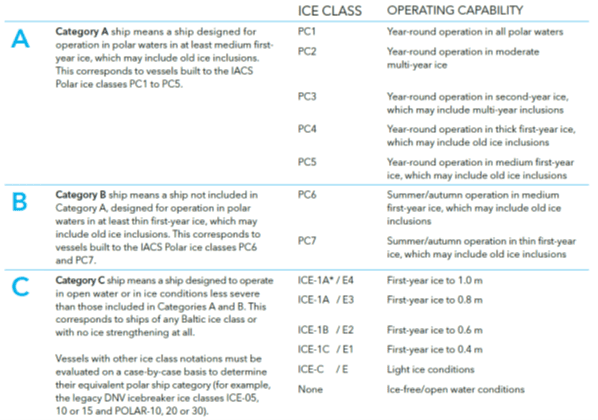
Not all icebreakers are equal.  We rank ships based on their ice class, which relates to the thickness and strength of ice they break.  Higher class matches to stronger structure and bigger ships.  This gets confusing, since multiple companies developed different rating systems.  Figure 2‑1 shows one of the more common systems, the polar ice class.  A ship with class PC6 matches the summer months.  A vessel that normally avoids solid icepack and only breaks the occasional small icebergs.  At the high end, only a few vessels exist with class PC2, as of 2022.  The cruise ship Le Commandant Charcot was built to take passengers to the North Pole, cracking through ice 2.5 m (8 ft) thick! [1]  Think about that.  A wall of ice as tall as the ceiling, and thick ships pushes straight through.  With 93 major icebreakers in service at 2017, there were NO PC1 vessels. [2]  That shows the magnitude of the challenge behind designing icebreakers. 

Iceclass.png

3.0 The Ice Belt

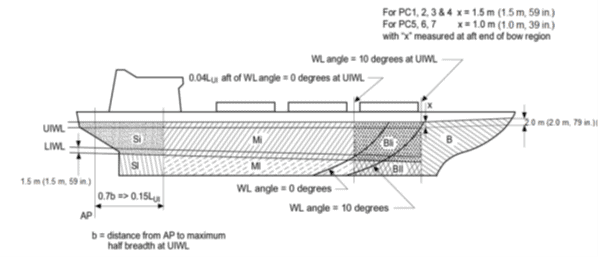
We can’t build the ship from solid steel.  It must remain light enough to float, and that requires us to think strategically about where we need reinforcement for ice.  Most icebreakers run with a deep draft, meaning the hull extends down below regular ice thickness.  And large sections extend above the ice thickness.  A very narrow region near the waterline takes the bulk of abuse from icebreaking.  We call this the ice belt. (Figure 3‑1)  The ice class determines the size and strength of this ice belt. 

Structural engineers hate complicated diagrams like this, because they mean lots of calculations.  We prefer to simply things with an easy rectangle.  It tells a lot about the burden of the ice belt that this diagram includes so much detail.  The ice belt forms in the region between the lower ice waterline (LIWL) and upper ice waterline (UIWL).  Notice that the region starts larger at the bow and narrows towards the stern.  Every piece of different hatching shows a region with different reinforcement requirements.  That ice belt requires so much steel that we drop to lighter structure as quickly as possible.

We need to drop the weight.  On the Mackinaw (WAGB 83), a 1936 icebreaker local to the Great Lakes, the ice belt had hull plating 35 mm (1-3/8 in.) thick. [4, p. 19]  A single square meter of this plate weighed 275 kg (605 lb).  You need a crane just to pickup a small section of plating.  At a rough guess, the Mackinaw had 352 m2, making 97 MT (95 LT) in weight just for the plating!  I know whole ships that weigh less than this ice belt.  For icebreakers, structural design is a careful balance between strength and weight.  To achieve that balance, we scrutinize every single detail.

4.0 Bow Reinforcement

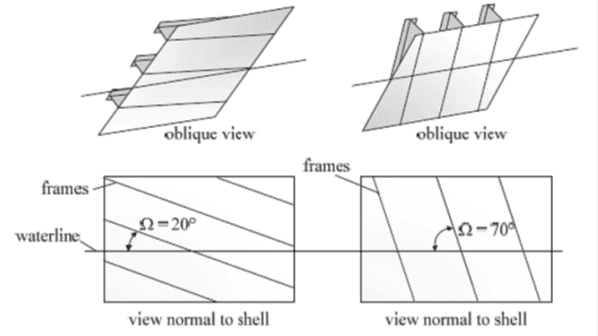
Another region for scrutinization:  the bow.  We shape the bow like a giant ramp, intended to ride up on top of the ice and crash down from above.  This results in titantic forces.  We intentionally impact against the ice.  Surviving this impact requires more than strong steel.  Just like tanks angle their armor to deflect shells, we carefully shape the hull to pick the angles at the point of impact. (Figure 4‑1) 

We shape the hull so the ice rakes along the plating, instead of hitting it squarely.  This considers both the horizontal and vertical angles of the shell plate.  The equations even change with the orientation of the supporting stiffeners.  We really do design the hull to deflect bullets.  Or in this case, chunks of ice.

5.0 Steel Strength

Given the need to create strong structures with light weight, you might think we immediately go to the highest strength steel we can find.  But no.  Higher strength steels come with trade-offs.  They tend to become more brittle.  We want ductile, flexible steel.  When a chunk of ice hits, we want the steel to flex and bend, not crack and break.  Brittle steel spells doom for icebreaking.

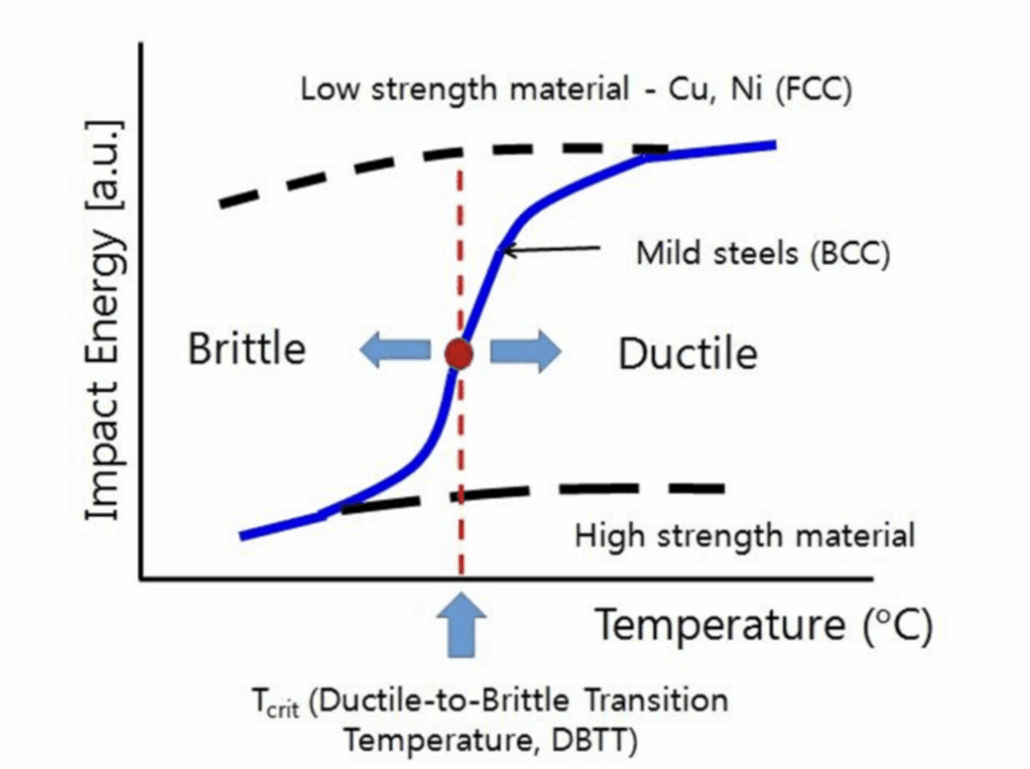
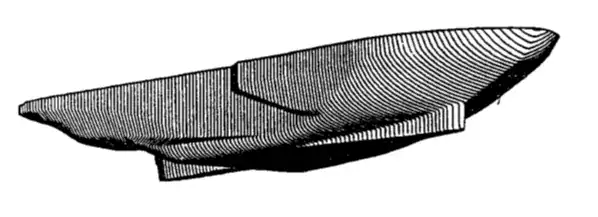
And in cold water, normally ductile steel can become brittle.  Below a transition temperature, the steel stops behaving in a ductile manner and acts brittle. (Figure 5‑1)  And that transition temperature hovers around the same point as cold polar temperatures.  Normal mild steel transitions around -15C [5]  Icebreakers definitely experience temperatures below the freezing point of water (0C), or we wouldn’t have ice!

Now, structural design goes beyond simple strength of steel; we also need to consider the impact energy, at cold temperatures.  Simplifying all the science, more impact energy at lower temperatures equals more ductility.  We can test this in the lab, after freezing our samples to low temperature conditions.  Despite our need for high strength steel, the impact energy may govern our selection for steel properties.  We may choose a low strength steel to ensure it remains ductile and survives decades of abuse as an icebreaker.
Ductilebrittletransition

6.0 Conclusion

Someone once told me that icebreaking felt like crashing your car straight into a brick wall . . . and then repeating the process every minute of the day.  The structure on icebreakers is highly optimized, reinforced and shaped to avoid any concentrated forces.  Every impact spreads the pressures through the hull, and turns a collision into glancing blows.  Careful and smart with our application of steel, only add the strength and weight where we need it.  The small pieces build together.  We form a hull so strong, that we crash straight through the brick wall.

7.0 References

[1] Wikipedia Authors, “Polar Class,” Wikipedia, 15 Dec 2022. [Online]. Available: https://en.wikipedia.org/wiki/Polar_Class. [Accessed 13 Mar 2023].
[2] US Coast Guard, “Major Icebreakers of the World, Explanatory Piece,” USCG office of Waterways and Ocean Policy, Washgington, D.C., USA, 2017.
[3] ABS, “Part 6: Specialized Items and Systems,” in Rules for Building and Classing Marine Vessels, Houston, TX, American Bureau of Shipping, Jan 2023, p. 19.
[4] S. L. Planisek, Icebreaker Mackinaw, 2nd. Edition, Mackinaw City, MI: Great Lakes Lighthouse Keepers Association, 2008.
[5] Shigley, Mechanical Engineering Design, 10th Ed., New York, NY, USA: McGraw-Hill, 2014.
[6] YENA Engineering, “Ductile-Brittle Transition Temperature and Impact Energy Tests,” YENA Engineering, [Online]. Available: https://yenaengineering.nl/ductile-brittle-transition-temperature-and-impact-energy-tests/. [Accessed 13 Mar 2023].
[7] Wikipedia Authors, “Projectil Deflection Effects,” Wikimedia Commons, 16 Jun 2010. [Online]. Available: https://commons.wikimedia.org/wiki/File:Projectil_deflection_effects.jpg. [Accessed 13 Mar 2023].

Share This Post

  • Share on Facebook
  • Share on X
  • Share on WhatsApp
  • Share on Pinterest
  • Share on LinkedIn
  • Share on Tumblr
  • Share on Vk
  • Share on Reddit
  • Share by Mail

More Like This

Ai Image Corrosion

Avoiding Rust: Science of Corrosion on Ships

Hull Structure, Miscellaneous, Shell and Supporting Structure, Structural
https://dmsonline.us/wp-content/uploads/2026/03/AI-Image-Corrosion.png 1024 1024 Nicholas Barczak /wp-content/uploads/2025/06/DMS-logo.svg Nicholas Barczak2026-06-09 07:00:002026-03-26 11:07:47Avoiding Rust: Science of Corrosion on Ships
Project Habbakuk Ship From Ice

Project Habbakuk: A Ship from Ice!

Hull Structure, Materials, Structural
https://dmsonline.us/wp-content/uploads/2023/12/HabbakukCover-Small-1.jpg 489 500 Nate Riggins /wp-content/uploads/2025/06/DMS-logo.svg Nate Riggins2024-09-24 09:18:002026-06-01 10:09:21Project Habbakuk: A Ship from Ice!
050618 G 3721c 067

Surviving the Arctic: Polar Class Icebreakers

Design Support, Fluids, Mechanical, Propulsion, Special Purpose Mechanical Systems, Structural
https://dmsonline.us/wp-content/uploads/2023/12/USCGC_Healy_WAGB-20_north_of_Alaska-scaled-1.jpg 633 1200 Nate Riggins /wp-content/uploads/2025/06/DMS-logo.svg Nate Riggins2024-05-14 09:00:002026-06-01 10:09:22Surviving the Arctic: Polar Class Icebreakers
Mackinawice1

Ramming the Ice: Icebreaker Propulsion

Energy Generation, Fluids, Hull Structure, Propulsion, Propulsion Plant, Propulsion Units, Propulsors, Structural, Transmission and Propulsor Systems
https://dmsonline.us/wp-content/uploads/2023/12/MackinawIce1-scaled-1.jpg 883 1200 Nate Riggins /wp-content/uploads/2025/06/DMS-logo.svg Nate Riggins2024-03-19 09:00:002026-06-01 10:09:22Ramming the Ice: Icebreaker Propulsion
Freighter In Ice

Breaking the Ice: Icebreakers

Hull Structure, Propulsion, Propulsion Units, Propulsors, Structural
https://dmsonline.us/wp-content/uploads/2023/12/MackinawIce2-scaled-1.jpg 1200 985 Nate Riggins /wp-content/uploads/2025/06/DMS-logo.svg Nate Riggins2024-01-16 09:00:002026-06-01 10:09:23Breaking the Ice: Icebreakers
Mvaltairgeneralarrangementplan Smallresolution

How to Design a Ship

Arrangements, Hydrostatics, Mechanical, Piping, Structural
https://dmsonline.us/wp-content/uploads/2022/06/MVAltairGeneralArrangementPlan_SmallResolution.webp 299 640 Nate Riggins /wp-content/uploads/2025/06/DMS-logo.svg Nate Riggins2022-09-12 06:00:002025-09-30 07:31:20How to Design a Ship
Twinrudder

Commercial Ship Safety

Auxiliary Systems, Hull Structure, Quality Assurance
https://dmsonline.us/wp-content/uploads/2022/06/TwinRudder-scaled-1.jpg 1476 2048 Nate Riggins /wp-content/uploads/2025/06/DMS-logo.svg Nate Riggins2022-06-13 06:00:002025-08-15 10:34:26Commercial Ship Safety
Foundation 3 – Stress Pattern

Strength and Stiffness: Design of Structural Foundations

Hull Decks, Hull Structural Bulkheads, Hull Structure, Masts, Kingposts, Service Platforms, Miscellaneous, Shell and Supporting Structure, Special Purpose Structure
https://dmsonline.us/wp-content/uploads/2021/10/M21006-Fig5-8.png 721 1430 Nate Riggins /wp-content/uploads/2025/06/DMS-logo.svg Nate Riggins2021-10-04 22:53:032025-08-15 13:25:42Strength and Stiffness: Design of Structural Foundations
Kitboat

5 Steps to (NOT) Build a Boat

Engineering Business, Hull Structure, Integration / Engineering, Production Engineering, Project Management, Shipyard And Support Services
https://dmsonline.us/wp-content/uploads/2020/12/KitBoat.jpg 327 436 Nate Riggins /wp-content/uploads/2025/06/DMS-logo.svg Nate Riggins2021-02-01 07:00:002026-06-01 10:09:245 Steps to (NOT) Build a Boat
Previous Previous Previous Next Next Next

Categories

  • 3D Modeling
  • Arrangements
  • Auxiliary Systems
  • Command and Surveillance
  • Design Support
  • Drafting
  • Economics
  • Elastic Static Loading
  • Electrical
  • Energy Generation
  • Engineering Business
  • Equipment Integration
  • Fatigue
  • FEA / Numerical Methods
  • Fluid Dynamics
  • Fluid Loads
  • Fluids
  • Fluids Special Methods
  • Fluids Testing
  • Green Ship Design
  • Hiring Consultant
  • Hull Decks
  • Hull Structural Bulkheads
  • Hull Structure
  • Human Ergonomics
  • Hydrostatics
  • Insurance
  • Integration / Engineering
  • Legal
  • Marine Entrepreneurship
  • Masts, Kingposts, Service Platforms
  • Materials
  • Mechanical
  • Mechanical Handling Systems
  • Miscellaneous
  • Naval Architecture
  • Passenger Vessel
  • Piping
  • Production Engineering
  • Project Management
  • Propulsion
  • Propulsion Plant
  • Propulsion Units
  • Propulsor Shrouds and Ducts
  • Propulsors
  • Quality Assurance
  • Recreation
  • Regulations
  • Replenishment Systems
  • Resistance
  • Seakeeping / Fluid Structure Interaction
  • Shell and Supporting Structure
  • Ship Control Systems
  • Ship Maneuvering
  • Ship Motion Control
  • Ship Response
  • Shipyard And Support Services
  • Special Methods
  • Special Purpose Mechanical Systems
  • Special Purpose Structure
  • Stability Test
  • Structural
  • Support Services
  • Sustainable Marine Technology
  • Towing Tank
  • Transmission and Propulsor Systems
  • Unmanned Vessels
  • USCG
  • Vessel Design
  • Waterjet Propulsors

Our Socials

About Us

Ship designs tailored to your mission. Engineering that advances profits.

Dms Logo Negatives

What We Do

Vessel Design

Naval Architecture

Advanced Analysis

Marine Systems

Civil Engineering

Contact Us

(616) 504-1619

[email protected]

Website by Abstrakt Marketing Group ©
  • Privacy Policy
  • Sitemap
Scroll to top Scroll to top Scroll to top

This site uses cookies. By continuing to browse the site, you are agreeing to our use of cookies.

AcceptLearn more

Cookie and Privacy Settings


How we use cookies

We may request cookies to be set on your device. We use cookies to let us know when you visit our websites, how you interact with us, to enrich your user experience, and to customize your relationship with our website.

Click on the different category headings to find out more. You can also change some of your preferences. Note that blocking some types of cookies may impact your experience on our websites and the services we are able to offer.

Essential Website Cookies

These cookies are strictly necessary to provide you with services available through our website and to use some of its features.

Because these cookies are strictly necessary to deliver the website, refusing them will have impact how our site functions. You always can block or delete cookies by changing your browser settings and force blocking all cookies on this website. But this will always prompt you to accept/refuse cookies when revisiting our site.

We fully respect if you want to refuse cookies but to avoid asking you again and again kindly allow us to store a cookie for that. You are free to opt out any time or opt in for other cookies to get a better experience. If you refuse cookies we will remove all set cookies in our domain.

We provide you with a list of stored cookies on your computer in our domain so you can check what we stored. Due to security reasons we are not able to show or modify cookies from other domains. You can check these in your browser security settings.

Other external services

We also use different external services like Google Webfonts, Google Maps, and external Video providers. Since these providers may collect personal data like your IP address we allow you to block them here. Please be aware that this might heavily reduce the functionality and appearance of our site. Changes will take effect once you reload the page.

Google Webfont Settings:

Google Map Settings:

Google reCaptcha Settings:

Vimeo and Youtube video embeds:

Accept settingsHide notification only