Datawave Marine Solutions
  • Dms Logo
  • Services
    • Vessel Design
      • Concept Design
    • Naval Architecture
    • Advanced Analysis
    • Marine Systems
    • Civil Engineering
  • Marine Operations
    • Passenger Vessels
    • Work Boats
    • Research Boats
    • Shipyards
    • Marine Startups
    • Waterway Maintenance
    • Autonomous Vessels
  • Portfolio
  • About Us
  • Resources
    • Blog
    • GHS Tutorials
    • FAQs
  • Contact
  • Menu Menu

Batteries for Electric Propulsion

Which battery to choose? The batteries form one of the most expensive components in electric propulsion. Today, review the basic battery chemistries out there, allowing you to quickly identify the best battery strategy.

1.0 Introduction

Which battery to choose?  The batteries form one of the most expensive components in electric propulsion, but not because of their complexity.  With batteries, you simply need a LOT of them.  This becomes a serious challenge for space and weight, since batteries are also very heavy.  Further, the market appears very complex, with dozens of battery vendors, all claiming they are the best.  Today, I will review the basic battery chemistries out there, pros and cons, and best use scenarios for each chemistry.  Armed with this knowledge, you can quickly determine which battery type best suits you, eliminating 90% of the marketing hype.

2.0 Batteries

When selecting batteries, we start by considering the chemistry.  Which type of battery do you want?  This depends on several factors:

  1. Battery capacity
  2. Depth of discharge / useable capacity
  3. Weight
  4. Volume / space for storage
  5. Lifetime charge cycles
  6. Cost

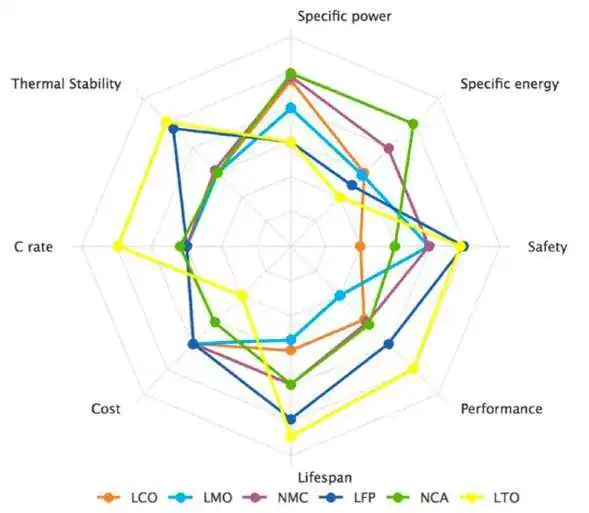
When comparing battery types, we often see charts like Figure 3‑1.  But did you notice the little asterix that said “Based on Bare Cell”?  These numbers come from a test battery; something only ever used in a lab.  It doesn’t consider the weight of the casing, spacing of multiple cells, any included electronics to protect the battery.  And it ignores cost.  Is this actually realistic?

I prefer to compare real-world batteries in their final state. (Figure 2‑2)  This offers a skewed perspective, because I only compare individual manufacturers, with no guarantee that I picked the best manufacturer in each category.  But it provides an excellent overview to decide which battery chemistry warrants further scrutiny.

Figure 2‑2 shows the same comparison of weight and volume, but based on real world batteries.  We see that they largely segregate into three categories.  Lead acid and AGM batteries form the entry level.  Nothing impressive from a weight and volume perspective.  Lithium iron phosphate (LiFePO4) stands out as the clear winner, both weighing less and requiring less volume.  Then carbon foam stands in its own category.  This doesn’t win any prizes for weight, with similar specific energy to lead acid.  But it leads the pack in terms of volumetric density.  Carbon foam packs the energy into a small space, requiring even less volume than LiFePO4.  Not a good choice for racing boats that need to minimize weight.  But if you have a cruising boat and just need to fit lots of battery into a small space, carbon foam offers a good option.  Which battery works you?  Your lifestyle determines the best battery chemistry.

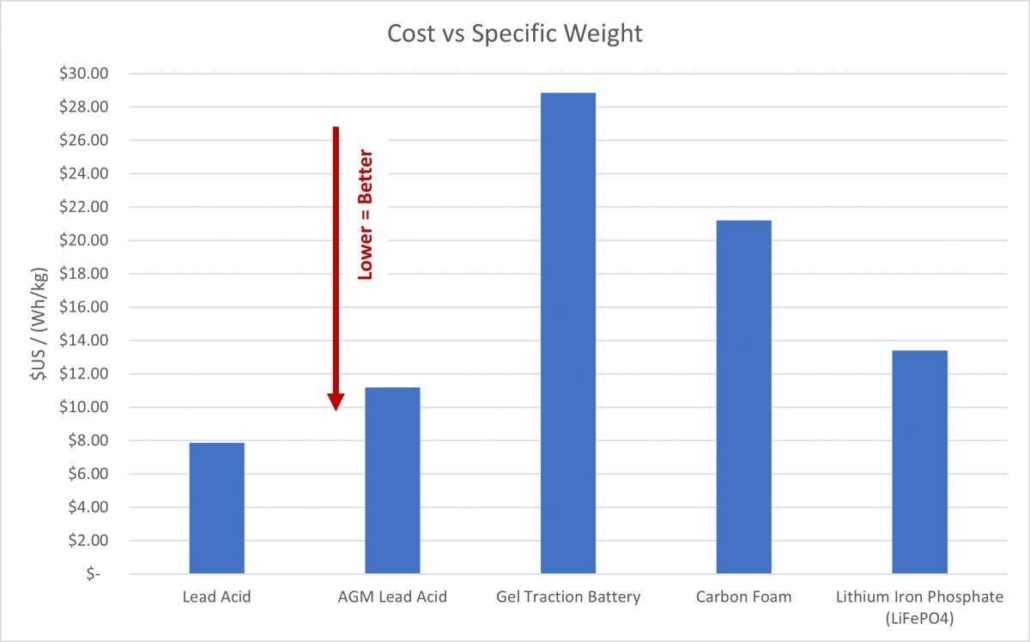
By lifestyle, I actually mean your wallet.  It’s no secret that cost factors largely into purchase decisions.  Better performance requires higher cost.  So how much do we pay for those fancy lightweight batteries?  Figure 2‑3 compares cost against specific weight.  This combines the energy supplied, weight of the battery, and cost for purchase into one comparison.  In this comparison, lithium batteries only cost about 20% more than AGM batteries.  Sure, you pay more for lithium, but you get more as well.  Looking at the graph, we also see that carbon foam batteries don’t win on a weight basis.  The previous graph confirmed this:  carbon foam batteries stand out for more energy in a smaller package.  But there’s more to a battery than weight.  We also care about the cost of the power they deliver.

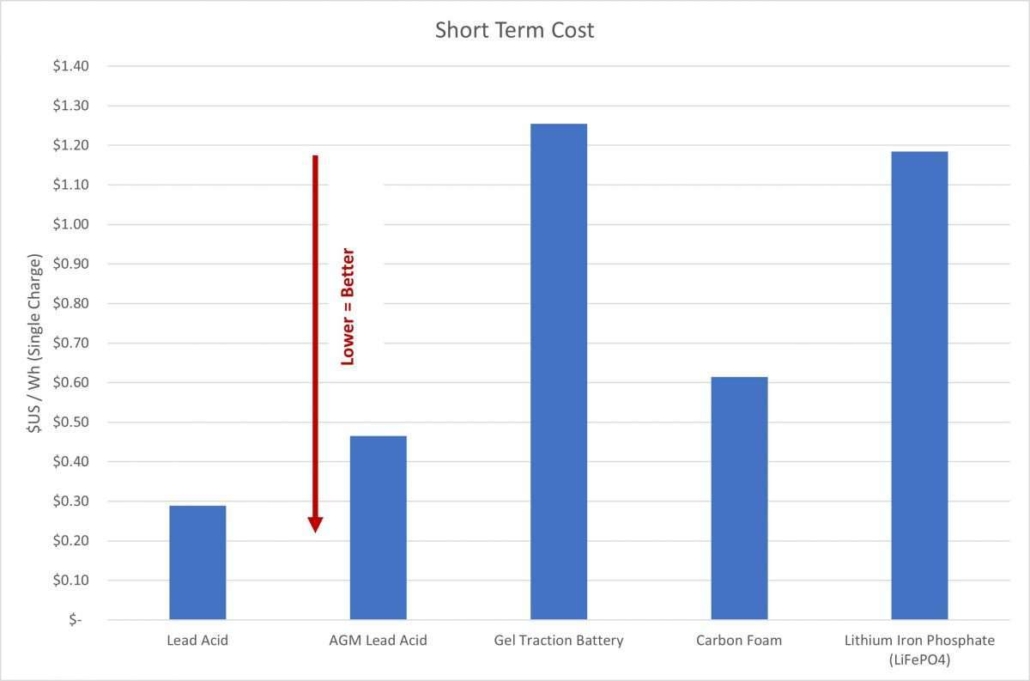
With large investments like batteries, we especially need to ensure we get good value for our money.  We want batteries that are good at storing electricity, for a reasonable price.  I compared purchase price against energy storage in the batteries.  Now things get interesting; value sways heavily based on two major factors:

  1. Depth of discharge:  To maintain battery life, you shouldn’t discharge a battery completely before recharging.  This sets the useable capacity of your battery.
  2. Total lifetime cycles:  how many times can you recharge the battery before it stops working.

The answer shows a strong relationship between these two factors, leading to many complicated graphs and tables.  I kept things simple by selecting the best values in each category, creating a best case comparison.  But best value depends on how you use the battery.

Figure 2‑4 shows two cost comparisons.  The Short Term Cost compares purchase price against the useable energy from a single charge of the battery.  The Long Term Cost compares against the total energy stored in the battery across the lifetime of all recharge cycles.  In the long term, LiFePO4 batteries trounce lead acid.  Lithium extracts a heavy price, but it may be the last battery you ever buy.  Carbon foam batteries fall in very close to lithium.  Less performance, but less cost as well.  Here’s the catch.  These high costs only make sense if you plan to use the full life of the battery.

Even with daily use, a lithium battery lasts around 16 years.  Do you plan to use your boat for that long?  The average weekend sailor barely uses their battery.  They fall more into the short term comparison.  In the short term, lead acid devastates lithium and carbon foam.  Simple and cheap is the way to go for short term usage.  Sure, it doesn’t win any performance competitions.  But you never needed performance. 

Performance or bargain basement?  The best value for battery chemistry depends on your lifetime.  How do you plan to use the batteries and how long will you own them?
M220007 02 Battery Density
Costvsspecificweight
M22007 02 Long Term Battery Cost
M22007 02 Short Term Battery Cost

3.0 Lithium Battery Safety

Given the high energy requirements for electric propulsion, many people opt for the performance of lithium ion batteries.  But within the category of lithium ion, you run into several more choices.  There are many different types of lithium ion chemistries.  The chemistry favored by the recreational market is lithium iron phosphate (LiFePO4).  We like these for a safety reason:  they do not suffer from thermal runaway as easily as the other batteries.

Thermal runaway.  That’s a nice way to say that if your lithium battery gets too hot, it can ignite and burn a hole through your boat!  More technically, all lithium chemistries have a temperature where the different chemistries start to break down, releasing oxygen and generating extensive heat.  Thermal runaway happens when this starts in one cell of the battery, and the heat raises the temperature high enough to kick off the next cell.  And the next and the next, until the entire battery is one hot ball of flame. 

With lithium iron phosphate (LiFePO4), this is extremely difficult. [2] [3] [4]  Certainly, LiFePO4 still heats and vents profusely, if used improperly.  Lots of smoke, but rarely any fire.  By design, the heat of a single cell should not raise the temperature high enough to ignite the neighboring cells.  One major exception is a puncture to the battery.  Some type of physical damage that creates a new conductor between cells and allows rapid current flow.  This could result in major heat and may possibly create thermal runaway in a few circumstances.  But I place that as a low risk.  Ask yourself, what scenario results in a physical puncture to the protected battery?  Almost any answer to that starts with some other disaster that will likely take precedent.  For all but a few unlikely events, thermal runaway doesn’t happen with LiFePO4 batteries.  When shopping for marine lithium batteries, LiFePO4 is the only safe choice.

4.0 Conclusion

Going electric grants you a lot of options . . . and dozens of decisions.  With batteries, this comes down to a few key decisions:

  1. How will you use the battery?  Is this is a long term investment, or short term project?
  2. How much do you care about weight?
  3. How much space do you have available?
  4. If considering lithium ion batteries, make sure you pick lithium iron phosphate (LiFePO4).

These key questions very quickly filter the choices and ease the workload of selecting your batteries.  Just take it one stage at a time.  And don’t be afraid to change your mind.  You got this.

5.0 Acknowledgement

Many thanks to Jeff Cote from Pacific Yacht Systems for helping with much of the background and practical knowledge of these articles.  For more information on yacht electrical installations, check out their YouTube channel at:  https://www.youtube.com/c/PacificYachtSystems

6.0 References


[1] Epec, “Battery Cell Comparison,” NASA – National Aeronautics and Space Administration, . Available: https://www.epectec.com/batteries/cell-comparison.html. .
[2] E. Bretscher, “Lithium Battery Banks – Fundamentals,” Nordkyn Design: Science and Engineering, 27 Sep 2015. . Available: https://nordkyndesign.com/lithium-battery-banks-fundamentals/. .
[3] D. R. e. al., “Thermal Runaway Propagation Suppression in Lithium-Ion Battery Systems,” in DOE OE Energy Storage Peer Review, SAND2016-9433C, Sept 22, 2016.
[4] YouTube Creator, “How to Prevent thermal Runaway in Li Ion Batteries 07 01 2020,” YouTube, 24 Aug 2020. . Available: https://youtu.be/aUqS6beG52w. .
[5] T. O’Kelly’s, “$1M Charter Catamaran Conversion -PART 2- Top Secret (electric) Boat Tour,” YouTube, 16 May 2019. . Available: https://youtu.be/nchKhM_TxYk. .
[6] R. Munyan, “Low Voltage But Not Low Risk,” Electrical Contractor, . Available: https://www.ecmag.com/section/miscellaneous/low-voltage-not-low-risk. .
[7] Elco Motors, “EP-100 Electric Inboard,” Elco Motors, . Available: https://www.elcomotoryachts.com/product/ep-100-electric-inboard/. .
[8] R. Tangney, “Generator Synchronization – Theory and Simulation,” YouTube, 11 Jan 2021. . Available: https://youtu.be/4lFGVGz454c. .
[9] West Marine, “NORTHSTAR BATTERY High Performance Pure Lead 24M AGM,” West Marine, . Available: https://www.westmarine.com/northstar-battery-elite-high-performance-pure-lead-24m-agm-battery-with-sae-threaded-terminals-19225192.html. .
[10] Interstate Battery, “SRM-31,” Interstate Battery, . Available: https://www.interstatebatteries.com/products/srm-31?productline=marine. .
[11] Battery University, “BU-804: How to Prolong Lead-Acid Batteries,” Battery University, . Available: https://batteryuniversity.com/article/bu-804-how-to-prolong-lead-acid-batteries. .
[12] Mastervolt, “Determining the lifespan of a battery,” Mastervolt, . Available: https://www.mastervolt.com/determining-the-lifespan-of-a-battery/. .
[13] Mastervolt, “MVSV 280,” Mastervolt, . Available: https://www.mastervolt.com/products/mvsv-2v-gel/mvsv-2-280-gel/. .
[14] MegaDepot, “Mastervolt 68000280 MVSV 280 Ah 2-Volt Gel Battery,” MegaDepot, . Available: https://megadepot.com/product/mastervolt-68000280-mvsv-280-ah-2-volt-gel-battery. .
[15] Firefly Energy, “Oasis MCF G31,” Firefly Energy, . Available: https://fireflyenergy.com/oasis-mcf-g31.html. .
[16] E Marine Systems, “RELiON Lithium Batteries,” E Marine Systems: Marine Energy Solutions, . Available: https://www.emarineinc.com/categories/RELiON-Lithium-Batteries. .
[17] E Marine Systems, “RELiON RB80 12V 80Ah LiFePO4 Battery,” E Marine Systems Marine Energy Solutions, . Available: https://www.emarineinc.com/RELiON-RB80-12V-80Ah-LiFePO4-Battery. .
[18] Hybrid Marine, “How our Hybrids Work,” Hybrid Marine, . Available: https://www.hybrid-marine.co.uk/index.php/hybrid-info/how-our-hybrid-work. .
[19] Solar Energy Scout, “Lead Acid vs Lithium Batteries. Which Should You Choose?,” Solar Energy Scout, . Available: https://solarenergyscout.com/lead-acid-vs-lithium-batteries/. .
[20] Iron Edison, “Nickel Iron Battery – Depth of Discharge life,” Wikimedia Commons, 6 May 2011. . Available: https://commons.wikimedia.org/wiki/File:Nickel_Iron_Battery_-_Depth_of_Discharge_life.jpg. .
[21] HighTechLab, “LiFePO4 Puncture Test – Can these batteries catch fire? Is LiFePO4 Safe?,” YouTube, 4 Feb 2021. . Available: https://youtu.be/07BS6QY3wI8. .

Share This Post

  • Share on Facebook
  • Share on X
  • Share on WhatsApp
  • Share on Pinterest
  • Share on LinkedIn
  • Share on Tumblr
  • Share on Vk
  • Share on Reddit
  • Share by Mail

More Like This

Ai Image Corrosion

Avoiding Rust: Science of Corrosion on Ships

Hull Structure, Miscellaneous, Shell and Supporting Structure, Structural
https://dmsonline.us/wp-content/uploads/2026/03/AI-Image-Corrosion.png 1024 1024 Nicholas Barczak /wp-content/uploads/2025/06/DMS-logo.svg Nicholas Barczak2026-06-09 07:00:002026-03-26 11:07:47Avoiding Rust: Science of Corrosion on Ships
Seakeeper Clickbait

How a Seakeeper Works: Gyro Stabilization Explained

Fluid Dynamics, Fluid Loads, Fluids, Miscellaneous, Naval Architecture, Ship Motion Control
https://dmsonline.us/wp-content/uploads/2026/03/Clickbait.jpg 720 1280 Nicholas Barczak /wp-content/uploads/2025/06/DMS-logo.svg Nicholas Barczak2026-04-07 07:00:002026-06-01 10:09:14How a Seakeeper Works: Gyro Stabilization Explained
Big Luxury Cabin Motorboat Cruiser Yacht Engine At Trailer Ramp

Hybrid Electric Boats: The Prius of the Sea?

Electrical
https://dmsonline.us/wp-content/uploads/2026/04/Big-luxury-cabin-motorboat-cruiser-yacht-engine-at-trailer-ramp.jpg 1250 2000 Abstrakt Marketing /wp-content/uploads/2025/06/DMS-logo.svg Abstrakt Marketing2026-04-01 17:35:042026-06-01 10:09:15Hybrid Electric Boats: The Prius of the Sea?
How to Buy a Towing Tank

How to Buy a Towing Tank: Purchase and Design Guide

Fluids, Fluids Special Methods, Miscellaneous, Towing Tank
https://dmsonline.us/wp-content/uploads/2025/08/Clickbait.jpg 720 1280 Nicholas Barczak /wp-content/uploads/2025/06/DMS-logo.svg Nicholas Barczak2025-11-11 07:00:002026-06-01 10:09:18How to Buy a Towing Tank: Purchase and Design Guide
Large Oil Barge In A River

Marine Highways: Short Sea Shipping

Economics, Integration / Engineering, Miscellaneous, Support Services
https://dmsonline.us/wp-content/uploads/2025/07/Large-Oil-Barge-in-a-River.jpg 1250 2000 Nicholas Barczak /wp-content/uploads/2025/06/DMS-logo.svg Nicholas Barczak2025-08-22 14:44:512026-06-01 10:09:21Marine Highways: Short Sea Shipping
M22008 Clickbait

Electric Yacht Charging

Electrical, Miscellaneous
https://dmsonline.us/wp-content/uploads/2022/09/ClickBait_2.89.9-scaled-1.jpg 675 1200 Nate Riggins /wp-content/uploads/2025/06/DMS-logo.svg Nate Riggins2023-04-03 08:00:002025-08-15 10:36:17Electric Yacht Charging
Slide21 Clickbait

Electric Yacht System Design

Electrical, Miscellaneous
https://dmsonline.us/wp-content/uploads/2022/09/Slide21-Clickbait-scaled-1.jpg 675 1200 Nate Riggins /wp-content/uploads/2025/06/DMS-logo.svg Nate Riggins2023-01-30 08:00:002026-04-01 17:35:22Electric Yacht System Design
M22006 Clickbait

Emergency Electric Propulsion

Electrical, Miscellaneous
https://dmsonline.us/wp-content/uploads/2022/09/M22006-ClickBait-scaled-1.jpg 675 1200 Nate Riggins /wp-content/uploads/2025/06/DMS-logo.svg Nate Riggins2022-12-05 08:00:002025-08-15 10:38:53Emergency Electric Propulsion
M22005 Clickbait

5 Myths with Electric Propulsion

Electrical
https://dmsonline.us/wp-content/uploads/2022/09/ClickBait_2.74.6-scaled-1.jpg 675 1200 Nate Riggins /wp-content/uploads/2025/06/DMS-logo.svg Nate Riggins2022-10-31 06:00:002025-08-15 10:50:455 Myths with Electric Propulsion
Previous Previous Previous Next Next Next

Categories

  • 3D Modeling
  • Arrangements
  • Auxiliary Systems
  • Command and Surveillance
  • Design Support
  • Drafting
  • Economics
  • Elastic Static Loading
  • Electrical
  • Energy Generation
  • Engineering Business
  • Equipment Integration
  • Fatigue
  • FEA / Numerical Methods
  • Fluid Dynamics
  • Fluid Loads
  • Fluids
  • Fluids Special Methods
  • Fluids Testing
  • Green Ship Design
  • Hiring Consultant
  • Hull Decks
  • Hull Structural Bulkheads
  • Hull Structure
  • Human Ergonomics
  • Hydrostatics
  • Insurance
  • Integration / Engineering
  • Legal
  • Marine Entrepreneurship
  • Masts, Kingposts, Service Platforms
  • Materials
  • Mechanical
  • Mechanical Handling Systems
  • Miscellaneous
  • Naval Architecture
  • Passenger Vessel
  • Piping
  • Production Engineering
  • Project Management
  • Propulsion
  • Propulsion Plant
  • Propulsion Units
  • Propulsor Shrouds and Ducts
  • Propulsors
  • Quality Assurance
  • Recreation
  • Regulations
  • Replenishment Systems
  • Resistance
  • Seakeeping / Fluid Structure Interaction
  • Shell and Supporting Structure
  • Ship Control Systems
  • Ship Maneuvering
  • Ship Motion Control
  • Ship Response
  • Shipyard And Support Services
  • Special Methods
  • Special Purpose Mechanical Systems
  • Special Purpose Structure
  • Stability Test
  • Structural
  • Support Services
  • Sustainable Marine Technology
  • Towing Tank
  • Transmission and Propulsor Systems
  • Unmanned Vessels
  • USCG
  • Vessel Design
  • Waterjet Propulsors

Our Socials

About Us

Ship designs tailored to your mission. Engineering that advances profits.

Dms Logo Negatives

What We Do

Vessel Design

Naval Architecture

Advanced Analysis

Marine Systems

Civil Engineering

Contact Us

(616) 504-1619

[email protected]

Website by Abstrakt Marketing Group ©
  • Privacy Policy
  • Sitemap
Scroll to top Scroll to top Scroll to top

This site uses cookies. By continuing to browse the site, you are agreeing to our use of cookies.

AcceptLearn more

Cookie and Privacy Settings


How we use cookies

We may request cookies to be set on your device. We use cookies to let us know when you visit our websites, how you interact with us, to enrich your user experience, and to customize your relationship with our website.

Click on the different category headings to find out more. You can also change some of your preferences. Note that blocking some types of cookies may impact your experience on our websites and the services we are able to offer.

Essential Website Cookies

These cookies are strictly necessary to provide you with services available through our website and to use some of its features.

Because these cookies are strictly necessary to deliver the website, refusing them will have impact how our site functions. You always can block or delete cookies by changing your browser settings and force blocking all cookies on this website. But this will always prompt you to accept/refuse cookies when revisiting our site.

We fully respect if you want to refuse cookies but to avoid asking you again and again kindly allow us to store a cookie for that. You are free to opt out any time or opt in for other cookies to get a better experience. If you refuse cookies we will remove all set cookies in our domain.

We provide you with a list of stored cookies on your computer in our domain so you can check what we stored. Due to security reasons we are not able to show or modify cookies from other domains. You can check these in your browser security settings.

Other external services

We also use different external services like Google Webfonts, Google Maps, and external Video providers. Since these providers may collect personal data like your IP address we allow you to block them here. Please be aware that this might heavily reduce the functionality and appearance of our site. Changes will take effect once you reload the page.

Google Webfont Settings:

Google Map Settings:

Google reCaptcha Settings:

Vimeo and Youtube video embeds:

Accept settingsHide notification only