• Dms Logo
  • Services
    • Vessel Design
      • Concept Design
    • Naval Architecture
    • Advanced Analysis
    • Marine Systems
    • Civil Engineering
  • Marine Operations
    • Passenger Vessels
    • Work Boats
    • Research Boats
    • Shipyards
    • Marine Startups
    • Waterway Maintenance
    • Autonomous Vessels
  • Portfolio
  • About Us
  • Resources
    • Blog
    • GHS Tutorials
    • FAQs
  • Contact
  • Menu Menu

Electric Yacht Charging

Electric power entices us with its flexibility and adaptability. And that extends to our charging sources. We gain the ability to recharge our batteries from nearly any source, assuming everything works together. Discover the critical issues to combine multiple charging sources for electric propulsion.

1.0 Introduction

Without a method to recharge them, electric batteries just make expensive paperweights.  A major allure behind electric propulsion is the ability to recharge the batteries from multiple sources, leading to vastly extended range.  But this isn’t easy.  Most electric yachts require multiple charging sources.  How to make them all work together nicely?  Today I review methods of charging on electric yachts, and how to combine them.

2.0 DC Charging

When recharging the massive battery bank, go straight to the source.  Direct current (DC) chargers.  Many electric yachts include multiple DC sources for charging: 

  1. Solar panels
  2. Engine alternator
  3. Methanol fuel cell
  4. Regeneration from propulsion motor
  5. Wind turbine

How to combine them?  Charging on the DC circuit offers the simplest option.  Generally, each source includes its own battery charger.  The battery charger takes the raw output from your charging source and controls it to provide a tempered current flow to the battery.  The current controls the rate of recharge for the battery, and we want to slow down that recharge as the battery gets full.  Recharging heats up the battery; too much heat and we damage the battery.  For some batteries, too much heat also means fire or explosion.  This is why the good battery chargers are programmed with different charging profiles, depending on your battery chemistry.  Smarter chargers make for healthy batteries.

Charging too fast makes batteries go boom; so, combining multiple chargers makes for a terrible idea, right?  Nope.  There is nothing wrong with connecting all these battery chargers to the same point, going straight into the battery.  Chargers work by sensing the voltage at the battery.  As the battery recharges up to full, the voltage from the battery increases slightly.  A nominal 12V battery may generate 13 – 13.6V when fully charged.  This is how a charger tracks the state of the battery.  But it also means that to put power into the battery, the charger needs to supply that full voltage, or even slightly higher.

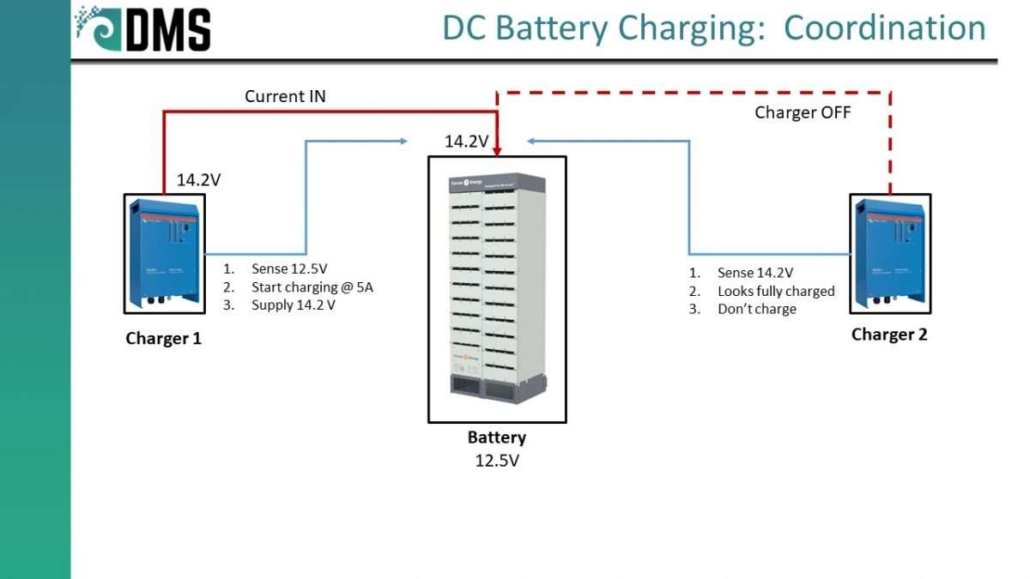
Now play this out with two battery chargers going to one battery. (Figure 2‑1)  Charger 1 reads the battery voltage as 12.5V.  It starts recharging the battery, supplying a voltage of 14.2V.  The voltage now reads as 14.2V everywhere on that circuit.  Charger 2 came into the game a little too late.  Now it reads 14.2V, thinking that is the battery voltage.  Charger 2 thinks the battery is full and turns off.  This method of coordination means multiple chargers will not overload the battery.  You can happily connect dozens of chargers, and only one turns on at any given time.  But sometimes we want more than one charger. 

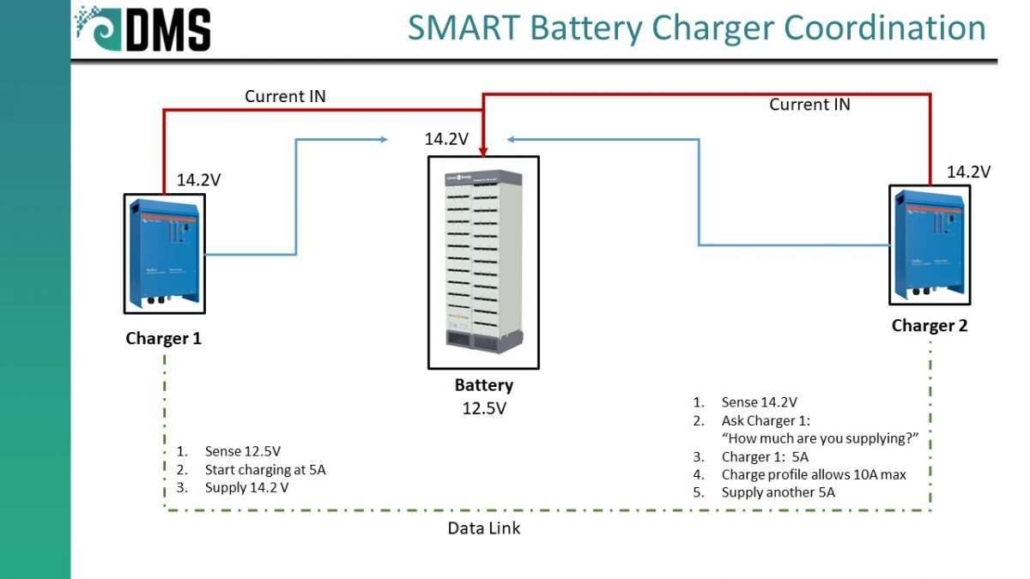
Electric propulsion frequently requires smart battery chargers.  To get a reasonable recharge time on those massive batteries, we generally need more current than one charger can muster.  Smart battery chargers work in parallel. (Figure 2‑2)  Rather than just sensing the voltage at the battery, these chargers communicate with each other directly.  Normally, one the chargers becomes the master, with a charge profile that specifies current limits for each stage in the charge cycle.  The master charger then coordinates with the others to ensure the combined total stays within that charge profile.

How do they coordinate?  Not sure on the details.  That lies beyond my knowledge, and the specific details usually depend on the manufacturer.  This often ties you to one manufacturer.  When coordinating with multiple smart charges, expect they all need to come from the same manufacturer.  Probably even models from the same series of products.  Carefully select your manufacturer, since you may buy a LOT of equipment from them.
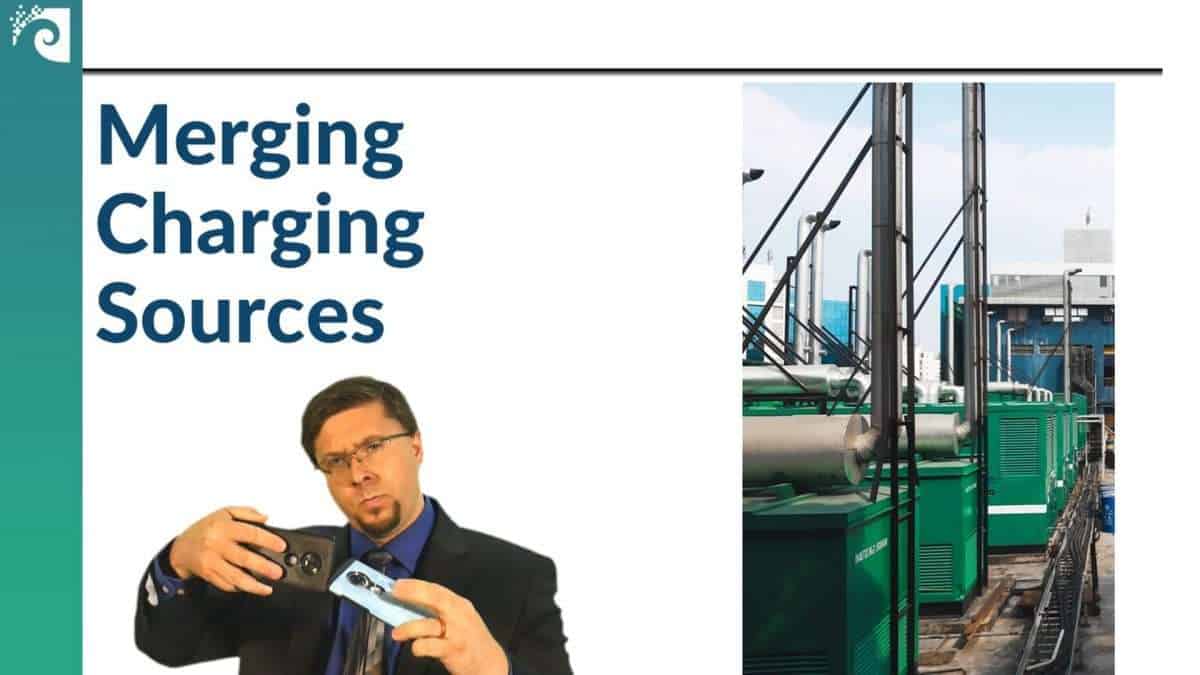
M22007 Example Of Charger Coordination
M22007: Example Of Smart Battery Charging

2.1 Charging Lithium Batteries

When charging lithium ion batteries, be especially cautious.  Ensure your battery charger has a profile for lithium ion batteries.  If a lithium battery gets too hot, that can lead to fire in the wrong circumstances.  Temperature monitoring becomes critical.  With lithium, the wrong settings mean more than just a damaged battery. 

And be sure any engine alternator is designed for lithium ion batteries.  Lithium batteries often come with internal circuity to protect the battery during recharging.  If the battery gets too hot, that internal circuit disconnects the battery to protect it, just like flipping a switch.  Engine alternators don’t like it when they suddenly lose the battery.  It tends to damage or destroy the alternator.  Be sure your alternator is protected against this if recharging a lithium battery. 

3.0 Diesel Generators

Diesel generators are great for long term storage of energy.  Yes, they consume diesel fuel, which has negative environmental effects.  But batteries can’t compete with the energy density of diesel fuel.  Even adjusting for the weight and size of the generator, diesel fuel holds much more energy in a smaller space than any battery.

So go out and buy a DC generator, right?  I just extolled the simplicity of DC charging.  A massive DC generator can supply huge quantities of power and quickly recharge the batteries, right?  Not so easy.  Here we suffer from supply limits.  Most large generators are AC supply.  They were built for a traditional yacht market, where the largest loads come from the AC side:  refrigeration, air conditioning, etc.  Most likely, you need to buy an AC generator and then convert that into DC power for battery charging.

This is normally where people talk about inverters.  A standard yacht comes with an inverter to convert from DC power to AC, and the inverter can go the other way, converter your AC generator into DC battery charging.  Seems normal to connect that generator with the inverter.  Maybe not.  This depends on cost. 

Remember that you need to convert a huge amount of power to supply electric propulsion.  Large power means large, expensive equipment.  A simple battery charger costs less than the fancy inverter.  You can potentially save some money by running the generator through a dedicated battery charger and then buy a smaller inverter for the regular hotel loads.

4.0 Merging Power Supplies

There is a myth that ABYC standards do not allow boats to combine AC charging sources.  You only get to select the internal generator or the shore power.  Seems like a major problem on an electric yacht where charging sources abound.  Let me reassure you, AC charging absolutely allows you to combine sources, but it gets a little more complicated than the DC side.  We need to tackle the problem of synchronization.  (Figure 4‑1)

Figure 4‑1:  Explanation for Synchronizing AC Sources [1]

AC power works with electrons moving back and forth through the wires.  They travel in both directions, working in a rhythm.  That rhythm is the frequency of the power, normally 60 Hz in North America.  When adding a new AC source in, we need to match that rhythm in three ways: 

  1. Match voltage
  2. Match frequency
  3. Match phase

All these items need to match (within tolerance) before connecting two or more AC sources together.  This synchronization takes specialized equipment, which is why ABYC will not let you just throw a switch and connect the wires from two AC sources.  But add synchronizing equipment as a bridge between the two AC sources, and its perfectly fine to combine them.  This is covered in ABYC standard A-32, part 32.12.  Thankfully, you don’t need to learn the process of manually synchronizing your generators.  We have equipment now to automatically synchronize AC sources.

In fact, you may already have an AC synchronizer.  Some modern inverters allow parallel operation of shore power and an AC generator.  How does the inverter combine these?  It has an internal synchronizer.  So multiple AC sources are very possible, with synchronization.

5.0 Conclusion

Electric power entices us with its flexibility and adaptability.  And that extends to our charging sources.  We gain the ability to recharge our batteries from nearly any source.  When properly wired with the correct equipment, this is a nearly flawless process.  It happens automatically, a silent symphony of synchronized equipment.  Just take the time to ensure you buy the right equipment.

6.0 Acknowledgement

Many thanks to Jeff Cote from Pacific Yacht Systems for helping with much of the background and practical knowledge of these articles.  For more information on yacht electrical installations, check out their YouTube channel at:  https://www.youtube.com/c/PacificYachtSystems

7.0 References

[1] R. Tangney, “Generator Synchronization – Theory and Simulation,” YouTube, 11 Jan 2021. . Available: https://youtu.be/4lFGVGz454c. .
[2] T. O’Kelly’s, “$1M Charter Catamaran Conversion -PART 2- Top Secret (electric) Boat Tour,” YouTube, 16 May 2019. . Available: https://youtu.be/nchKhM_TxYk. .
[3] R. Munyan, “Low Voltage But Not Low Risk,” Electrical Contractor, . Available: https://www.ecmag.com/section/miscellaneous/low-voltage-not-low-risk. .
[4] Elco Motors, “EP-100 Electric Inboard,” Elco Motors, . Available: https://www.elcomotoryachts.com/product/ep-100-electric-inboard/. .
[5] E. Bretscher, “Lithium Battery Banks – Fundamentals,” Nordkyn Design: Science and Engineering, 27 Sep 2015. . Available: https://nordkyndesign.com/lithium-battery-banks-fundamentals/. .
[6] D. R. e. al., “Thermal Runaway Propagation Suppression in Lithium-Ion Battery Systems,” in DOE OE Energy Storage Peer Review, SAND2016-9433C, Sept 22, 2016.
[7] YouTube Creator, “How to Prevent thermal Runaway in Li Ion Batteries 07 01 2020,” YouTube, 24 Aug 2020. . Available: https://youtu.be/aUqS6beG52w. .
[8] LDSreliance, “Lead Acid Battery Charging Stages,” YouTube, 4 Apr 2017. . Available: https://www.youtube.com/watch?v=vyfcWBCmuHM. .
[9] Energy Matters, “DEEP CYCLE BATTERY VOLTAGE & STATE OF CHARGE,” Energy Matters, . Available: https://www.energymatters.com.au/battery-voltage-discharge/. .

Share This Post

  • Share on Facebook
  • Share on X
  • Share on WhatsApp
  • Share on Pinterest
  • Share on LinkedIn
  • Share on Tumblr
  • Share on Vk
  • Share on Reddit
  • Share by Mail

More Like This

Ai Image Corrosion

Avoiding Rust: Science of Corrosion on Ships

Hull Structure, Miscellaneous, Shell and Supporting Structure, Structural
https://dmsonline.us/wp-content/uploads/2026/03/AI-Image-Corrosion.png 1024 1024 Nicholas Barczak /wp-content/uploads/2025/06/DMS-logo.svg Nicholas Barczak2026-06-09 07:00:002026-03-26 11:07:47Avoiding Rust: Science of Corrosion on Ships
Seakeeper Clickbait

How a Seakeeper Works: Gyro Stabilization Explained

Fluid Dynamics, Fluid Loads, Fluids, Miscellaneous, Naval Architecture, Ship Motion Control
https://dmsonline.us/wp-content/uploads/2026/03/Clickbait.jpg 720 1280 Nicholas Barczak /wp-content/uploads/2025/06/DMS-logo.svg Nicholas Barczak2026-04-07 07:00:002026-06-01 10:09:14How a Seakeeper Works: Gyro Stabilization Explained
Big Luxury Cabin Motorboat Cruiser Yacht Engine At Trailer Ramp

Hybrid Electric Boats: The Prius of the Sea?

Electrical
https://dmsonline.us/wp-content/uploads/2026/04/Big-luxury-cabin-motorboat-cruiser-yacht-engine-at-trailer-ramp.jpg 1250 2000 Abstrakt Marketing /wp-content/uploads/2025/06/DMS-logo.svg Abstrakt Marketing2026-04-01 17:35:042026-06-01 10:09:15Hybrid Electric Boats: The Prius of the Sea?
How to Buy a Towing Tank

How to Buy a Towing Tank: Purchase and Design Guide

Fluids, Fluids Special Methods, Miscellaneous, Towing Tank
https://dmsonline.us/wp-content/uploads/2025/08/Clickbait.jpg 720 1280 Nicholas Barczak /wp-content/uploads/2025/06/DMS-logo.svg Nicholas Barczak2025-11-11 07:00:002026-06-01 10:09:18How to Buy a Towing Tank: Purchase and Design Guide
Large Oil Barge In A River

Marine Highways: Short Sea Shipping

Economics, Integration / Engineering, Miscellaneous, Support Services
https://dmsonline.us/wp-content/uploads/2025/07/Large-Oil-Barge-in-a-River.jpg 1250 2000 Nicholas Barczak /wp-content/uploads/2025/06/DMS-logo.svg Nicholas Barczak2025-08-22 14:44:512026-06-01 10:09:21Marine Highways: Short Sea Shipping
Lithium Chemistries Spider Chart

Batteries for Electric Propulsion

Electrical, Miscellaneous
https://dmsonline.us/wp-content/uploads/2022/09/Lithium-Chemistries-Spider-Chart.webp 513 589 Nate Riggins /wp-content/uploads/2025/06/DMS-logo.svg Nate Riggins2023-03-06 08:00:002025-08-15 10:30:12Batteries for Electric Propulsion
Slide21 Clickbait

Electric Yacht System Design

Electrical, Miscellaneous
https://dmsonline.us/wp-content/uploads/2022/09/Slide21-Clickbait-scaled-1.jpg 675 1200 Nate Riggins /wp-content/uploads/2025/06/DMS-logo.svg Nate Riggins2023-01-30 08:00:002026-04-01 17:35:22Electric Yacht System Design
M22006 Clickbait

Emergency Electric Propulsion

Electrical, Miscellaneous
https://dmsonline.us/wp-content/uploads/2022/09/M22006-ClickBait-scaled-1.jpg 675 1200 Nate Riggins /wp-content/uploads/2025/06/DMS-logo.svg Nate Riggins2022-12-05 08:00:002025-08-15 10:38:53Emergency Electric Propulsion
M22005 Clickbait

5 Myths with Electric Propulsion

Electrical
https://dmsonline.us/wp-content/uploads/2022/09/ClickBait_2.74.6-scaled-1.jpg 675 1200 Nate Riggins /wp-content/uploads/2025/06/DMS-logo.svg Nate Riggins2022-10-31 06:00:002025-08-15 10:50:455 Myths with Electric Propulsion
Previous Previous Previous Next Next Next

Categories

  • 3D Modeling
  • Arrangements
  • Auxiliary Systems
  • Command and Surveillance
  • Design Support
  • Drafting
  • Economics
  • Elastic Static Loading
  • Electrical
  • Energy Generation
  • Engineering Business
  • Equipment Integration
  • Fatigue
  • FEA / Numerical Methods
  • Fluid Dynamics
  • Fluid Loads
  • Fluids
  • Fluids Special Methods
  • Fluids Testing
  • Green Ship Design
  • Hiring Consultant
  • Hull Decks
  • Hull Structural Bulkheads
  • Hull Structure
  • Human Ergonomics
  • Hydrostatics
  • Insurance
  • Integration / Engineering
  • Legal
  • Marine Entrepreneurship
  • Masts, Kingposts, Service Platforms
  • Materials
  • Mechanical
  • Mechanical Handling Systems
  • Miscellaneous
  • Naval Architecture
  • Passenger Vessel
  • Piping
  • Production Engineering
  • Project Management
  • Propulsion
  • Propulsion Plant
  • Propulsion Units
  • Propulsor Shrouds and Ducts
  • Propulsors
  • Quality Assurance
  • Recreation
  • Regulations
  • Replenishment Systems
  • Resistance
  • Seakeeping / Fluid Structure Interaction
  • Shell and Supporting Structure
  • Ship Control Systems
  • Ship Maneuvering
  • Ship Motion Control
  • Ship Response
  • Shipyard And Support Services
  • Special Methods
  • Special Purpose Mechanical Systems
  • Special Purpose Structure
  • Stability Test
  • Structural
  • Support Services
  • Sustainable Marine Technology
  • Towing Tank
  • Transmission and Propulsor Systems
  • Unmanned Vessels
  • USCG
  • Vessel Design
  • Waterjet Propulsors

Our Socials

About Us

Ship designs tailored to your mission. Engineering that advances profits.

Dms Logo Negatives

What We Do

Vessel Design

Naval Architecture

Advanced Analysis

Marine Systems

Civil Engineering

Contact Us

(616) 504-1619

[email protected]

Website by Abstrakt Marketing Group ©
  • Privacy Policy
  • Sitemap
Scroll to top Scroll to top Scroll to top

This site uses cookies. By continuing to browse the site, you are agreeing to our use of cookies.

AcceptLearn more

Cookie and Privacy Settings


How we use cookies

We may request cookies to be set on your device. We use cookies to let us know when you visit our websites, how you interact with us, to enrich your user experience, and to customize your relationship with our website.

Click on the different category headings to find out more. You can also change some of your preferences. Note that blocking some types of cookies may impact your experience on our websites and the services we are able to offer.

Essential Website Cookies

These cookies are strictly necessary to provide you with services available through our website and to use some of its features.

Because these cookies are strictly necessary to deliver the website, refusing them will have impact how our site functions. You always can block or delete cookies by changing your browser settings and force blocking all cookies on this website. But this will always prompt you to accept/refuse cookies when revisiting our site.

We fully respect if you want to refuse cookies but to avoid asking you again and again kindly allow us to store a cookie for that. You are free to opt out any time or opt in for other cookies to get a better experience. If you refuse cookies we will remove all set cookies in our domain.

We provide you with a list of stored cookies on your computer in our domain so you can check what we stored. Due to security reasons we are not able to show or modify cookies from other domains. You can check these in your browser security settings.

Other external services

We also use different external services like Google Webfonts, Google Maps, and external Video providers. Since these providers may collect personal data like your IP address we allow you to block them here. Please be aware that this might heavily reduce the functionality and appearance of our site. Changes will take effect once you reload the page.

Google Webfont Settings:

Google Map Settings:

Google reCaptcha Settings:

Vimeo and Youtube video embeds:

Accept settingsHide notification only