Why are ship structures so labor intensive to design? Engineers need to anticipate multiple methods of failure, which makes a lot of work. The trick of efficient structural analysis focuses on recognizing which methods of failure are likely in each scenario. This article reveals six major methods of structural failure, with examples of common applications. Because it will be the failure mode you didn’t consider that ultimately leads to catastrophe.
Why are ship structures so labor intensive to design? Just slap together some beams. Complication: for every single beam and plate, engineers need to anticipate multiple methods of failure. DMS engineers need to protect against every failure mode, for each stiffener and plate on the ship. The trick for efficient structural analysis focuses on recognizing which methods of failure are likely in each scenario. This article reveals six major methods of structural failure, with examples of common applications.
1.0 Local Bending
Most structures on the ship were designed to resist bending. Every stiffener and beam typically exists to fight bending. The challenge is that each beam gets loaded differently. The mathematics change, depending on the loading scenario. Figure 1‑1 shows an example diagram for beam bending; one simple case yields fairly large complexity. And a ship encompasses hundreds of different scenarios.
DMS engineers utilize a combination of experience and software tools to identify the important loading scenarios and ensure they remain safe. Local bending specifically focuses on loads in small sections of the vessel. Examples include:
Bending of the hull between web frames
Loads from heavy equipment like the engine
Foundation design for cranes
Car wheels on the deck of a car ferry
Each bending scenario may be relatively quick for an engineer to solve. The workload compounds because we need to check all relevant scenarios. The efficient engineer utilizes their experience to avoid analyzing the obviously safe conditions. But that still leaves plenty of situations to analyze and document. Without these safety checks, the first sign of a problem may be cracked welds and giant potholes in your deck.
2.0 Global Bending
Beyond the local bending, we also consider the ship as a whole. Think of the entire ship as a single giant beam. Figure 2‑1 demonstrates that the ship actually flexes and moves due to waves and other loading. This is global bending.
Figure 2‑1: Deflection of Ship in Waves [2]
The primary source for global bending resides in the balance between ship weight and hull buoyancy. They rarely match at each segment of the ship. Think how the hull changes along the ship length. The ends taper down, contributing less to buoyancy. But we also put the engine in the aft end, which is a heavy weight. The cargo concentrates near midships, but it doesn’t exactly match buoyancy at midships. These differences between weight and buoyancy result in global bending of the hull. The engineer checks this, considering variations:
Changes in cargo loads
Changes in tank loads
Changes in buoyancy distribution due to waves
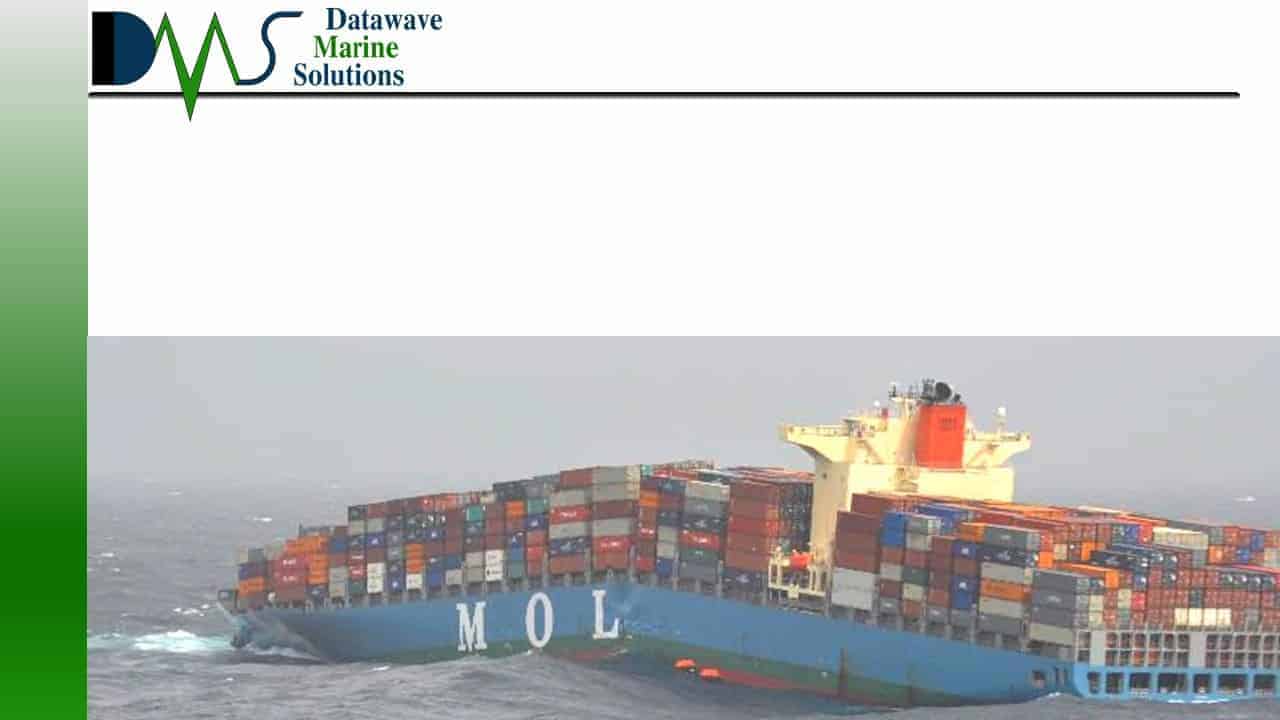
Again, we discover multiple cases to check and document. Important checks, because failure in global bending means catastrophe. The ship breaks its back and folds in two. (Figure 2‑2) That happens in cases of extreme bending loads, which usually occur while in terrible storms. Large storms are the worst time to discover structural weakness on your ship. The critical nature of global bending warrants special attention to consider all possible scenarios.
By the way, the ship shown in Figure 2‑2 was the MOL Comfort, which became famous because no one in the maritime community expected this type of structural failure. The vessel featured all the benefits of modern ship design, it was in good repair, and the master followed correct procedures. Later investigations discovered that the bottom plating failed unexpectedly due to a complex combination of loading factors. [4] This unlikely failure began with plate buckling on the bottom of the hull.
3.0 Buckling
Buckling concerns stanchions, sailing masts, and hull plates. We will focus on simple columns. As the column compresses, it deforms from being perfectly straight. Continue to increase the compression force, and the deformation reaches a critical point. After that, the column collapses, delivering a very bad day.
Buckling seems simple in perfect columns, except that real structures are not perfect. Figure 3‑1 demonstrates six potential scenarios, with vastly different predictions for the critical compression load. The math gets even worse when we consider imperfect buckling. Engineers need to consider real world items like side loading (think sailing mast), eccentricity, and curvature on the column. Typically, DMS errs on the side of caution and assumes conditions slightly worse than reality. This allows a safety margin for changes and imperfections in manufacturing. Buckling warrants extra time to decide on the correct mathematical model before predicting critical loads.
Figure 3‑1: Examples of Column Buckling [5]
4.0 Shear
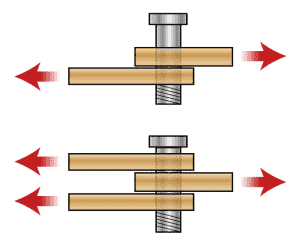
Shear almost gets forgotten. When scissors cut through paper, that is shear failure of the paper. We don’t see many cases of pure shear failures in ships; most ship structures are beams, which fail in bending long before shear. In 90% of all cases on ships, shear is not a concern and engineers ignore it, based on experience. But engineers exist to identify and worry about that last 10%. Common areas to check against shear failure:
Shafts with high torsion
Short bearing axles
Hull of open deck container ships
Bolted connections of beams (large bolt patterns)
Don’t forget shear just because of low prevalence. It only takes one failure to upset everything.
5.0 Fatigue
Your structure was perfectly fine for years . . . until it cracked and broke. Fatigue failures often surprise many owners. The structural damage often begins internal in the metal and hides from visible detection until that fatal crack appears. Fatigue just requires time and cyclic loading to build towards failure.
Fatigue happens under cyclic loading, with stresses constantly rising and falling. We see a lot of cyclic loading in the hull, due to ocean waves. Structures fail in fatigue at stress levels far below the yield limit of the material. It also creates a false sense of security, due to the years of safe service before failure. But eventually all structures wear out due to fatigue; this limits the life of any ship hull.
Sadly, fatigue predictions are not easy. Engineers face three complexities in predicting fatigue life:
Identifying the load history: ocean waves lead to complex mathematics
Identifying the critical fatigue locations: normally at a weld joint
Predict the fatigue life based on material properties at that location
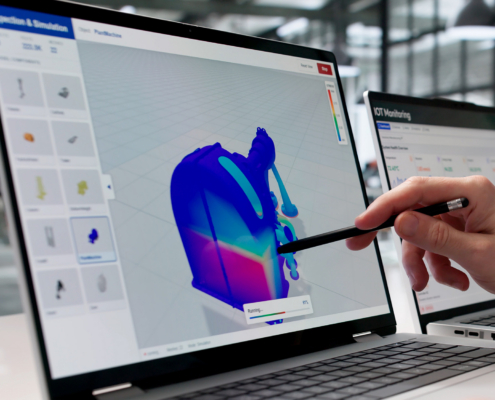
The combination of all three factors often require extensive checks using advanced mathematics and finite element analysis (FEA). Figure 5‑1 shows a demo of this process for a simple bicycle part. The payoff is that fatigue analysis can extend the life of your vessel. Different parts of the vessel fatigue at different rates. DMS can perform fatigue analysis to identify the critical segments of your vessel. Use this to perform selective maintenance or renew those small problem spots to extend your service life. Most ships were designed to only last about 30 years, due to fatigue. But with fatigue analysis, you gain the option to extend that life another 5-15 years, depending on service. A worthy investment, and cheaper than replacing the ship.
Figure 5‑1: Demo Process of FEA for Fatigue [7]
6.0 Combined Stresses
Combined stresses interact with all the previous methods of failure. Each of the previous five methods looked at one mode of failure due to specific loading scenarios. Ships are not that convenient. Most segments of the structure face multiple loading scenarios simultaneously. The sinking of the MOL Comfort involved combined stresses. [4] Each individual stress may remain under acceptable limits. But the combination of simultaneous stresses adds up until to exceed material limits. Common areas to check for combined stresses:
Crane foundations
Hull stiffeners (local and global bending)
Long shafts (bending, shear, and fatigue)
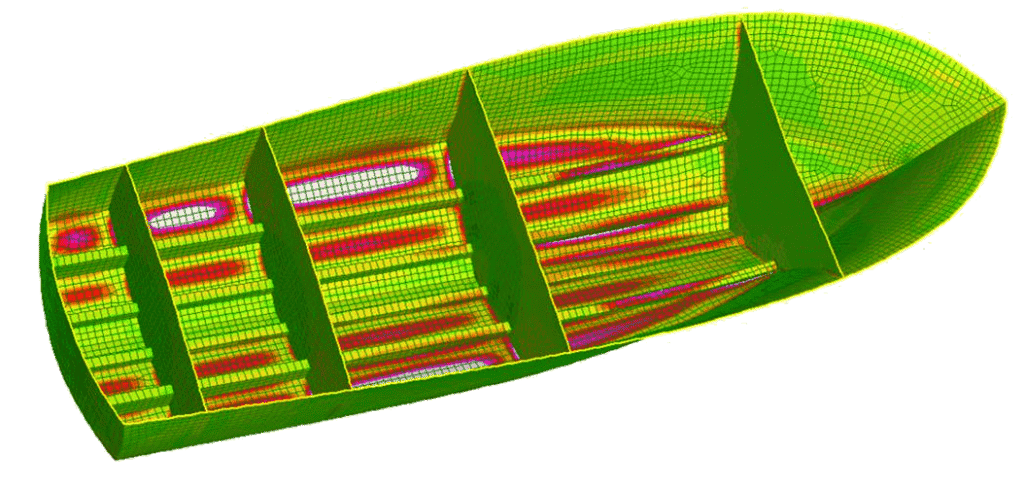
For many of these cases, DMS engineers resort to finite element analysis (FEA) to capture all combinations. (Figure 6‑1) FEA simulates a segment of the ship structure with a specified loading condition. The computer simulation predicts the stress distribution and allows engineers to check stress combinations across the entire structure.
FEA works best by simulating structures in bulk. The engineers at DMS can model entire sections of the ship and rapidly iterate through dozens of load cases. This allows the engineers to quickly check all those potential combined stresses. It brings peace of mind, knowing that the engineer went through every significant combination.
7.0 Conclusion
The next time you think structural analysis should be quick and easy, remember that engineers at DMS approach the analysis with an attitude of total structural health. We consider all methods of failure, which sometimes requires extensive calculations and checks. But a worthy investment, because it will be the failure mode you didn’t consider that ultimately leads to catastrophe.
8.0 References
[1]
Wikipedia Authors, “Elastic Load Method (full),” Wikimedia Commons, 2010 July 27. . Available: https://es.m.wikipedia.org/wiki/Archivo:Elastic_load_method_(full).png. .
[2]
S. Petrov, “MOL Excellence – Bending of Underdeck Passage,” YouTube, 2 Nov 2012. . Available: https://www.youtube.com/watch?v=rHlEXn37dVg. .
[3]
The Commonwealth of the Bahamas, “Report of the Investigation Into the Sinking of the “MOL Comfort” in the Indian Ocean,” Bahamas Maritime Authority, London, UK, September, 2015.
[4]
ClassNK, “The Investigative Panel on Large Container Ship Safety,” Class NK, September 2014.
https://dmsonline.us/wp-content/uploads/2026/08/What-Is-Finite-Element-Analysis.jpg12502000Abstrakt Marketing/wp-content/uploads/2025/06/DMS-logo.svgAbstrakt Marketing2026-08-07 08:12:582026-08-07 08:13:03What Is Finite Element Analysis (FEA)?
https://dmsonline.us/wp-content/uploads/2023/12/HabbakukCover-Small-1.jpg489500Nate Riggins/wp-content/uploads/2025/06/DMS-logo.svgNate Riggins2024-09-24 09:18:002026-06-01 10:09:21Project Habbakuk: A Ship from Ice!
https://dmsonline.us/wp-content/uploads/2023/12/USCGC_Healy_WAGB-20_north_of_Alaska-scaled-1.jpg6331200Nate Riggins/wp-content/uploads/2025/06/DMS-logo.svgNate Riggins2024-05-14 09:00:002026-06-01 10:09:22Surviving the Arctic: Polar Class Icebreakers
https://dmsonline.us/wp-content/uploads/2022/06/MVAltairGeneralArrangementPlan_SmallResolution.webp299640Nate Riggins/wp-content/uploads/2025/06/DMS-logo.svgNate Riggins2022-09-12 06:00:002025-09-30 07:31:20How to Design a Ship
We may request cookies to be set on your device. We use cookies to let us know when you visit our websites, how you interact with us, to enrich your user experience, and to customize your relationship with our website.
Click on the different category headings to find out more. You can also change some of your preferences. Note that blocking some types of cookies may impact your experience on our websites and the services we are able to offer.
Essential Website Cookies
These cookies are strictly necessary to provide you with services available through our website and to use some of its features.
Because these cookies are strictly necessary to deliver the website, refusing them will have impact how our site functions. You always can block or delete cookies by changing your browser settings and force blocking all cookies on this website. But this will always prompt you to accept/refuse cookies when revisiting our site.
We fully respect if you want to refuse cookies but to avoid asking you again and again kindly allow us to store a cookie for that. You are free to opt out any time or opt in for other cookies to get a better experience. If you refuse cookies we will remove all set cookies in our domain.
We provide you with a list of stored cookies on your computer in our domain so you can check what we stored. Due to security reasons we are not able to show or modify cookies from other domains. You can check these in your browser security settings.
Other external services
We also use different external services like Google Webfonts, Google Maps, and external Video providers. Since these providers may collect personal data like your IP address we allow you to block them here. Please be aware that this might heavily reduce the functionality and appearance of our site. Changes will take effect once you reload the page.